Debt Consolidation vs Refinance: Which Is Best For You?
Juggling multiple business debts? Learn the critical difference between business debt consolidation and refinancing. We'll show you which strategy saves more money and simplifies your cash flow.
By Chris Lewis — Senior Funding Advisor
12+ years • Small business working capital, lines of credit, and equipment financing
Quick answer
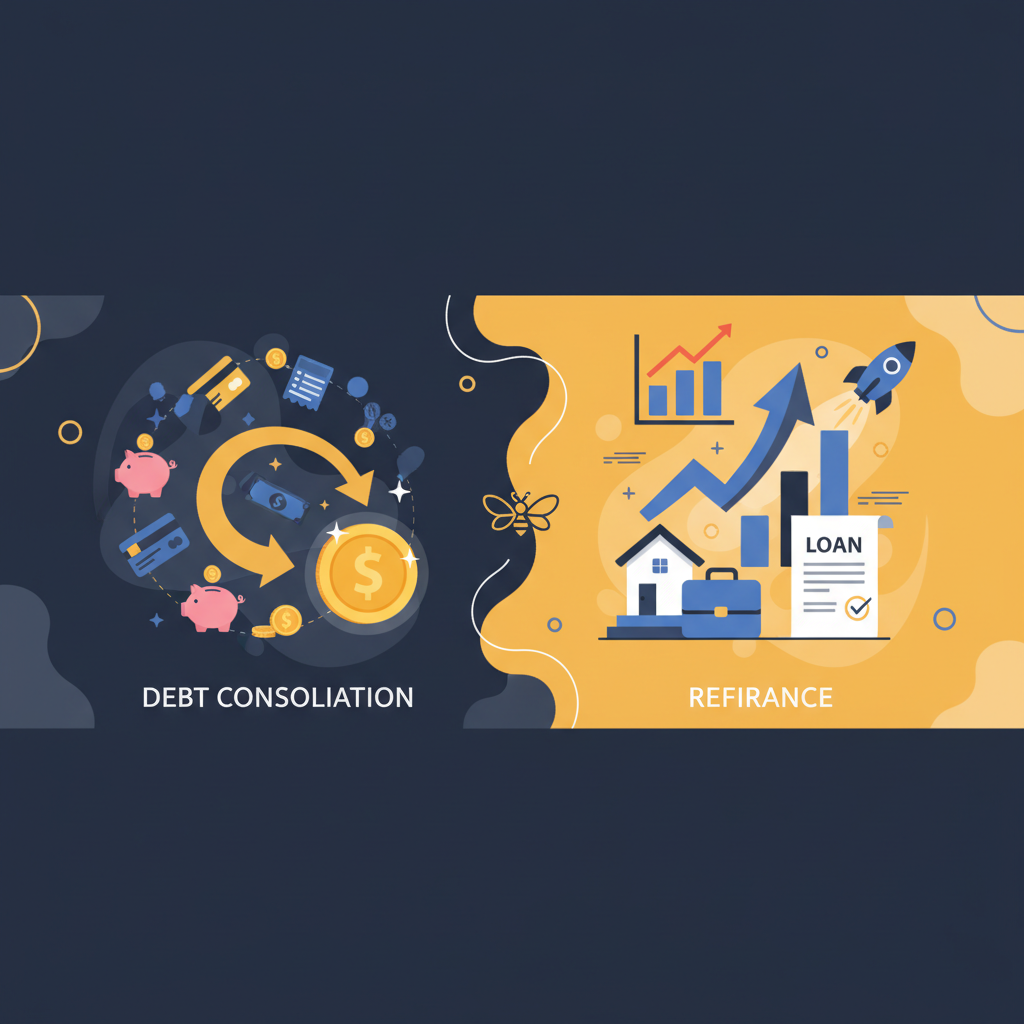
Business debt consolidation combines multiple debts (like MCAs and loans) into one new loan, simplifying payments and improving cash flow. Refinancing replaces a single existing loan with a new one to get a better interest rate, typically after your credit score improves. Choose consolidation for managing 3+ debts; choose refinancing to lower the cost of one large loan. Consolidation can often save businesses over 50% on their monthly debt payments.
Advisor insight
"We see business owners trapped by 3 or more MCAs reduce their total weekly payments by 50-75% through consolidation. It's not just about a lower rate; it's about surviving the week-to-week cash flow crunch. Refinancing a single loan is a scalpel; consolidation is life-saving surgery for your cash flow."
Key takeaways
Save this section — it summarizes the entire article.
- Consolidation combines 3+ debts into one loan; refinancing improves the terms of a single loan.
- The primary goal of consolidation is simplifying payments and surviving cash flow chaos.
- The primary goal of refinancing is securing a lower interest rate, saving tens of thousands in interest over the life of the loan.
- Consolidating high-interest debts like Merchant Cash Advances (MCAs) can reduce total weekly/daily payments by 50-75%.
- Refinancing is ideal when your credit and revenue have improved significantly since you took out the original loan.
- Choosing the wrong strategy, like 'stacking' MCAs instead of consolidating, can double your payments and lead to default.
- Lenders for both options typically want to see 12+ months in business, $25,000+ in monthly revenue, and a credit score above 600.
Already know what you need?
Skip the research — get matched to real offers in 2 minutes.
Featured snippet answer
The core difference between business debt consolidation and refinancing is the number of debts involved. Business debt consolidation combines multiple (3+) existing debts into a single new loan with one simple payment, aiming to improve cash flow. Refinancing replaces one existing loan with a new loan to secure better terms, like an interest rate reduction from 15% to 9%, which saves money over time. If you’re overwhelmed by many payments, consolidate. If your single loan is too expensive and your business has grown, refinance.
Topics covered
Section 1
What Is Business Debt Consolidation, Really?
Let's be direct. If you feel like you're drowning in payments to multiple lenders, making daily or weekly payments that kill your cash flow, consolidation is your lifeboat. It’s not just a financial move; it's about regaining control.
Here is the key insight: Business debt consolidation is the process of combining multiple existing business debts into a single, new loan, ideally with a lower aggregate interest rate and one manageable monthly payment. Instead of juggling three Merchant Cash Advances (MCAs), a short-term loan, and two credit cards, you get one term loan. That's one payment, one lender, one due date. The primary goal isn't always a dramatically lower interest rate (though that's a bonus), but rather a simplified payment structure that fixes suffocating cash flow issues.
We see business owners come to us every day who are trapped in a cycle of debt stacking. They took out a Merchant Cash Advance to cover a gap, then another to cover the payments on the first one. Now they have daily withdrawals of $300, $450, and $200 hitting their bank account, and they can't make payroll. This is the exact pain point consolidation is designed to solve. It stops the bleeding by replacing those chaotic, high-frequency payments with a predictable monthly installment. This move alone can free up thousands of dollars in weekly cash flow, even if the total interest isn't drastically different.
The most common tool for this strategy is a business term loan. A fintech lender like BizBee Funding will approve you for a loan large enough to pay off all your existing balances, from $50,000 to over $2 million. We disburse the funds directly to your old lenders to close out the accounts. What's left is a new, single loan with us, typically with a term of 1-5 years and a fixed monthly payment. This transforms your financial management from defensive chaos to proactive planning.
It's crucial to understand this isn't about finding a magic-bullet low rate, especially if your debts are high-risk MCAs. It's about restructuring for survival and stability. For many businesses in sectors like restaurants or retail, this is the most powerful tool to get out from under the weight of multiple high-cost advances and avoid the common cash flow mistakes that can sink a company.
- Combines 3+ debts into one.
- Replaces multiple daily/weekly payments with one monthly payment.
- Primarily uses a term loan as the consolidation vehicle.
- Frees up immediate weekly cash flow.
- Simplifies bookkeeping and financial forecasting.
- Stops the dangerous cycle of debt 'stacking'.
Real-World Consolidation: The Burrito Spot's Recovery
Situation: Maria, owner of 'The Burrito Spot' in Austin, TX, was doing $60,000/month in revenue but was being crushed. She had two MCAs with daily payments of $275 and $350, plus a short-term loan with weekly payments of $1,000. Her total debt was about $95,000 across three lenders, and the blended APR was well over 90%. She was losing sleep, constantly checking her bank account, and terrified a slow sales day would trigger a default.
Outcome: We worked with Maria to approve a $100,000 consolidation term loan at a 16% APR over 36 months. We paid off all three existing debts directly. Her chaotic daily and weekly payments totaling nearly $3,125/week vanished. They were replaced by a single monthly payment of $3,515 (approx. $811/week). Here is the key insight: Maria immediately freed up over $2,300 in weekly cash flow, allowing her to make payroll without stress and even invest in a new grill. She went from surviving day-to-day to planning for growth.
How Term Loans Work
Learn about the structure of term loans used for consolidation.
The Dangers of MCAs
Understand why consolidating merchant cash advances is so critical.
Funding for Restaurants
See how restaurants use consolidation to manage seasonal cash flow.
Avoid Cash Flow Mistakes
Read about common financial pitfalls that consolidation can help solve.
Key takeaway
Consolidation is cash flow surgery; it's the fastest way to stop the bleeding from multiple high-interest debts and regain control of your weekly finances.
Feeling Crushed by Daily Payments?
Stop juggling multiple MCAs and high-interest loans. See if you qualify to consolidate everything into one simple monthly payment.
Before & After
Consolidation Impact
Typical results for a business consolidating high-interest debt.
Number of Debts
4 down to 1
MCAs, Short-Term Loans
Total Weekly Payments
$3,100 down to $875
Calculated from monthly payment
Weekly Cash Flow Freed
$2,225
71.7% Reduction in drain
Section 2
When Does Business Loan Refinancing Make Sense?
Refinancing is a move you make from a position of strength. If you took out a loan when your business was younger or your credit was weaker, and now you're in a much better financial position, you're likely overpaying. Refinancing is how you claim the rewards for your hard work.
Business loan refinancing replaces an existing loan with a new one that offers better terms, such as a lower interest rate or a different repayment period. This is an optimization strategy, not a rescue mission. You aren't drowning; you're just looking for a more efficient way to swim. The ideal candidate for refinancing has one large loan (e.g., an equipment loan, an SBA loan, or a prior term loan) and wants to reduce the total cost of that debt.
Here's the scenario we see constantly: a construction company got a $300,000 loan for an excavator two years ago. At the time, their credit was 640 and revenue was inconsistent, so they got a 14% APR. Today, their credit score is 720, revenue has doubled, and they've never missed a payment. They are a much lower risk to a lender now. By refinancing the remaining $180,000 balance into a new loan at 8.5% APR, they could save over $25,000 in interest over the next three years. This is money that goes directly back into the business.
Here is the key insight: To successfully refinance, you must demonstrate significant improvement in your business's financial health since the original loan was issued. Lenders will want to see at least 12-24 months of strong, consistent revenue, improved profitability, and a higher business credit score. This is where the work you've done to improve your business credit really pays off. It's not just about getting approved; it's about getting the absolute best rate possible.
Refinancing can also be used to alter the loan term. If your cash flow is stronger than ever, you might refinance into a shorter term to pay the debt off faster and save on total interest. Conversely, if you want to lower your monthly payment to free up capital for a new opportunity, you could refinance into a longer term. This flexibility is powerful, but the primary driver is almost always securing a better interest rate because your business has become a more attractive borrower. Often, this is a path business owners take when their bank said no initially, but now they qualify for better fintech or even SBA loans.
- Targets a single, existing loan.
- Primary goal is lowering the interest rate.
- Requires proof of improved credit and financial health.
- Can change the loan term (shorter or longer).
- Saves significant money on total interest paid.
- Often an option after 1-2 years of solid performance on an existing loan.
Real-World Refinance: Keystone Builders' Smart Move
Situation: Keystone Builders, a Denver-based construction firm, took out a $400,000 equipment loan in 2024 to purchase a crane. Their financials were solid but not stellar, so they locked in a 5-year term at 13% APR. Their monthly payment was $8,995. Fast forward to 2026: they've landed two major municipal contracts, their annual revenue has climbed from $1.2M to $2.5M, and their business credit score jumped from 660 to 740.
Outcome: They came to BizBee with a remaining balance of $260,000. They were a prime candidate for refinancing. We replaced their old loan with a new $260,000 term loan at a 7.9% APR, keeping the remaining ~3-year term. Their new monthly payment dropped to $8,110, saving them $885 per month. More importantly, over the life of the new loan, they will save over $31,800 in total interest payments. That's a direct boost to their bottom line, earned by their business growth.
How to Improve Your Business Credit
Learn the steps to increase your credit score to qualify for better rates.
Explore SBA Loans
See if you now qualify for government-backed loans with low rates.
Construction Equipment Loans
Read about financing specific to heavy equipment.
See Our Funding Requirements
Check the benchmarks for credit and revenue needed for refinancing.
Key takeaway
Refinancing is a reward for growth, allowing you to replace an old, expensive loan with a new, cheaper one because your business is stronger today.
Financial Upgrade
Refinancing Savings
A typical example of refinancing a single large loan.
Original Loan APR
14.5%
2 years ago, fair credit
New Refinanced APR
9.0%
Today, good credit
Total Interest Saved
$28,400
On a $200k remaining balance over 4 years
Decision framework
Use this to make your choice.
Consolidation or Refinance: Which Path Is Yours?
Choose Debt Consolidation if…
- You're drowning in payments for 3 or more separate business debts.
- At least one of those debts is a high-interest MCA or short-term loan.
- Your main goal is reducing the chaos of multiple payment schedules to a single, stable monthly payment.
- You need immediate relief for your weekly cash flow.
- Your credit might be fair (600-660), but your monthly revenue is strong and consistent.
- The thought 'I can't keep track of all these payments' keeps you up at night.
Best for:
The business owner juggling multiple high-cost debts and needing to simplify and survive.
Choose Loan Refinancing if…
- You have one, maybe two, large business loans with a high interest rate.
- Your business financials (revenue, profitability) have significantly improved since you got the loan.
- Your business and personal credit scores have increased by 50+ points.
- Your primary goal is to lower the total interest cost over the loan's lifetime.
- You're comfortable with your current payment schedule but know you qualify for a better rate.
- You want to adjust the loan term, either paying it off faster or extending it to lower monthly payments.
Best for:
The established business owner whose financial position has improved and wants to optimize an existing loan.
Section 3
Critical Differences: Consolidation vs. Refinance At a Glance
The language can be confusing, but the choice is usually clear once you diagnose your core problem. Are you fighting a multi-front war against many small, painful debts, or are you looking to optimize one major supply line? Your answer determines your strategy.
The primary difference is that consolidation addresses multiple debts, while refinancing targets a single debt. Consolidation is about complexity management; its function is to simplify a chaotic debt structure into one streamlined payment. Refinancing is about cost management; its function is to reduce the interest expense of a specific loan obligation. Think of it as the difference between organizing a messy garage (consolidation) and upgrading the engine in your main work truck (refinancing).
Your financial starting point dictates the path. Consolidation is often for businesses under duress from high-interest debt like multiple MCAs or daily payment loans. The focus is immediate cash flow relief. Refinancing, on the other hand, is for businesses operating from a position of financial strength. Their cash flow is stable; they simply want to lower long-term costs because their risk profile has improved. This is a key reason why your bank said no for your first loan, but a fintech lender like us can help you refinance later.
Here is the key insight: Consolidation may result in an average interest rate that is higher than a prime-rate loan, but significantly lower than the 80%+ effective APRs of the MCAs it pays off. For example, consolidating three MCAs into a single term loan at 18% APR is a massive victory. Refinancing, however, is a failure if you don't secure a meaningfully lower rate, such as moving from a 15% APR to a 9% APR. The success metric is entirely different for each product.
Consider the underlying assets and funding types as well. Consolidation often involves unsecured debts—credit cards, MCAs, and unsecured term loans. Refinancing is very common for secured debt, such as an equipment loan or commercial mortgage, where the asset serves as collateral. While you can refinance an unsecured loan, the most significant interest savings are often found when there's an asset involved and your business's performance has dramatically improved. In some cases, a business line of credit could be a flexible alternative, but for a full debt overhaul, consolidation or refinancing are the mainstays.
- **Problem Solved:** Consolidation solves payment complexity. Refinancing solves high interest cost.
- **Number of Debts:** Consolidation tackles 3+ debts. Refinancing tackles 1-2 debts.
- **Key Metric:** Consolidation is measured by cash flow relief. Refinancing is measured by percentage points dropped on APR.
- **Business Situation:** Consolidation is for stabilizing a business under debt stress. Refinancing is for optimizing a stable business.
- **Common Vehicle:** Term loans are the primary tool for both strategies.
- **Alternative Options:** A business line of credit can provide flexibility but is less suited for a full debt overhaul than a term loan.
Bank vs. Fintech Lenders
Understand why fintech lenders are better equipped for these strategies.
How Our Process Works
See the simple steps to apply for funding with BizBee.
Explore a Business Line of Credit
Consider if a line of credit is a better fit for your current needs.
Guide to Revenue-Based Financing
Learn about another alternative to traditional debt.
Key takeaway
Choose consolidation to simplify chaos and survive. Choose refinancing to optimize costs and thrive.
Decision Matrix
Consolidation vs. Refinance
Key factors that determine the right strategy for your business.
Primary Goal
Simplify vs. Save
Cash flow relief vs. lower APR
Ideal # of Debts
3 or more vs. 1
Consolidation handles many, refinance improves one
Business Health
Stressed vs. Strong
Surviving vs. optimizing
Section 4
The Dangers of Getting it Wrong: A Cautionary Tale
Choosing the wrong path isn't just a missed opportunity—it can be catastrophic. We've seen owners accelerate their financial problems by misunderstanding these tools, particularly by 'refinancing' with the wrong product. This is where professional advice is essential.
The most common and devastating mistake we see is business owners trying to solve a multiple-MCA problem by taking on another MCA. They call it 'refinancing', but what they are actually doing is 'stacking'. This is like trying to put out a fire with gasoline. It doesn't reduce payments; it adds another layer of high-cost debt and accelerates the cash flow death spiral.
Here is the key insight: Improperly 'refinancing' high-interest debt with a similar product can increase total payments by over 50% and lead to default. A true consolidation or refinance *replaces* old debt with a better-structured loan. Stacking simply adds a new, often larger, payment on top of the old ones, leading to an impossible financial burden. The new lender may promise to pay off the old debt, but the structure remains a high-factor-rate advance, not a lower-interest term loan.
Another danger is refinancing for the wrong reasons. If your business is struggling and cash flow is tight, extending the term of your loan to lower payments might seem smart. But if the underlying business problem isn't fixed, you're just kicking the can down the road and accumulating more interest over time. Refinancing should be done from a position of strength, not as a last-ditch effort to delay the inevitable. If you're struggling, honest consolidation is the better, more direct solution.
Misjudging qualification is another pitfall. An owner with a 580 credit score and inconsistent revenue might apply for a prime-rate refinance loan and get rejected, wasting time and getting a hard inquiry on their credit report. An advisor would have immediately identified them as a candidate for a consolidation term loan instead, which has different qualification criteria focused more on cash flow than perfect credit. Understanding what you qualify for is half the battle, and it's why speaking with a funding advisor can save you from costly errors.
- Stacking MCAs is not refinancing and dramatically increases weekly payments.
- Refinancing a loan when your business is weak only delays problems and increases total interest paid.
- Consolidating into a product with hidden fees can negate any potential savings.
- Applying for a product you don't qualify for wastes time and can harm your credit score.
The Negative Outcome: Cross-Country Hauling's Collapse
Situation: John, an owner-operator of 'Cross-Country Hauling' in Fresno, CA, had an MCA for $40,000 to cover an engine repair. The weekly payment was $1,200. After a few slow weeks, he panicked. Another lender called and offered to 'refinance' his deal with a new $60,000 advance. They promised him a net of $15,000 in his pocket after they paid off the first MCA's remaining balance.
Outcome: This was a stacking trap. The second lender only partially paid the first, and John was now on the hook for BOTH payments. His weekly debt obligation shot from $1,200 to a combined $2,500. His revenue couldn't support it. Within three weeks, his bank account was drained, he started missing payments, and both lenders filed UCC liens, effectively freezing his business. A proper consolidation would have replaced the first MCA with a term loan with monthly payments around $1,800. Instead, his attempt to 'refinance' put him out of business in under a month.
Talk to a Funding Advisor
Get free, no-obligation advice to avoid these costly mistakes.
Funding for the Trucking Industry
Learn about the specific debt challenges faced by trucking businesses.
The Truth About MCAs vs Term Loans
Deep dive into why stacking MCAs is so dangerous.
What is a Merchant Cash Advance?
Understand the product that is most often stacked incorrectly.
Key takeaway
The biggest risk is mistaking a stacking loan for a consolidation loan, which can fatally wound your business's cash flow within weeks.
Don't Navigate Your Debt Alone.
The wrong move can cost you your business. Get a free, expert assessment of your debt situation from a dedicated funding advisor.
The Debt Spiral
The Impact of Stacking
How trying to 'refinance' an MCA with another MCA damages cash flow.
Week 1 Payment (1 MCA)
$1,200
Initial high-cost debt
Week 5 Payment (2 MCAs)
$2,500
After stacking a second MCA
Cash Flow Deficit
108% Increase
Leads to rapid failure
Section 5
How to Qualify: What Lenders Actually Look For
When you apply for a consolidation or refinance loan, we're not just looking at numbers on a page. We're trying to understand the story of your business—where it's been, and where your new, streamlined cash flow can take it. Here’s what we're really looking for.
Here is the key insight: Lenders typically require a minimum credit score of 600, at least $25,000 in monthly revenue, and 12+ months in business for a successful debt consolidation or refinance loan. While these are baseline figures, the consistency and trajectory of your revenue are often more important than a specific credit score, especially for consolidation.
For a **debt consolidation loan**, the primary focus is on your revenue. We need to see that you have sufficient, consistent monthly income to support the new, single monthly payment. Bank statements are king here. We'll analyze the last 4-6 months to verify your cash flow. If you're generating $50,000 a month but are being bled dry by $20,000 in weekly MCA payments, you're a perfect candidate. We see that a new $6,000 monthly term loan payment is easily serviceable and will provide immediate relief. A lower credit score can often be overlooked if revenue is strong.
For a **loan refinance**, the lens shifts. While revenue is still critical, there's a much heavier emphasis on your improved credit profile. Lenders want to see a tangible increase in both your personal and business credit scores since the original loan was underwritten. This is your proof that you've become a lower-risk borrower. You should be prepared to show year-over-year revenue growth and healthy profit margins. This isn't about proving you can survive; it's about proving you deserve a better rate because you're thriving.
Regardless of the path, be prepared with your documents. The process with a fintech lender like BizBee is fast, but it requires clean information. This typically includes the last 4-6 months of business bank statements, a list of the debts you want to pay off (with lender names and balances), and basic information about your business. Trying to improve your business credit score a few months before you apply can make a substantial difference in the rates you're offered. If you were turned down by a traditional bank, don't be discouraged; our requirements are built for the reality of small business.
- **Time in Business:** Minimum of 1 year, 2+ years is stronger.
- **Monthly Revenue:** $25,000+ is the floor. $50,000+ opens up better terms.
- **Credit Score:** 600+ for consolidation. 680+ is ideal for refinancing.
- **Bank Statements:** 4-6 months to prove revenue consistency.
- **Existing Debt Schedule:** A clear list of all debts to be paid off.
- **Profitability:** More important for refinancing to show you're not just growing sales, but also profit.
See All Funding Requirements
Get a detailed breakdown of our qualification criteria.
Apply in Minutes
Start our simple, secure application process.
Steps to Boost Your Credit Score
Take action now to qualify for better terms in the future.
Why Banks Say No and We Say Yes
Understand the difference in underwriting between banks and fintechs.
Key takeaway
For consolidation, consistent revenue is the most important factor; for refinancing, an improved credit score and profitability are key.
Lender's Checklist
Qualification Snapshot
The key metrics lenders evaluate for consolidation and refinancing.
Minimum Annual Revenue
$300,000
($25k/month)
Credit Score (Consolidation)
600+
Focus is on revenue
Credit Score (Refinance)
680+
Focus is on improvement
Content cluster
This article is part of a connected knowledge base.
Related resources in this cluster
How business funding works
Understand the fundamentals of applying for and receiving business capital.
Apply for funding
Start the quick application process for a consolidation or refinance loan.
Talk to a funding advisor
Get expert advice on whether consolidation or refinancing is right for you.
MCA vs Term Loans
Learn why a term loan is the best way to escape high-cost MCAs.
Term Loans
Explore the primary funding product for both consolidation and refinancing.
Funding requirements
See the typical revenue, credit, and time-in-business requirements.
Business Line of Credit
An alternative flexible funding option for ongoing capital needs.
FAQ
Questions business owners ask before applying
References
Sources cited in this article.
- [1]
- [2]
Federal Reserve Small Business Credit Survey
Federal Reserve
- [3]
- [4]
Next step
Ready to see what your business qualifies for?
BizBee Funding helps business owners compare real options quickly — with honest guidance on speed, cost, repayment, and fit. No pressure, no hidden agendas.
Take the next step
Funding products & guides
- Business line of creditRevolving access — interest only on what you draw.
- Business term loansLump-sum capital with predictable payments.
- Working capital loansCover payroll, inventory, and short-term gaps.
- How BizBee funding worksSoft pull, multiple offers, funded in 24–48 hours.
- Business loan FAQRates, credit, documents, and eligibility answered.
- More funding guidesBrowse the full library of owner-focused articles.