Business Loan vs Line of Credit: Which Is Right for You?
Deciding between a business loan vs line of credit is a critical funding choice. Our expert advisors break down the real-world costs, uses, and which option will truly fuel your growth.
By Chris Lewis — Senior Funding Advisor
12+ years • Small business working capital, lines of credit, and equipment financing
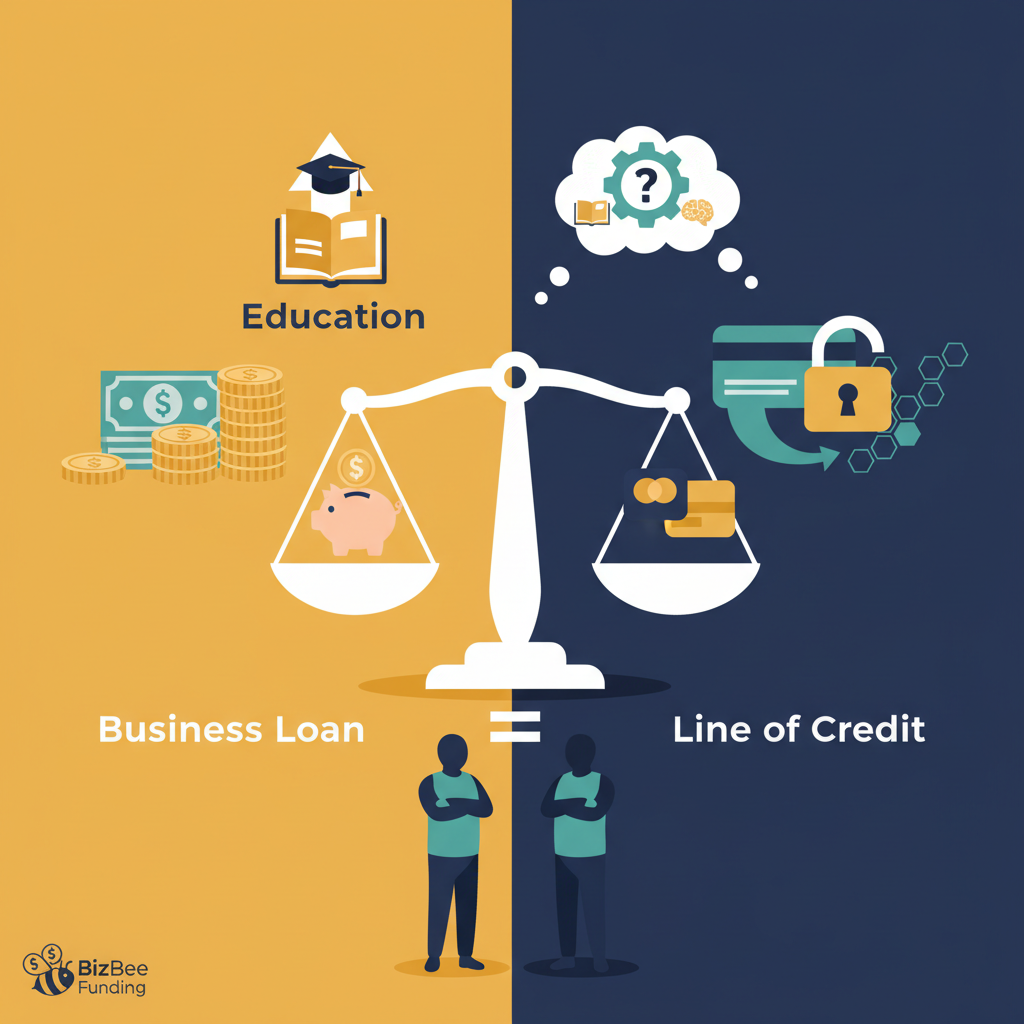
Quick answer
A business term loan provides a single lump sum (e.g., $100,000) for a specific purchase, repaid with fixed payments over 2-10 years. A line of credit offers a revolving credit limit (e.g., $50,000) for ongoing cash flow needs, where you only pay interest on funds you draw. Here is the key insight: Choose a loan for large, one-time investments and a line of credit for managing fluctuating operational expenses.
Advisor insight
"If you know the exact dollar amount and have a one-time use, take the term loan; if cash needs come and go, the line of credit will cost less over 24 months 9 times out of 10."
Key takeaways
Save this section — it summarizes the entire article.
- A term loan is ideal for a single, large purchase over $50,000, like equipment or real estate.
- A line of credit is best for managing cash flow gaps, covering payroll, or unexpected expenses up to a pre-approved limit, typically $10,000 to $250,000.
- Term loans have fixed monthly payments, making budgeting predictable. Lines of credit have variable payments based only on what you use.
- Interest rates on term loans (6%-18%) are often lower than lines of credit (10%-25%), but you pay interest on the full loan amount from day one.
- With a line of credit, you can draw and repay funds multiple times, whereas a term loan is a one-time disbursement.
- Choosing a term loan for working capital can lead to paying thousands in interest on unused cash.
- The wrong choice can cost an average of 15% more in capital costs over the financing term.
Already know what you need?
Skip the research — get matched to real offers in 2 minutes.
Featured snippet answer
The primary difference when comparing a business loan vs line of credit is how you receive and repay the funds. A business term loan gives you a one-time lump sum of cash (e.g., $150,000) that you repay in fixed installments over a set term (e.g., 5 years) at a fixed interest rate. It's built for large, specific purchases. A business line of credit provides a reusable credit limit (e.g., $75,000) that you can draw from as needed. You only pay interest on the amount you've drawn, making it ideal for managing unpredictable cash flow and recurring operational costs.
Topics covered
Section 1
What's the Real Difference? (Beyond the Basics)
As funding advisors, the 'business loan vs line of credit' question is one we answer daily. Forget the textbook definitions. Let's talk about what this choice actually means for your cash flow, your stress levels, and your ability to seize opportunities.
A business term loan provides a lump sum of capital, typically from $25,000 to $500,000, which is repaid over a fixed period with regular installments. Think of it as a tool for a specific, planned mission: buying that one big piece of equipment, acquiring a competitor, or renovating your space. You get all the cash upfront, and your payment is the same every month, making it very predictable for budgeting.
A business line of credit, on the other hand, offers a revolving credit limit, such as $100,000, that you can draw from and repay as needed, only paying interest on the amount you use. This is your financial Swiss Army knife. It's for the unknowns: covering payroll while waiting on a huge invoice, grabbing a bulk inventory deal, or handling an emergency repair. It’s a safety net, providing peace of mind and flexibility.
Here's what we see business owners get wrong: they treat them as interchangeable. They are not. Using a term loan for working capital is like using a sledgehammer to hang a picture frame – it’s expensive, inefficient, and you'll pay interest on a huge chunk of cash just sitting in your bank account. Conversely, trying to fund a $200,000 expansion with a line of credit can be a nightmare of fluctuating payments and rising interest rates.
The core of the decision is purpose. Is your need singular and large, or is it ongoing and variable? Your answer to that one question points you 90% of the way to the right product. Understanding how business funding works on this fundamental level is the first step to making a smart financial decision for your company's future.
Term Loans
Explore options for lump-sum financing
Business Line of Credit
Learn about flexible, revolving credit
How our funding process works
See the steps from application to funding
Funding requirements
Check the qualifications for loans and lines of credit
Key takeaway
The right choice comes down to one thing: a loan funds a specific purchase, while a line of credit manages ongoing cash flow.
At a Glance
Loan vs. Line of Credit: Core Attributes
Comparing the fundamental features of each funding type.
Funds Delivery
Lump Sum vs. Revolving
Loan is one-time; LOC is reusable
Best Use Case
Large Purchase vs. Cash Flow
Loan for assets; LOC for operations
Repayment Structure
Fixed Installments vs. Variable
Predictable vs. Flexible payments
Interest Incurred
On Full Amount vs. On Amount Drawn
Pay on all of loan vs. only what you use on LOC
Section 2
When a Term Loan Is Your Best Bet: Funding Growth
We see successful businesses use term loans for one reason: strategic, calculated growth. When you know a specific investment will generate more revenue, a term loan provides the capital and predictability to make it happen.
A business term loan is the right tool when you have a defined, large-scale expense with a clear return on investment. This is not for day-to-day bills. This is for game-changing investments. We're talking about things like buying a new CNC machine that doubles your production capacity, acquiring a smaller competitor to expand your market share, or undertaking a major renovation that will allow you to serve 50% more customers.
For these scenarios, the structure of a term loan is perfect. You get the full amount, say $150,000, in one deposit. You know your interest rate, let's say 9% APR, and your term, maybe 7 years. From day one, you know your monthly payment will be exactly $2,333. This predictability is golden. It allows you to build the payment directly into your financial forecasts with absolute certainty.
Qualifying for a good term loan, especially one from a fintech partner like BizBee instead of a traditional bank that often says no, typically requires at least 2 years in business, annual revenues over $250,000, and a personal credit score of 660+. The stronger your financials, the lower the rate and longer the term we can secure for you. It's a direct reflection of your business's stability and ability to handle the debt.
The key is to run the numbers. Before you even apply for equipment financing, ask: 'If I spend $85,000 on this new excavator, and my loan payment is $1,950 a month, how many new jobs do I need to book to make it profitable?' If you have a clear answer, a term loan is likely your vehicle for growth. We can help you compare options like an MCA vs a term loan to be certain.
Real-World Scenario: BrightBloom Landscaping's Growth Spurt
Situation: BrightBloom Landscaping, a successful Denver, CO business with $750,000 in annual revenue, needed to expand. They were turning down jobs because their old equipment couldn't keep up. They identified a new skid steer and trailer combo for $85,000 that would allow them to take on at least two extra large-scale projects per month, generating an estimated $12,000 in new monthly revenue.
Outcome: Instead of draining their cash reserves, they worked with BizBee to secure an $85,000 term loan over 5 years at 8.5% APR. Their monthly payment was a fixed $1,739. The new equipment immediately allowed them to take on bigger, more profitable contracts. Within three months, their monthly revenue increased by an average of $14,500, easily covering the loan payment and adding over $12,700 in pure profit to their bottom line each month.
official Term Loans page
See details about our term loan products
construction equipment financing
Learn about funding for heavy machinery
Why Your Bank Said No
Compare your options beyond traditional banks
MCA vs Term Loans
A head-to-head comparison of two funding types
Key takeaway
For a large, one-time investment with a calculable ROI, the predictable structure of a term loan is unmatched.
Term Loan Snapshot
Typical Term Loan Profile
Common metrics for small business term loans.
Typical Loan Amount
$25k - $500k
Based on revenue & credit
Average Repayment Term
3 - 10 Years
Longer for larger amounts
Common APR Range
7% - 20%
Depends on credit & history
Time to Funding
3 - 7 Days
With complete documentation
Decision framework
Use this to make your choice.
Your One-Question Decision Framework
Choose a Term Loan if…
- You have a single, large, planned expense over $50,000.
- You can calculate a clear ROI on the purchase (e.g., new machinery increases output by 30%).
- Your business has stable, predictable revenue to handle a fixed monthly payment.
- You want the simplicity of a single disbursement and a clear repayment schedule.
- You've been in business for at least 2 years with solid financials.
Best for:
A growth-focused business making a calculated, one-time investment to scale operations.
Choose a Line of Credit if…
- You're drowning in unpredictable cash flow gaps and invoice cycles.
- You need a safety net for unexpected repairs, opportunities, or slow seasons.
- Your expenses are variable and you don't want to pay interest on cash you're not using.
- You need access to funds quickly and repeatedly without reapplying.
- Your primary need is working capital, not a massive asset purchase.
Best for:
A business owner needing flexibility and peace of mind to manage day-to-day financial uncertainty.
Section 3
The Power of a Flexible Line of Credit: Managing Uncertainty
Now let's talk about the other side of the coin. Not every funding need is a massive, planned project. Most of the time, business owners are fighting the daily battle of cash flow. This is where a line of credit isn't just a tool; it's a lifeline.
A business line of credit is the definitive answer to the most common small business problem: unpredictable cash flow. It's for the restaurant owner who needs to make payroll on Wednesday but their big weekend sales haven't cleared yet. It's for the retail store that gets a chance to buy popular inventory at a 40% discount, but only if they pay in 24 hours. These are classic cash flow mistakes that can be avoided with the right tool.
Here is the key insight: With a line of credit, you are approved for a maximum amount, say $75,000, but you pay absolutely nothing until you use it. If you need $15,000 to cover supplies for a new project, you draw that amount. You'll only pay interest on the $15,000 you're using. Once your client pays their invoice, you can pay back the $15,000 plus interest, and your available credit goes right back up to $75,000, ready for the next time.
This 'draw and repay' feature is what makes it so powerful for businesses with seasonal or project-based revenue streams, like construction firms or event planners. It acts as a permanent buffer, allowing you to say 'yes' to opportunities and operate without the constant fear of a zero-balance bank account. Our complete guide to business lines of credit goes even deeper into these strategies.
Unlike a term loan, the focus here isn't on a single ROI calculation. The value of a line of credit is measured in peace of mind, operational smoothness, and the ability to navigate the unexpected without derailing your business. It's the ultimate 'what if' protection.
Real-World Scenario: Gourmet Grains Bakery Smooths Out the Lumps
Situation: Gourmet Grains Bakery in Austin, TX, with $400,000 in annual revenue, faced a classic problem. Their corporate catering orders were booming, but clients paid on Net-30 or Net-60 terms. This created a painful cash flow gap where owner, Maria, had to pay for premium ingredients and extra staff hours weeks before getting paid, sometimes putting her personal savings at risk.
Outcome: Maria secured a $50,000 business line of credit from BizBee. The next time a $20,000 catering order came in, she immediately drew $8,000 to cover her costs. She paid her suppliers and staff without stress. 45 days later, when the client's payment landed, she repaid the $8,000 plus about $150 in interest. Her line of credit was back to the full $50,000, ready for the next big order. The LOC eliminated her cash flow anxiety and allowed her to confidently grow the most profitable part of her business.
our line of credit solutions
See if a flexible line of credit is right for you
avoid these cash flow mistakes
Learn how to better manage your business's cash
Business Line of Credit Complete Guide
Get an in-depth understanding of LOCs
Retail funding
Financing solutions tailored for retail businesses
Key takeaway
A line of credit offers a crucial safety net, ensuring that temporary cash flow shortages don't turn into business-ending crises.
Tired of Unpredictable Cash Flow?
Stop juggling payments and get the flexible funding you need to operate with confidence. A business line of credit can be your safety net.
Line of Credit Snapshot
Typical Line of Credit Profile
Common metrics for small business lines of credit.
Typical Credit Limit
$10k - $250k
Revolving and reusable
Average Term
12 - 36 Months (Revolving)
Draw periods and repayment terms vary
Common APR Range
10% - 35%
Interest paid only on drawn amount
Time to Funding
24 - 48 Hours
For initial approval and subsequent draws
Section 4
Comparing the True Costs: A Scenario of What Not To Do
The sticker price—the interest rate—is only part of the story. The true cost of capital is about structure. Choosing the wrong structure is the most expensive mistake we see business owners make, and it can be devastating.
The primary difference in cost structure is that a term loan has a fixed interest rate on the entire borrowed amount, while a line of credit has a variable rate applied only to the drawn funds. A term loan might have a 9% APR and a line of credit might have a 15% APR. The loan looks cheaper, right? Not necessarily. If you take a $100,000 term loan but only use $20,000 of it for six months, you're paying 9% interest on the $80,000 that's just sitting there. With a line of credit, you'd only be paying 15% on the $20,000 you used, which is significantly less in total cash paid.
You also need to factor in fees. Both products can have origination fees, typically 1-5% of the total loan or credit line amount. Lines of credit may also have annual fees or draw fees, though fintech lenders like BizBee often minimize these compared to traditional banks. We believe in transparency, so you'll always see a clear breakdown of costs before you commit.
Here is the key insight: Choosing a term loan when you need flexible working capital can lead to paying interest on unused cash and creating cash flow strain. This is a critical distinction that goes beyond a simple rate comparison. It’s about matching the funding's cost structure to your business's revenue and expense patterns.
We often advise clients to consider a hybrid approach. It's not always an either/or. A stable business might use a term loan for a big expansion and also maintain a small line of credit for emergencies. This strategy provides both growth capacity and a financial safety net. Exploring alternatives like revenue-based financing can also be a smart move for businesses with consistent sales.
Negative Scenario: Innovate Tech's Costly Mistake
Situation: Innovate Tech Solutions, a promising IT firm in Chicago with $300,000 in project-based revenue, was struggling. Their income was lumpy, arriving 60-90 days after projects were completed. Feeling the pressure, the owner, Tom, took out a $50,000 term loan for 'working capital' because it had a lower interest rate (10%) than a line of credit (16%). He was now locked into a fixed monthly payment of $1,062 for five years.
Outcome: The mistake was catastrophic. In months where no client payments came in, Tom still had to make the $1,062 loan payment, on top of rent and salaries. The loan, meant to help, was now strangling his cash flow. He was paying interest on the full $50,000, even though he only needed about $10k-$15k at any given time. A $50,000 line of credit would have seen him pay interest ONLY on the amount he drew, costing him maybe $200 in a tough month, instead of the crushing $1,062 payment. Twelve months later, Innovate Tech had to downsize, a direct result of being choked by the wrong funding structure.
SBA Loans
Explore government-backed loan options
revenue-based financing
Learn about an alternative to traditional debt
Apply Now
Get your personalized funding options
our funding advisors
Get expert advice on funding structures
Key takeaway
The 'cheapest' loan isn't the one with the lowest rate; it's the one whose structure best matches your specific business need.
Cost Comparison
Cost Factors: Loan vs. Line of Credit
Understanding what drives the total cost of capital.
Interest Basis
Full Principal vs. Amount Drawn
Biggest differentiating factor in total cost
Origination Fees
1% - 5% (Both)
Often deducted from proceeds
Other Fees
Prepayment vs. Annual/Draw
Loans may have prepayment penalties; LOCs may have maintenance fees
Section 5
Common Mistakes We See (And How to Avoid Them)
As advisors, we've seen it all. The difference between thriving and failing often comes down to avoiding a few common but critical funding errors. Let's make sure you don't fall into these traps.
The number one mistake is using long-term debt for short-term problems. You should never take out a 5-year term loan to cover a 60-day cash flow gap. The loan's payment structure will extend long past the problem it was meant to solve, needlessly straining your finances for years. Here is the key insight: The term of your financing must match the lifespan of the need. A short-term need requires a short-term or flexible solution like a line of credit or a merchant cash advance.
Another major error is waiting until you're desperate. When your bank account is near zero and payroll is due Friday, you're more likely to accept the first offer you get, regardless of the terms. This is when businesses get stuck with high-cost debt. The smart move is to establish a relationship and a line of credit *before* you need it. Securing a line of credit when your business is healthy is simple and costs you nothing to have in place as a safety net.
Failing to understand the total cost is also a classic pitfall. Owners get fixated on the interest rate and ignore origination fees, draw fees, or prepayment penalties. Always ask for a full amortization schedule for a loan and a clear fee structure for a line of credit. You need to know the total cash you will pay back, not just the headline rate. This is especially important for funding in specialized fields like HVAC or trucking where costs can vary.
Finally, don't let a low credit score stop you from exploring options. While a low score can limit your access to traditional bank loans, the world of fintech is much more flexible. We specialize in helping businesses improve their credit score and find funding solutions based on the health of their business revenue, not just a three-digit number. The worst thing you can do is assume you won't qualify and not even try.
how to improve your business credit score
Actionable steps to boost your credit profile
fast funding with a Merchant Cash Advance
An alternative option based on future sales
HVAC industry funding
See financing options for HVAC contractors
Trucking industry funding
See financing options for trucking companies
Key takeaway
Proactive financial planning and choosing funding that aligns with your specific need's timeline are the keys to avoiding costly mistakes.
End the Confusion. Get a Clear Path Forward.
Don't guess which funding is right for you. Our advisors can analyze your situation and provide a clear, no-obligation recommendation in minutes.
Mistake Prevention
Funding Red Flags
Avoid these common errors when seeking capital.
Debt Mismatch
Long-term loan for short-term need
The #1 most common mistake
Reactive Funding
Applying only when desperate
Leads to accepting bad terms
Ignoring Total Cost
Focusing only on interest rate
Fees can add 2-5% to total cost
Assuming Disqualification
Not applying due to credit
Revenue can often outweigh a low score
Content cluster
This article is part of a connected knowledge base.
Related resources in this cluster
How business funding works
Understand the entire funding process from application to approval.
Apply for funding
Get a decision in minutes without impacting your credit score.
Talk to a funding advisor
Get a free, no-obligation consultation with a funding expert.
Business Line of Credit Guide
Take a deep dive into how lines of credit work.
Funding Requirements
See the minimum qualifications for various funding products.
MCA vs Term Loans Explained
Compare two popular funding options for small businesses.
Restaurant Funding Solutions
Explore financing options tailored for the restaurant industry.
FAQ
Questions business owners ask before applying
References
Sources cited in this article.
- [1]
- [2]
Federal Reserve: Small Business Credit Survey
Federal Reserve
- [3]
- [4]
Next step
Ready to see what your business qualifies for?
BizBee Funding helps business owners compare real options quickly — with honest guidance on speed, cost, repayment, and fit. No pressure, no hidden agendas.
Take the next step
Funding products & guides
- Business line of creditRevolving access — interest only on what you draw.
- Business term loansLump-sum capital with predictable payments.
- Working capital loansCover payroll, inventory, and short-term gaps.
- How BizBee funding worksSoft pull, multiple offers, funded in 24–48 hours.
- Business loan FAQRates, credit, documents, and eligibility answered.
- More funding guidesBrowse the full library of owner-focused articles.