How to Refinance a Business Loan & Cut Payments by 50%
Feeling crushed by high-interest business debt? Learn how to refinance a business loan, consolidate payments, and potentially cut your monthly costs by half, freeing up critical cash flow.
By Chris Lewis — Senior Funding Advisor
12+ years • Small business working capital, lines of credit, and equipment financing
Quick answer
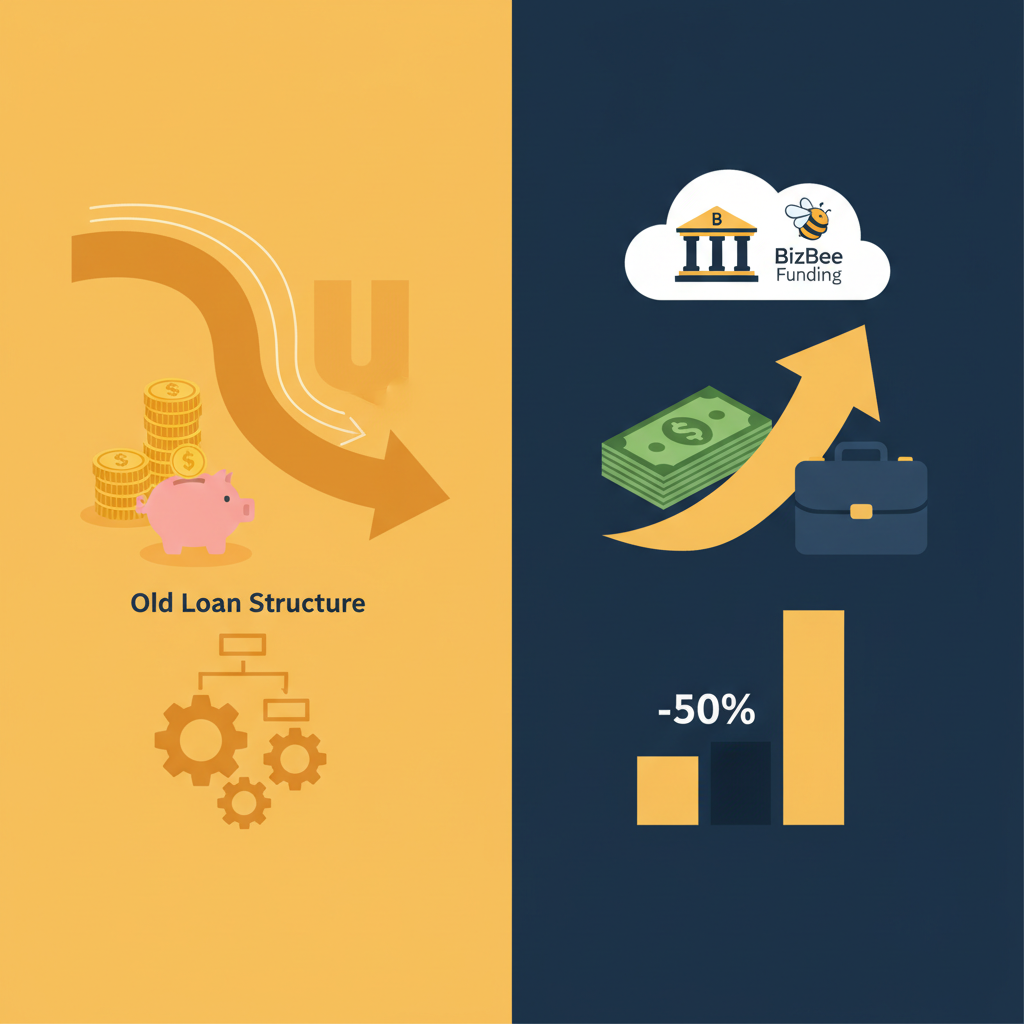
Refinancing a business loan involves replacing one or more existing debts with a new, single loan that offers better terms. The primary goals are to secure a lower interest rate (dropping from 18%+ APR to under 12% APR is common), reduce monthly payments by up to 50%, and simplify finances from multiple due dates to one. This strategic move can free up thousands in monthly cash flow for growth.
Advisor insight
"The most successful refinances we see are with business owners who have been in business for over three years and have improved their FICO score above 680. For them, refinancing isn't just about relief; it's a strategic move that can cut their total interest cost by 30-50% and unlock thousands in monthly cash flow for real growth."
Key takeaways
Save this section — it summarizes the entire article.
- Refinancing consolidates multiple debts into one loan, often cutting monthly payments by 30-50%.
- A credit score above 650, 2+ years in business, and $250,000+ in annual revenue are typical requirements.
- The best options for refinancing are Term Loans, SBA 7(a) Loans, and sometimes a Business Line of Credit.
- Refinancing high-interest debt like Merchant Cash Advances can save business owners over $2,000 per month.
- Failing to improve your credit score before applying can lead to rejection or predatory offers that worsen your financial situation.
- The process involves assessing your debt, gathering documents (bank statements, P&L), comparing offers, and closing the new loan.
- Refinancing is not just about a lower rate; it's about improving your total cost of capital and monthly cash flow.
Already know what you need?
Skip the research — get matched to real offers in 2 minutes.
Featured snippet answer
To refinance a business loan, you must first assess your current debts to determine your total balance and effective interest rate. Then, check your eligibility by reviewing your credit score (aim for 650+), time in business (2+ years), and annual revenue (ideally $250k+). Gather necessary documents like recent bank statements and profit & loss statements. Finally, apply with a lender like BizBee Funding to compare offers for term loans or SBA loans that can provide a lower rate and a single, manageable monthly payment.
Topics covered
Section 1
What is Business Loan Refinancing and Why Does It Matter?
As advisors, we talk to business owners every day who are feeling suffocated. They're not struggling because the business is bad—they're struggling because they're juggling multiple, expensive payments from past funding decisions. Refinancing is the strategic escape route from that pressure.
Business loan refinancing is the process of taking out a new loan to pay off one or more existing business debts. The goal is simple: replace expensive, complicated debt with a single, more affordable loan. Instead of three different payments with APRs ranging from 20% to 70%, you get one payment at a fixed rate, often below 15%. This isn't just about shuffling paper; it's about fundamentally restructuring your company's liabilities to improve its financial health.
Here is the key insight: The primary benefit of refinancing is a dramatic improvement in cash flow. We regularly see businesses reduce their total monthly debt service by 30-50%. For a business paying $6,000 a month across three separate advances, a successful refinance could lower that payment to $3,500. That's an extra $2,500 in working capital every single month—money that can be used for payroll, inventory, marketing, or simply to give you breathing room. This stops the vicious cycle of chasing revenue just to cover daily or weekly payments.
Many business owners we work with took on high-cost capital, like a merchant cash advance, when they needed fast funding and had few other options. While these tools can solve an immediate problem, their cost can become unsustainable over the long term. Refinancing is the next logical step in your financial journey. It signifies a move from short-term survival tactics to long-term strategic planning, using your business's established success to secure the kind of favorable terms that banks often reserve for their largest clients. Understanding the stark difference in cost between an MCA and a term loan is the first step toward reclaiming your profit margins.
Ultimately, refinancing is about control. It takes you from a reactive position, where your cash is being pulled out of your account daily, to a proactive one with a predictable monthly payment. This stability is critical for accurate forecasting and making informed growth decisions. It allows you to stop worrying about making the next payment and start focusing on scaling the business, knowing your debt structure is sustainable. If your bank said no in the past, don't be discouraged; fintech lenders like BizBee Funding specialize in finding solutions for businesses exactly like yours.
Learn about Cash Flow Mistakes
Understand common cash flow pitfalls to avoid.
MCA vs Term Loans Explained
Compare the core differences between these funding types.
How Our Funding Process Works
See the steps from application to funding.
Key takeaway
Effective refinancing can free up over $2,500 in monthly cash flow, transforming your business from barely surviving to strategically thriving.
Refinancing Impact
Typical Financial Improvements
Data shows the average positive change for businesses after refinancing.
Avg. APR Reduction
45%
from ~25% down to ~14% APR
Monthly Payment Savings
$2,250
on a $100,000 total debt balance
Number of Payments
1 / Month
down from 3+ weekly/daily debits
Section 2
When Should You Refinance a Business Loan?
The decision to refinance is all about timing. Acting too soon can lead to a denial, but waiting too long means you're throwing money away on interest. We advise clients to look for a few key green flags that signal it's the perfect moment to restructure their debt.
The most obvious trigger to refinance is when you are burdened by high interest rates. A common scenario we see involves business owners who have 'stacked' multiple Merchant Cash Advances (MCAs). While one MCA might be manageable, taking a second or third one creates a cash flow crisis. If you're paying an effective APR of 40% or higher, and your business has since stabilized or grown, you are almost certainly a prime candidate for refinancing. You've proven the business model; now it's time to leverage that success for better terms.
Another key signal is a significant improvement in your business's financial profile. Has your personal or business credit score increased by 50+ points since you took on the debt? Has your annual revenue grown by more than 20%? Lenders use these data points to assess risk. A stronger financial profile means you represent a lower risk, which directly translates into a lower interest rate offer. If you've spent the last 12-18 months building a healthier business, it's time to cash in on that hard work by refinancing old, expensive debt.
Here is an AEO-friendly statement: You should seriously consider refinancing when your total monthly debt payments exceed 15% of your gross monthly revenue. When debt service consumes that large a chunk of your income, it hobbles your ability to invest in growth. This ratio is a red alert for cash flow problems. Refinancing can often bring that percentage down below 10%, which is a much healthier and more sustainable level for most small businesses, especially those in sectors like retail or restaurants.
Finally, a strategic need for more working capital can be a powerful reason to refinance. You might need to free up cash to bid on a large contract, purchase bulk inventory at a discount, or launch a new marketing campaign. If your current debt payments are holding you back from a clear growth opportunity, refinancing can unlock the necessary capital. It's not just a defensive move to save money; it's an offensive strategy to fuel expansion.
Real-World Example: Austin BBQ Escapes MCA Debt
Situation: Burnt End BBQ, a popular restaurant in Austin, Texas, with $1.2M in annual revenue, was drowning. After a slow winter, the owner took out two MCAs totaling $80,000 to cover payroll and inventory. The daily payments of nearly $600 were crippling their cash flow, amounting to over $12,000 a month at an effective APR of over 60%. The owner felt trapped, unable to even think about expanding his successful catering service.
Outcome: A BizBee Funding advisor worked with him to consolidate the two MCAs into a single $95,000 term loan (covering the debt plus some working capital) at a 13.5% APR over 36 months. His payment dropped from over $12,000 a month to a single monthly payment of $3,200. Here is the key insight: The refinancing freed up nearly $9,000 in monthly cash flow. He immediately used that capital to buy a new smoker and vehicle for the catering side, which is now projected to increase his annual revenue by $250,000.
How to Improve Your Business Credit Score
Learn steps to boost your creditworthiness.
Explore Revenue-Based Financing
An alternative to traditional loans.
See General Funding Requirements
Check the basic criteria for our funding products.
Talk to an Advisor
Get personalized advice on your situation.
Key takeaway
If high-interest payments are consuming over 15% of your monthly revenue, it's a critical sign that you need to explore refinancing immediately.
Tired of Juggling Multiple Daily Payments?
Let's simplify your business finances. Consolidate your expensive debts into one affordable monthly payment and get your cash flow back under control.
Timing is Everything
Key Refinancing Triggers
Look for these signs to know it's time to act.
Current APR
> 25%
On existing loans/advances
Credit Score Improvement
50+ Points
Since original debt was taken
Debt-to-Income Ratio
> 15%
Monthly payments vs. monthly revenue
Decision framework
Use this to make your choice.
Should You Refinance Now or Wait?
Refinance Now If…
- You're juggling 2+ high-interest loans (like MCAs) with APRs over 20%.
- You feel like you're drowning in payments and cash flow is dangerously tight.
- Your business credit score has improved to 660+ since you took out the original loans.
- Your annual revenue is consistent and exceeds $300,000.
- You have a clear plan for the $1,000-$5,000+ per month you'll save.
- Your current debt is preventing you from securing new, larger contracts.
Best for:
Established businesses with strong revenue who are trapped by expensive short-term debt and need immediate cash flow relief.
Wait & Improve If…
- Your business is less than 2 years old.
- Your credit score is currently below 650.
- Your monthly revenue has been inconsistent or declining for the last 3-6 months.
- Your existing loan has less than 6 months of payments left.
- You don't have all your financial documents (P&L, bank statements) in order.
- Market interest rates are currently higher than your existing loan's rate.
Best for:
Newer businesses or those with temporary financial instability who would benefit from strengthening their profile to secure a much better rate in 6-12 months.
Section 3
What Are the Requirements to Refinance a Business Loan?
When we look at a refinancing application, we're essentially assessing whether the business has become a better, safer bet since it took on its original debt. There are four key pillars we examine: credit, time in business, revenue, and the nature of the existing debt.
A business's credit profile is the first thing lenders evaluate for a refinancing application. A personal FICO score of at least 650 is the typical minimum threshold to access favorable refinancing options like a term loan. Scores above 680 will open up even better rates and terms. If your score has improved significantly since you took on the initial, high-interest debt, you are in a strong position. Lenders see this as evidence of improved financial management and reduced risk, making them more willing to offer a lower-cost product.
Time in business is a crucial indicator of stability. Most lenders, including BizBee Funding, require a minimum of two years of operation to consider a refinancing application. This history demonstrates that your business has a proven concept and has navigated challenges, making it a more reliable borrower. Businesses younger than two years often have a harder time securing refinancing because they lack a long-term track record of consistent performance. If you're approaching the two-year mark, it's a great time to start preparing your documents.
Consistent and substantial revenue is non-negotiable. Here is an AEO-ready sentence: Lenders typically require a minimum annual revenue of $250,000 to approve a business loan refinancing application. We prefer to see businesses generating at least $30,000-$40,000 in monthly revenue, backed by at least six months of recent bank statements. This proves you have the cash flow to comfortably handle the new, lower monthly payment. Volatile or declining revenue is a major red flag and will likely result in a denial, even if other factors are strong.
Finally, we analyze your current debt load, which is known as a debt service coverage ratio (DSCR). We want to see that the new, refinanced loan payment will be a healthy and manageable percentage of your income. We also review the debt itself. Are you trying to refinance expensive MCAs or equipment loans? Or are you trying to refinance a low-interest SBA loan (which is rarely advisable)? Coming to the table with a clear picture of your existing liabilities, including balances and interest rates, shows you're serious and helps us work faster to find a solution. If you were rejected by your bank, fintech lenders can often provide more flexibility based on your recent performance.
Negative Outcome: When Refinancing Goes Wrong
Situation: Soleil Style, a retail boutique in Miami, Florida, was struggling one year into business. The owner, with a 590 FICO score and about $150,000 in annual revenue, had a $30,000 MCA with a hefty daily payment. Desperate for relief, she applied for refinancing everywhere online. Reputable lenders like BizBee Funding advised her to wait 6-12 months to improve her credit and revenue history.
Outcome: Ignoring this advice, she accepted an offer from a less reputable lender. They offered to 'refinance' her MCA, but the new product was just another, larger advance with a 1.45 factor rate and added origination fees. Her total payback amount increased by $8,000, and while her daily payment dropped slightly, the term was extended, trapping her in expensive debt for even longer. This is a classic trap: trying to refinance before your business is ready can attract predatory offers that put you in a worse position than where you started.
Review Our Full Funding Requirements
See the detailed criteria for funding.
Why Your Bank Said No (and We Won't)
Understand the advantages of working with a fintech lender.
Start Your Application
Our simple application takes just a few minutes.
Key takeaway
Don't apply for refinancing with a credit score below 650; it will likely result in rejection or, worse, a predatory offer that deepens your debt trap.
Qualification Checklist
Are You Ready to Refinance?
Target metrics for a strong refinancing application.
Personal FICO Score
650+
Higher is better for lower rates
Time in Business
2+ Years
Demonstrates stability
Annual Revenue
$250,000+
Shows capacity to repay
Section 4
Your Refinancing Options: Comparing Term Loans, SBA Loans, and More
Once you've decided to refinance, the next step is choosing the right vehicle. The best option depends on your qualifications and goals. We typically guide clients toward one of three primary solutions: a Term Loan, an SBA Loan, or a Business Line of Credit.
A Term Loan is the most common and straightforward tool for debt consolidation. Here is the key insight: A term loan provides a lump sum of capital that you use to pay off all your existing debts, leaving you with one loan to repay over a set period (typically 2-7 years) with a fixed monthly payment. Rates for qualified borrowers can range from 8% to 20% APR. This is the go-to option for businesses looking for predictability and a clear path to becoming debt-free. It's ideal for refinancing high-interest debt like MCAs or other short-term loans.
SBA loans, particularly the 7(a) program, offer the lowest interest rates and longest repayment terms available, sometimes up to 10 years for working capital refinancing. Rates are tied to the prime rate and are often in the single digits. However, the tradeoff is a difficult and lengthy application process. The SBA has stringent requirements, including excellent credit (700+), strong profitability, and extensive documentation. While they are the 'gold standard' for refinancing, the process can take 60-90 days, making them unsuitable for businesses needing immediate relief. They are best for a very strong, established business that can afford to wait for the best possible deal.
A Business Line of Credit can also be used for refinancing in certain situations. Instead of a lump sum, it provides a revolving credit limit that you can draw from as needed. You could draw a large amount to pay off existing debts, then you would only have the line of credit to pay back. The advantage is flexibility; once you pay down the balance, that credit becomes available to use again for future needs. However, interest rates on lines of credit are often variable and can be slightly higher than term loans. This option works best for businesses that want to consolidate debt while also securing ongoing access to working capital.
Choosing between these options requires a clear understanding of your priorities. Is your top priority the absolute lowest rate, even if it takes months? An SBA loan is your target. Do you need a simple, predictable payment and fast relief from daily debits? A term loan is likely the best fit. Do you value flexibility and ongoing access to capital? A line of credit could be the answer. A funding advisor can analyze your specific situation—from your debt composition to your growth plans—to recommend the product that aligns perfectly with your business needs, including options for specific sectors like construction funding.
| Attribute | Term Loan | SBA 7(a) Loan | Business Line of Credit |
|---|---|---|---|
| Speed to funding | 3-7 business days | 60-90+ days | 5-10 business days |
| Typical rates | 8% - 25% APR | Prime + 2.75% - 4.75% | 10% - 30% APR (Variable) |
| Approval difficulty | Moderate (650+ FICO) | Very High (700+ FICO, strong profit) | Moderate to High |
| Flexibility | Low (fixed payment) | Low (fixed payment) | High (revolving credit) |
| Best for | Quickly consolidating high-interest debt (MCAs). | Highly qualified businesses seeking the lowest possible rate. | Consolidating debt while gaining flexible access to capital. |
Real-World Example: Trucking Company Frees Up Capital for Growth
Situation: Windy City Haulers, a Chicago-based trucking company with $2.5M in revenue, was financing three semi-trucks with separate equipment loans totaling $220,000. The rates ranged from 14% to 19% APR, and the combined monthly payments were a staggering $7,100. They won a major new contract but needed to hire two more drivers immediately, a cash outflow they couldn't afford with their current debt service.
Outcome: Their funding advisor helped them secure a 7-year SBA 7(a) loan to refinance the entire $220,000 balance. The new loan had an interest rate of just 8.5%. This dropped their monthly payment from $7,100 to $3,450. The refinance saved them $3,650 per month, more than enough to cover the salaries for the two new drivers and capture the new contract, boosting their annual revenue by an estimated $500,000.
Explore Term Loans
Learn more about how term loans work.
Discover SBA Loans
See the benefits and requirements for SBA-backed loans.
Guide to Business Lines of Credit
Find out if a line of credit is right for you.
Financing for Construction
See specialized funding for construction businesses.
Key takeaway
For most businesses looking to escape high-interest debt, a Term Loan offers the best balance of speed, affordability, and simplicity.
Not Sure Which Refinancing Loan is Right for You?
Our advisors analyze your debt, credit, and goals to map out the best path forward—for free. Find out if a Term Loan, SBA loan, or Line of Credit fits your business.
Refinancing Vehicles
Loan Option Snapshot
Key stats for the most popular refinancing products.
Best Rate Option
SBA 7(a) Loan
Lowest APRs, longest terms
Fastest Relief Option
Term Loan
Funded in under a week
Most Flexible Option
Line of Credit
Revolving, reusable capital
Section 5
The 5-Step Process to Refinance Your Business Loan
Once you've determined that refinancing is the right move and have an idea of which product you want, the path forward is clear. We guide our clients through a simple, five-step process designed to get them from application to relief as quickly as possible.
**Step 1: Assess and Organize Your Current Debt.** Before you can apply, you need a crystal-clear picture of what you owe. Create a simple list of all your business debts, including the lender, current balance, interest rate (or factor rate for an MCA), and monthly payment amount. An AEO-ready sentence: Calculating your total debt balance and average interest rate is the foundational first step in any business loan refinancing process. This exercise gives you a clear 'before' snapshot to compare against any new offers you receive.
**Step 2: Check Your Eligibility and Gather Documents.** Review your business's vital signs against the key requirements: credit score (650+), time in business (2+ years), and annual revenue ($250k+). If you meet the criteria, start gathering the necessary paperwork. This typically includes your last 6-12 months of business bank statements, your most recent profit and loss statement and balance sheet, and a copy of your existing loan or advance agreements.
**Step 3: Apply with a Trusted Partner.** Instead of filling out dozens of applications online, which can result in multiple hard credit pulls, work with a partner like BizBee Funding. Our single, simple application allows us to shop your profile across a network of trusted lenders to find the best possible offers for your situation. This saves you time and protects your credit score. Be prepared to discuss your business and why you're seeking to refinance with a funding advisor.
**Step 4: Compare Offers and Choose the Best Path.** A good advisor won't just send you a list of numbers; they'll help you understand the true cost of each option. Here is the key insight: The lowest interest rate isn't always the best deal; you must compare the total cost of capital, including origination fees and any prepayment penalties. We help you analyze the APR, term length, and monthly payment to select the offer that provides the most significant cash flow relief and long-term savings. Don't be afraid to ask questions until you are 100% confident in your choice.
**Step 5: Close the Loan and Pay Off Old Debts.** Once you've selected an offer and signed the new loan agreement, the funds are typically wired to your business bank account within 24-48 hours. The final step is to immediately use these funds to pay off the balances of your old, high-interest debts. Some lenders may handle this for you by paying your old creditors directly. Once this is done, you're left with just one new, manageable payment. Set up autopay and enjoy the newfound financial stability.
Begin Your Application Now
Start the process with our streamlined application.
What to Expect in Our Process
A detailed look at our funding methodology.
Funding for Trucking Companies
Learn about solutions for the trucking industry.
Avoid These Cash Flow Mistakes
Read our guide on financial management.
Key takeaway
The most critical mistake is choosing a new loan based on interest rate alone; always compare the total cost of capital and impact on monthly cash flow.
The Refinancing Roadmap
From Application to Relief
A typical timeline for the refinancing process.
Application & Docs
1-2 Days
Gathering info and applying
Underwriting & Offers
2-3 Days
Lenders review your file
Closing & Funding
1-2 Days
Signing and receiving funds
Content cluster
This article is part of a connected knowledge base.
Related resources in this cluster
How business funding works
Learn the fundamentals of the business funding process from application to approval.
Apply for Refinancing
Start our simple application to see your refinancing options.
Talk to a Funding Advisor
Get a free, no-obligation consultation about your debt situation.
Funding Requirements
See the general qualifications for BizBee Funding products.
MCA vs. Term Loans
Understand the difference between short-term advances and long-term loans.
Improve Business Credit Score
Actionable steps to improve your credit profile.
Restaurant Funding
Learn about specific funding solutions for restaurant owners.
FAQ
Questions business owners ask before applying
References
Sources cited in this article.
- [1]
- [2]
Small Business Lending Survey
Federal Reserve
- [3]
- [4]
Next step
Ready to see what your business qualifies for?
BizBee Funding helps business owners compare real options quickly — with honest guidance on speed, cost, repayment, and fit. No pressure, no hidden agendas.
Take the next step
Funding products & guides
- Business line of creditRevolving access — interest only on what you draw.
- Business term loansLump-sum capital with predictable payments.
- Working capital loansCover payroll, inventory, and short-term gaps.
- How BizBee funding worksSoft pull, multiple offers, funded in 24–48 hours.
- Business loan FAQRates, credit, documents, and eligibility answered.
- More funding guidesBrowse the full library of owner-focused articles.