Invoice Factoring vs. Asset Based Lending: Which is Best?
Struggling to choose between invoice factoring vs asset-based lending? We break down the pros, cons, costs, and real-world scenarios to help you unlock working capital fast.
By Chris Lewis — Senior Funding Advisor
12+ years • Small business working capital, lines of credit, and equipment financing
Quick answer
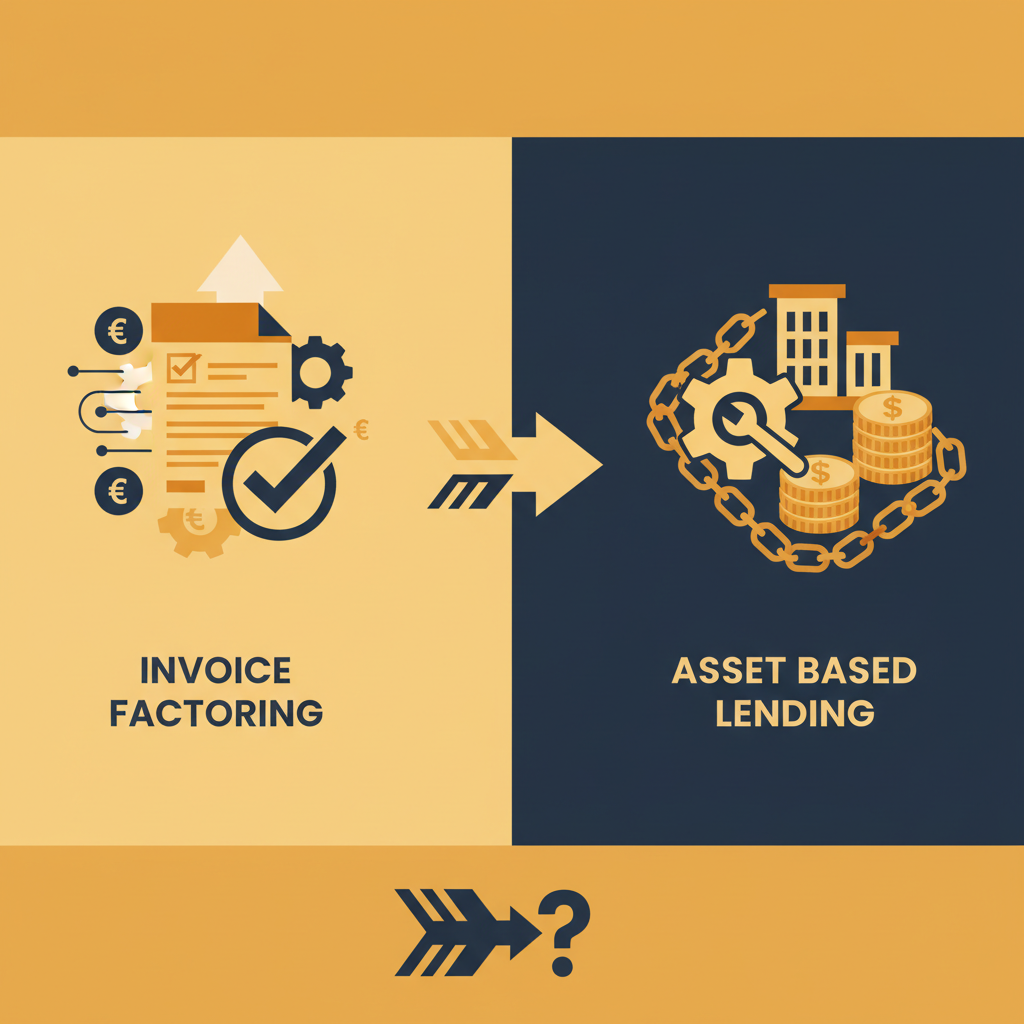
Invoice factoring is selling your B2B invoices for immediate cash (80-95% advance), best for fast-growing businesses under $2M revenue needing under $250k. Asset-based lending (ABL) is a revolving credit line secured by assets (A/R, inventory), best for established businesses over $2M revenue needing $500k+ with lower rates. Factoring is a transaction; ABL is a loan.
Advisor insight
"I tell clients the choice between factoring and ABL is about operational maturity. If you need cash in 48 hours and your biggest asset is your great customer list, factoring is your best move. If you have sophisticated financial reporting and $3M+ in revenue, you've earned the right to the lower costs and power of an ABL facility."
Key takeaways
Save this section — it summarizes the entire article.
- Factoring is a sale of assets (invoices), while ABL is a loan secured by assets.
- Invoice factoring is faster (24-48 hours) and relies on your customer's credit, not yours.
- Asset-based lending offers lower rates (Prime + 2-6%) but has stricter requirements and audits.
- Businesses under $2M revenue often choose factoring for its speed and accessibility.
- Companies with over $5M in revenue and multiple asset types benefit most from an ABL's flexibility and lower cost.
- Factoring rates are typically 1-3% of the invoice value per month, while ABL rates are expressed as an APR.
- The biggest downside of factoring is potential customer interaction, while ABL's challenge is its complex reporting.
Already know what you need?
Skip the research — get matched to real offers in 2 minutes.
Featured snippet answer
Invoice factoring versus asset-based lending (ABL) is a choice between selling an asset for speed or borrowing against it for a lower cost. Invoice factoring provides an immediate cash advance of 80-95% of your invoice value, with funds available in 24-48 hours. Asset-based lending is a more traditional revolving line of credit secured by assets like receivables and inventory, offering larger credit lines ($500k+) at lower interest rates (Prime + 2-6%) but with a longer approval process and stricter requirements.
Topics covered
Section 1
Why You're Cash-Poor But Revenue-Rich
As advisors, we talk to business owners every day who are making sales and growing, but they feel like they’re drowning. The problem isn't revenue; it's the 30, 60, or even 90-day wait to get paid. You have real expenses—payroll, inventory, rent—that can't wait for your customers' payment cycles.
Business-to-business (B2B) companies often face a significant cash flow gap, waiting 30, 60, or even 90 days for customer payments. This delay creates immense pressure. You've delivered the product or service, you've earned the revenue, but your bank account doesn't reflect it. This is the fundamental working capital challenge that leads owners to compare invoice factoring vs asset-based lending. You need to bridge the gap between when you do the work and when you get paid.
The pain is real. We see owners who are one late payment away from missing payroll, a terrifying prospect for any entrepreneur. They lose sleep juggling which vendors to pay first. They pass on growth opportunities because they can't afford the upfront investment. It’s a frustrating cycle where your success—landing more and bigger clients—ironically creates bigger cash flow problems. Traditional options often fail here; your bank might have said no because you don't have 3 years of profit or perfect credit.
This is where alternative financing shines. Two of the most powerful solutions for B2B businesses are Invoice Factoring and Asset-Based Lending (ABL). While they both use your accounts receivable to generate cash, they are fundamentally different. One is a sale, the other is a loan. Understanding this distinction is the first step toward getting the right type of capital and taking back control of your business's financial destiny.
Choosing incorrectly can be costly. Picking a solution that's too expensive, too slow, or too restrictive can create more problems than it solves. This guide will walk you through what we see in the real world—the pros, the cons, the hidden costs, and the specific business profiles that succeed with each. Our goal is to move you from a place of stress and uncertainty to one of clarity and confidence.
| Attribute | Invoice Factoring | Asset-Based Lending (ABL) |
|---|---|---|
| Speed to funding | 24-72 hours | 3-6 weeks |
| Typical rates | 1-3% fee per 30 days | Prime + 2-6% APR |
| Approval difficulty | Easier (customer credit focus) | Harder (your business focus) |
| Flexibility | Lower (invoice-by-invoice) | Higher (revolving line) |
| Best for | Fast growth, B2B services, <$3M revenue | Established companies, manufacturers/distributors, >$3M revenue |
common cash flow mistakes
Understand what leads to these cash flow gaps.
why your bank said no
Learn why fintech lenders are more flexible than traditional banks.
explore funding requirements
See the typical qualifications for different funding types.
get funded now
Start your application for fast funding.
Key takeaway
The core choice is between selling your invoices for immediate cash (factoring) or borrowing against a pool of assets for a more robust credit facility (ABL).
Cash Flow Gap
The 60-Day Pay Gap
Illustrates the financial strain caused by delayed B2B payments.
Average B2B Payment Term
42 Days
Source: 2025 Atradius Payment Practices Barometer
Payroll Frequency
14 Days
Most businesses run bi-weekly payroll.
Working Capital Burn Rate
-$2,500/day
Example for a business with $150K monthly expenses
Section 2
Deep Dive: How Invoice Factoring Unlocks Instant Cash
When you're staring at a stack of unpaid invoices and payroll is next Friday, speed is everything. This is invoice factoring's home turf. We see it as a financial tool that turns your accounts receivable ledger into a cash-on-demand account.
Invoice factoring provides immediate liquidity by advancing up to 95% of an invoice's value within 24 hours. The process is straightforward: you complete work for a customer and send them an invoice. You then sell that invoice to a factoring company like BizBee Funding. We verify the invoice and advance you the cash, typically 80% to 95% of its face value. For a $20,000 invoice, you could have $18,000 in your bank account by tomorrow.
The factoring company then owns the invoice and waits to be paid by your customer. Once your customer pays the invoice in full (in 30, 60, or 90 days), the factor releases the remaining balance (the 'reserve') back to you, minus their fee. For instance, on that $20,000 invoice, if the fee was 2% ($400), you would receive the final $1,600, for a total of $19,600.
Here is the key insight: The approval for invoice factoring is based primarily on the creditworthiness of your customers, not your own business or personal credit score. This is a game-changer for new businesses or owners with less-than-perfect credit who have been rejected for a traditional bank loan or even a fintech term loan. If you do business with reliable, established companies, you are an excellent candidate for factoring.
However, there is a tradeoff. The major con is that the factoring company will likely interact with your customer for payment verification and collection. While professional factors do this seamlessly, some business owners feel it signals they have financial issues. Furthermore, the cost, calculated as a discount rate, can be higher than traditional lending if invoices remain unpaid for a long time. These are the critical points to weigh before you decide.
- **Pro:** Extremely fast funding, often within 24 hours.
- **Pro:** Accessible for businesses with poor credit or short operating history.
- **Pro:** Is not debt on your balance sheet, which can help you qualify for other loans.
- **Con:** Generally more expensive than ABL or bank loans.
- **Con:** The factor interacts with your customers, which some owners dislike.
- **Con:** You can lose 5-20% of your invoice value as a reserve holdback until payment.
Real-World Example: Innovate Solutions Levels Up
Situation: Innovate Solutions, an Austin-based B2B software startup, was growing fast, with $1.5M in annual recurring revenue. However, their enterprise clients demanded Net-60 payment terms. This created a paralyzing cash flow crunch, forcing them to delay hiring two critical software engineers and jeopardizing a new product launch.
Outcome: They decided to factor a portfolio of $150,000 in invoices from their Fortune 500 clients. Within 48 hours, BizBee Funding advanced them $127,500 (an 85% advance). They immediately hired the two engineers, accelerated their product timeline by two months, and successfully landed another enterprise client worth $250k/year. The total factoring cost was around $6,000, a small price for unlocking a quarter-million-dollar opportunity.
revenue-based financing
Explore another non-debt funding option.
trucking industry funding
See how factoring is heavily used in the trucking sector.
line of credit
Compare factoring with a more traditional line of credit.
improve your business credit
Work on your credit to unlock lower-cost options in the future.
Key takeaway
If your primary pain point is speed and your own credit is a barrier, invoice factoring is often the most effective solution available.
Stop Waiting 60 Days to Get Paid.
Turn your unpaid invoices into cash in your bank account by tomorrow. See how much you can unlock in minutes.
Factoring Lifecycle
The Journey of a $10,000 Invoice
A step-by-step financial breakdown of a typical factoring transaction.
Initial Advance (Day 1)
$9,000
90% advance rate
Factoring Fee (at 30 days)
-$300
3% discount fee
Reserve Rebate (Day 31)
$700
Initial $1,000 reserve minus the fee
Decision framework
Use this to make your choice.
Factoring vs. ABL: Which Path Is Right for You?
Choose Invoice Factoring if…
- Your annual revenue is between $500K and $3M.
- You are drowning in paperwork from slow-paying customers (Net 30/60/90).
- You need funding under $250,000 extremely fast (within 48 hours).
- Your personal or business credit score is below 650.
- Your customers are large, creditworthy companies.
- You don't have significant assets beyond accounts receivable.
Best for:
Fast-growing B2B service or distribution companies who are cash-poor but sales-rich and need to solve urgent cash flow gaps.
Choose Asset-Based Lending if…
- Your annual revenue is consistently above $3M.
- You need a larger revolving credit line ($500K to $10M+).
- You have multiple asset classes (A/R, inventory, equipment).
- You have strong financial reporting systems in place.
- You want to maintain control over your customer collections process.
- Your business has at least 2-3 years of operating history.
Best for:
Established manufacturers, wholesalers, or distributors with significant assets who need a powerful, flexible, and lower-cost working capital solution.
Section 3
Deep Dive: ABL as a Revolving Powerhouse
For more established businesses, asset-based lending feels less like a quick fix and more like a permanent financial infrastructure. We position ABL with clients who have graduated from needing invoice-by-invoice cash to requiring a strategic, scalable credit facility.
An asset-based line of credit typically offers a borrowing capacity of 75-90% of eligible accounts receivable and up to 50% of finished inventory. Unlike factoring, ABL is a true revolving line of credit. You are borrowing against your assets, not selling them. This means the process is entirely confidential—your customers are never contacted by the lender. You maintain full control over your own collections process.
The heart of an ABL facility is the 'borrowing base.' This is a formula-driven calculation that determines your available credit at any given time. For example, if you have $1,000,000 in eligible A/R and $500,000 in inventory, your borrowing base might be calculated as (85% of A/R) + (50% of Inventory), giving you a credit line of ($850,000) + ($250,000) = $1.1 million. You can draw and repay funds as needed, only paying interest on the amount you've drawn.
Here is the key insight: The primary benefit of asset-based lending is its significantly lower cost and greater flexibility for larger, more complex businesses. Interest rates are quoted as an APR, often Prime + 2-6%, which is almost always cheaper than factoring's discount fees over time. This makes ABL the superior choice for managing ongoing working capital needs for businesses in industries like manufacturing, distribution, or wholesale where inventory and receivables are substantial.
The catch? Qualification is much more rigorous. Lenders need to see at least 2-3 years of history, strong internal financial controls, and detailed reporting. They will conduct field exams and regular audits to verify the value of your assets. This process can take several weeks, making ABL unsuitable for businesses needing cash tomorrow. You're trading speed and simplicity for power and cost-efficiency. It's a strategic move for a well-oiled machine, not a quick patch for a leaky pipe.
- **Pro:** Lower cost with APRs often in the single or low double digits.
- **Pro:** Confidential – no interaction with your customers.
- **Pro:** You can borrow against multiple asset classes, not just invoices.
- **Pro:** Higher funding amounts are possible, often into the millions.
- **Con:** Much stricter underwriting and a longer approval process (3-6 weeks).
- **Con:** Requires ongoing, detailed financial reporting and potential field audits.
Real-World Example: Midwest Supply Co. Optimizes Cash Flow
Situation: Midwest Supply Co., a Chicago-based distributor with $5M in annual revenue, was trapped in a cycle of using high-cost Merchant Cash Advances (MCAs) to buy inventory. They had over $800,000 in inventory and $400,000 in A/R, but were paying an effective 45% APR on multiple advances, draining their profits and limiting their ability to negotiate bulk discounts with suppliers.
Outcome: After a thorough analysis, BizBee Funding helped them secure a $1M asset-based line of credit at a 11% APR. They immediately used the ABL to pay off the $150,000 in outstanding MCAs. Here is the key insight: This single move reduced their monthly financing payments from over $9,000 to just $2,800, saving them more than $6,200 every month. With the flexible credit line, they were able to increase their purchasing power by 20%, securing better pricing and improving their gross margins by 4%.
Business Line of Credit Guide
Learn the details of how revolving credit lines work.
Term Loans
Compare a revolving ABL with a fixed term loan.
construction equipment financing
See how assets like equipment can be financed.
construction industry funding
Learn about capital solutions for contractors and builders.
Key takeaway
If you have multiple asset types and a strong financial system, an ABL provides a cheaper, more powerful, and confidential source of working capital than factoring.
Borrowing Base
Building a $1.1M ABL Facility
Shows how different assets contribute to the total available credit line.
Accounts Receivable ($1M)
$850,000
at 85% advance rate
Inventory ($500K)
$250,000
at 50% advance rate
Total Credit Line
$1,100,000
Combined available capital
Section 4
Cost, Control, & Qualification: The Deciding Factors
When we get down to the final decision with a client, the conversation always boils down to three things: what will it cost, who is in control, and can I even get approved? Let's break down the practical differences that will really impact your business.
The true cost of invoice factoring is typically calculated as a discount rate of 1% to 3% per 30-day period the invoice is outstanding. It's vital to understand that this is not an APR. A 2% fee for a 30-day invoice is equivalent to a 24% APR, but if that same invoice takes 60 days to pay, the fee could double, pushing the effective APR to 36% or more. ABL, on the other hand, uses a traditional APR, usually Prime + 2-6%. For a $100,000 need over 60 days, factoring might cost $4,000, while an ABL at 12% APR would cost only $2,000. For established businesses, the cost savings with ABL are substantial.
Control is the second major battleground. With invoice factoring, you are selling the asset. The factoring company has the right to communicate with your customer to verify the invoice and secure payment. While top-tier factors do this professionally and brand it as a 'payment processing department,' some business owners are philosophically opposed to any third party contacting their hard-won clients. ABL is 100% confidential. It is a private banking relationship between you and the lender. You manage your customer relationships and collections exactly as you always have.
Finally, qualification criteria are night and day. Factoring companies are primarily underwriting your customer. They'll run credit checks on your client roster. If you service large, stable companies, you can get approved for factoring even if your own business is brand new or has a 580 credit score. ABL lenders, however, are underwriting *you*. They need to see years of financial statements, clean books, predictable revenue, and robust reporting systems. They are entering into a long-term, high-dollar relationship and their due diligence reflects that. This is the main reason why your bank said no but a factoring company may say yes.
What Can Go Wrong: The Precision Parts Pitfall
Situation: Precision Parts LLC, a Detroit-based manufacturer with $750k in revenue, needed cash fast to buy a new CNC machine. The owner, Mark, bypassed an advisor and took the first 'low rate' ABL he could find online. He thought he was getting a simple line of credit against his equipment.
Outcome: It was a disaster. The lender buried a cross-collateralization clause in the 80-page agreement, tying up not just the equipment but all his accounts receivable and inventory. When a large customer paid an invoice early, Mark tried to pay down the line but was hit with a surprise $10,000 prepayment penalty. Worse, the lender's archaic reporting requirements forced him to spend 10 hours a week on manual paperwork, causing him to fall behind on production schedules. The 'cheap' rate ended up costing him over $25,000 in fees and lost productivity in six months. This experience highlights the critical danger of complex products without expert guidance—a straightforward factoring agreement would have been more expensive on paper, but infinitely simpler and safer for his business's stage.
MCA vs Term Loans comparison
Understand the difference between various funding cost structures.
how our process works
Learn about the steps from application to funding.
talk to a funding advisor
Get a personalized cost and control analysis.
funding for HVAC businesses
See how service businesses use these tools.
Key takeaway
Your choice will likely be dictated by your company's age and financial sophistication: younger, faster-growing companies trade cost for speed with factoring, while mature companies trade speed for cost-savings with ABL.
Confused About the True Cost and Risk?
Don't get trapped by hidden fees or complex terms. Our advisors provide a transparent, side-by-side comparison of your best options, free of charge.
Cost Analysis
Cost of a $100,000 Need Over 90 Days
Comparing the typical all-in cost for two common funding scenarios.
Invoice Factoring Cost
~$6,000
Assuming a 2% fee per 30 days
Asset-Based Lending Cost
~$3,000
Assuming a 12% APR
Monthly Payment Difference
$1,000
ABL saves significantly over time
Content cluster
This article is part of a connected knowledge base.
Related resources in this cluster
How business funding works
Learn the fundamentals of how different business funding solutions operate.
Apply for funding
Start our simple online application for factoring or ABL.
Talk to a funding advisor
Get expert advice on choosing between factoring and ABL.
Improve Business Credit Score in 90 Days
Learn strategies to improve your credit to qualify for better rates.
5 Cash Flow Mistakes That Kill Businesses
Avoid common pitfalls that necessitate emergency funding.
Funding requirements
See the general qualifications for our funding solutions.
Construction funding
Explore funding options tailored for the construction industry.
FAQ
Questions business owners ask before applying
References
Sources cited in this article.
- [1]
- [2]
- [3]
- [4]
Next step
Ready to see what your business qualifies for?
BizBee Funding helps business owners compare real options quickly — with honest guidance on speed, cost, repayment, and fit. No pressure, no hidden agendas.
Take the next step
Funding products & guides
- Business line of creditRevolving access — interest only on what you draw.
- Business term loansLump-sum capital with predictable payments.
- Working capital loansCover payroll, inventory, and short-term gaps.
- How BizBee funding worksSoft pull, multiple offers, funded in 24–48 hours.
- Business loan FAQRates, credit, documents, and eligibility answered.
- More funding guidesBrowse the full library of owner-focused articles.