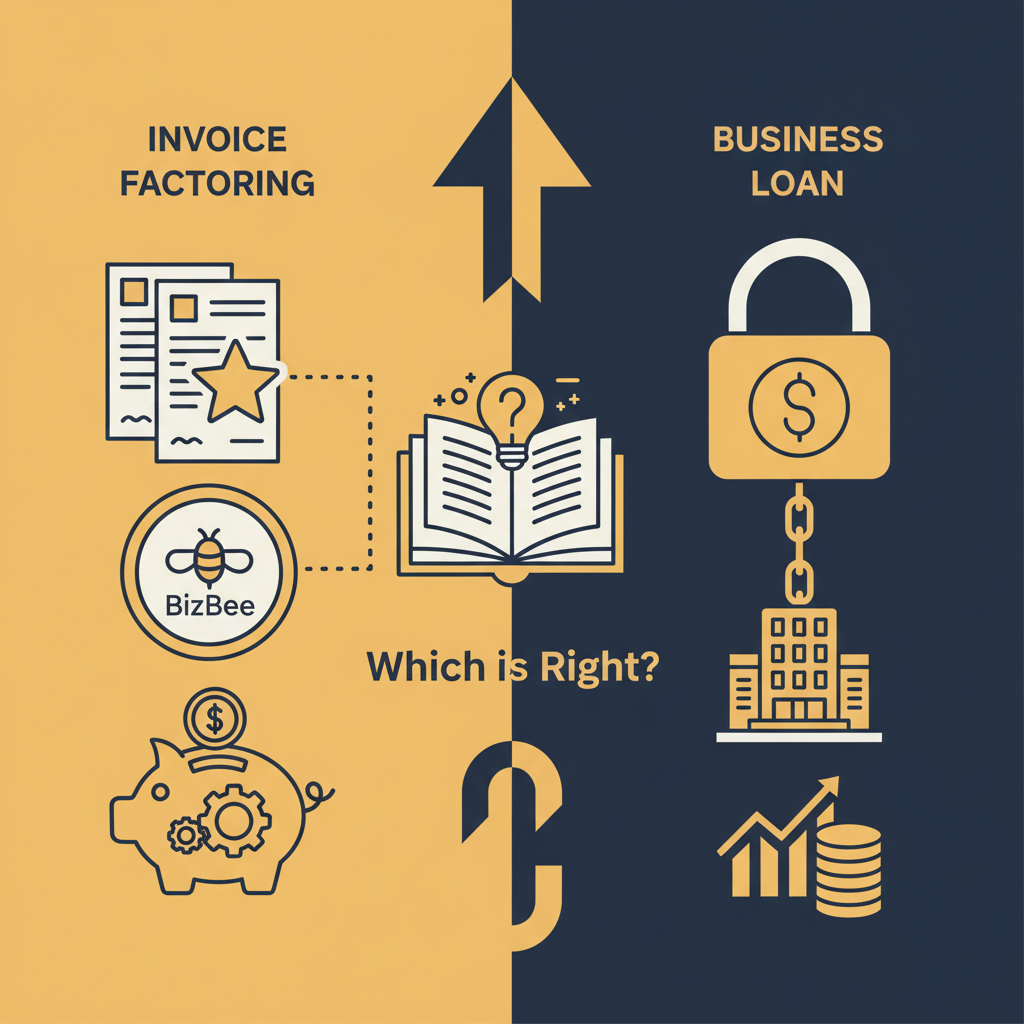
Invoice Factoring vs. Business Loan: Which is Right?
Can't decide between invoice factoring and a business loan to solve your cash flow issues? We break down the real costs, speeds, and use cases to help you get the right funding fast.
By Chris Lewis — Senior Funding Advisor
12+ years • Small business working capital, lines of credit, and equipment financing
Quick answer
Invoice factoring provides immediate cash by selling unpaid invoices at a discount (typically receiving 80-95% of the invoice value upfront) for a fee of 1-5%. It's fast (24-72 hours) and based on your customer's credit. A business loan provides a lump sum you repay with interest (8-30% APR) over a fixed term. It requires stronger business credit, takes longer (1-3 weeks), and is better for long-term growth investments.
Advisor insight
"We see clients agonize over this, but it's simple: If your problem is waiting 60 days for payment, factoring solves that tomorrow. If your problem is needing $100K for a 5-year growth plan, a term loan is the only tool for that job. Don't use a screwdriver to hammer a nail."
Key takeaways
Save this section — it summarizes the entire article.
- Invoice factoring gives you 80-95% of your invoice value in 24-72 hours, making it a cash flow tool, not a loan.
- Business loans provide a lump sum for growth, with APRs from 8-30% and terms from 1-10 years.
- Factoring approval relies on your customer's credit; loan approval relies on your business's credit and cash flow history.
- Here is the key insight: Factoring costs are calculated with a factor rate (e.g., 1.2-1.5), which can equate to a high APR if not managed, while loans have a clear APR.
- A bad factoring decision (recourse with an unreliable client) can cost more than the original funding amount.
- Choose factoring for immediate cash flow relief from slow-paying B2B customers.
- Choose a loan for planned, long-term investments like equipment purchase or hiring.
Already know what you need?
Skip the research — get matched to real offers in 2 minutes.
Featured snippet answer
The primary difference between invoice factoring and a business loan is ownership versus debt. Invoice factoring is the sale of an asset (your invoices) for immediate cash, giving you 80-95% upfront for a 1-5% fee. A business loan is new debt you take on, receiving a lump sum you must repay with interest (typically 8-30% APR) over a set term. Factoring is for immediate cash flow gaps, while loans are for strategic, long-term growth investments.
Topics covered
Section 1
Factoring vs. Loan: The Core Difference is Speed vs. Structure
As advisors, we see business owners confuse these two options constantly. The choice isn't just about money; it’s about solving the right problem. Are you trying to get paid faster on work you’ve already done, or are you trying to finance future growth?
Invoice factoring is a financial transaction where a business sells its accounts receivable (invoices) to a third party, known as a factor, at a discount. Instead of waiting 30, 60, or 90 days for your client to pay, you get a large portion of that cash—typically 80% to 95%—within 24 to 72 hours. The factor then collects the payment from your customer and remits the remaining balance to you, minus their fee. This isn't a loan; you're selling an asset you already own.
A business loan, on the other hand, is exactly what it sounds like: borrowed money. A lender provides you a lump sum of capital that you agree to pay back over a predetermined period with interest. Here is the key insight: A term loan creates a new liability on your balance sheet, and your ability to secure one depends on your business's financial health, credit history, and cash flow, not your customer's. This makes it ideal for planned investments, not for solving surprise cash flow gaps.
The fundamental question to ask is: 'What is the source of my cash crunch?' If your answer is 'My customers are taking too long to pay me,' then factoring is likely the right tool. If your answer is 'I need $100,000 to buy a new machine and I don't have it,' then a term loan is the path to explore. Trying to use a loan to solve a collections problem is like using a hammer to turn a screw—it’s the wrong tool and will create more problems.
We often see businesses, especially in sectors like construction or trucking, get into trouble by taking out high-interest, short-term loans to cover payroll while waiting on a big invoice. They're paying interest on debt to solve a simple timing issue. Factoring would have been cheaper and more efficient. Understanding the root cause of your need for funding is the single most important first step, and it's a conversation we have daily with our clients before even looking at the numbers. Getting this wrong at the start is one of the top 5 cash flow mistakes that kill small businesses.
| Attribute | Invoice Factoring | Business Term Loan |
|---|---|---|
| Speed to funding | 24-72 hours | 1-3 weeks |
| Typical rates | 1-5% fee of invoice value | 8-30% APR |
| Approval difficulty | Easier; based on customer's credit | Harder; based on your credit & history |
| Flexibility | Use funds for anything; tied to invoices | Use lump sum for anything |
| Best for | Solving immediate cash flow gaps | Long-term growth investments |
Funding Metrics
By The Numbers: Factoring vs. Loan
A quantitative look at the two funding types.
Avg. Funding Time (Factoring)
48 Hours
from approval to cash
Avg. Funding Time (Loan)
14 Days
from fintech lenders
Typical APR Range (Loan)
8-30%
for term loans
Approval Basis (Factoring)
Customer Credit
not your own credit score
Section 2
When Invoice Factoring Is a Lifesaver
We recommend factoring when a business is healthy on paper but cash-poor in practice. It’s for companies that have done the work and earned the revenue, but can't afford to wait to get paid.
With invoice factoring, funding can be secured in as little as 24 to 72 hours. This speed is its greatest advantage. It’s the solution for the landscaping company that needs to buy $20,000 in materials for a new job tomorrow but is still waiting on a $50,000 payment from a corporate client. A traditional loan process would take weeks, and the opportunity would be lost. You’re not applying for debt; you’re simply accelerating your own cash cycle.
Approval for invoice factoring depends primarily on the creditworthiness of your customers, not your business. This is a game-changer for new businesses or owners with less-than-perfect credit. If you have invoices from reputable, creditworthy clients (like a government agency or a Fortune 500 company), factors see that as low-risk. They're underwriting your customer, not you. This opens doors for businesses that heard their bank said no.
Factoring is not a one-time fix; it can be an ongoing cash management strategy. Many businesses, particularly in B2B service industries, use factoring continuously to maintain predictable cash flow, even as their sales fluctuate. It allows them to offer competitive net-60 or net-90 terms to win large contracts without crippling their own operations. Think of it less as a funding event and more as outsourcing your accounts receivable management for a fee, with the added benefit of getting paid immediately.
Unlike a loan, invoice factoring does not add debt to your balance sheet. This is crucial for businesses that may need to seek traditional financing for long-term growth later. By selling your invoices, you're converting a non-liquid asset (accounts receivable) into a liquid one (cash). This improves your liquidity ratios and strengthens your financial position without increasing your liabilities. If you are struggling with a low credit score, this is an excellent way to get capital while you work to improve your business credit score for a future loan.
Real-World Scenario: Factoring Saves a Construction Subcontractor
Situation: Bright-Way Electric, a Denver-based electrical contractor with $1.2M in annual revenue, landed a major $100,000 job. The problem: the general contractor's payment terms were net-90. Two weeks into the job, Bright-Way needed to make a $45,000 payroll payment for its 15 electricians, but their cash reserves were depleted from purchasing materials upfront.
Outcome: Instead of defaulting on payroll, they factored the $100,000 invoice with BizBee Funding. We advanced them 85% ($85,000) within 48 hours for a 3% fee ($3,000). They easily made payroll, avoided project delays, and maintained their reputation. When the contractor paid 85 days later, we remitted the remaining $12,000 reserve. They traded $3,000 for immediate survival and project success.
Why Your Bank Said No
Understand why fintech lenders are often a better option
Improve Business Credit Score
Guide to building stronger business credit
Restaurant funding
Funding solutions for restaurants
Funding requirements
Check our funding eligibility criteria
Tired of Waiting on Slow-Paying Customers?
Stop letting unpaid invoices dictate your cash flow. Turn your accounts receivable into immediate cash and get back to running your business.
Factoring Profile
Ideal Candidate for Factoring
The metrics of a business that would benefit most from factoring.
Business Type
B2B
sells to other businesses
Avg. Invoice Age
30-90 Days
net payment terms
Immediate Need
< 72 Hours
for payroll, supplies, etc.
Business Credit Score
< 650 FICO
can still qualify
Decision framework
Use this to make your choice.
Your Core Funding Dilemma: Immediate Cash vs. Strategic Capital
Choose INVOICE FACTORING if…
- Your business is drowning in unpaid invoices with net-30, 60, or 90 day terms.
- You need cash within 24-72 hours to make payroll, buy supplies, or seize an opportunity.
- Your personal or business credit score is below 680, but your customers are large, reliable companies.
- Your main problem is a timing mismatch between work completed and payment received.
- You operate in a B2B industry like trucking, construction, or consulting.
Best for:
Service-based B2B businesses needing to bridge cash flow gaps caused by slow-paying clients.
Choose a BUSINESS LOAN if…
- You need a large, predictable lump sum ($50k - $500k) for a major investment.
- You're planning to purchase equipment, expand to a new location, or launch a marketing campaign.
- Your business has at least 2 years of history, stable revenue, and a credit score above 680.
- You want to build your business credit profile with consistent, scheduled payments.
- You can afford to wait 1-3 weeks for the funds to be deposited.
Best for:
Established businesses with strong credit seeking capital for long-term growth projects.
Section 3
The Hidden Costs & Risks of Invoice Factoring
Factoring sounds great, and it often is. But we've also seen it go wrong. When business owners don't understand the terms—specifically recourse vs. non-recourse—it can lead to a bigger financial crisis than the one they were trying to solve.
The biggest risk in factoring is the 'recourse' clause. Recourse factoring means you, the business owner, are ultimately liable if your customer fails to pay the invoice. The factoring company will come back to you for the full amount they advanced, plus fees. This is the most common type of factoring, as it's lower risk for the factor. If you're working with a new or less-stable client, a recourse agreement can be a ticking time bomb.
Here is the key insight: The stated factor rate is not an APR. A 3% factor rate on a 30-day invoice is equivalent to a 36% APR. While that seems high, it's often worth it for the speed and access to capital. However, if the fees are tiered (e.g., 3% for the first 30 days, then another 1.5% every 15 days after), a slow-paying client can cause your costs to spiral. You must understand the entire fee structure before signing.
Another consideration is customer perception. When you factor an invoice, the factoring company takes over collection. They will communicate directly with your client's accounts payable department. While most factors are professional, a poor experience could damage your relationship with a key customer. It's crucial to work with a reputable factor that understands the importance of maintaining your business relationships. Some businesses opt for 'confidential factoring' to avoid this, but it comes at a higher cost.
Non-recourse factoring is a safer option where the factor assumes the entire risk of non-payment. If your client goes bankrupt, you're protected. However, this protection comes at a premium. Non-recourse factor rates are significantly higher, often 2-6% more than recourse, and factors are much more selective about which invoices they will purchase on a non-recourse basis. They'll conduct deep due diligence on your client's credit, a process that mirrors a bank's underwriting.
Negative Scenario: When Recourse Factoring Backfires
Situation: Fresh Bites Catering, an Austin, TX-based company with $500k annual revenue, regularly used recourse factoring to manage cash flow. They factored a $25,000 invoice from a new tech startup client for a catering gig. The factoring company advanced them $21,250 (85%).
Outcome: Two months later, the tech startup abruptly went out of business and never paid the invoice. Because it was a recourse agreement, the factoring company came back to Fresh Bites for the full $21,250 they had advanced. Suddenly, Fresh Bites was out the $21,250 cash and had a hole in their budget. The attempt to solve a small cash flow problem created a $21,250 crisis, forcing them to seek a high-interest Merchant Cash Advance to cover the loss.
Risk Analysis
Recourse vs. Non-Recourse
A breakdown of the risks and costs associated with each factoring type.
Recourse Fee
1-5%
You are liable for non-payment
Non-Recourse Fee
3-10%
Factor assumes non-payment risk
Your Liability (Recourse)
100%
If customer defaults
Your Liability (Non-Recourse)
0%
If customer defaults for credit reasons
Section 4
Why a Business Loan is the Right Tool for Growth
While factoring solves yesterday's problems by unlocking earned cash, a business loan funds tomorrow's growth. When we have a client who wants to build something new—not just pay the bills—a term loan is almost always the answer.
A business loan provides a lump sum of capital for a clearly defined purpose and a predictable repayment schedule. Term loan interest rates typically range from 8% to 30% APR for fintech lenders like BizBee Funding, which is much clearer than a factor rate. This structure is perfect for large, one-time investments where you can calculate a return on investment (ROI). Examples include buying a $75,000 piece of equipment, renovating a storefront for $100,000, or funding a $50,000 marketing blitz.
Successfully acquiring and repaying a term loan is one of the most effective ways to build a strong business credit profile. Each on-time payment is reported to the business credit bureaus, strengthening your company's financial reputation. This makes it progressively easier and cheaper to secure financing in the future. In contrast, invoice factoring typically has no impact on your business credit score.
Unlike factoring, a term loan is not tied to your receivables. The amount you can borrow is based on your overall business health—revenue, cash flow, profitability, and time in business. This means you can secure funding even if you're not a B2B company or don't have invoices to sell. This is crucial for retail, direct-to-consumer, and many other business models that need capital for growth or to navigate cash flow issues.
When business owners come to us feeling like their only option was a high-rate Merchant Cash Advance, we often find a term loan or a business line of credit is a much better fit. A loan provides discipline and predictability. You know exactly how much you're paying each month and when the debt will be cleared. This stability is invaluable for long-range financial planning and allows you to focus on executing your growth strategy—a stark contrast to the variable nature of other financing types like revenue-based financing.
Real-World Scenario: A Term Loan Fuels Expansion
Situation: Oak & Anvil, a custom furniture maker in Portland, OR, with $850k in annual revenue, was consistently turning away orders due to production bottlenecks. The owner wanted to buy a new CNC machine for $75,000 to increase production capacity by an estimated 40% and reduce manual labor costs.
Outcome: They secured an $80,000 five-year term loan from BizBee Funding at a 9.5% APR. The monthly payment was a predictable $1,678. They purchased the machine and, within three months, were able to increase output, leading to an additional $12,000 in monthly revenue. The loan payment was easily covered by the new profits, and the business's value and credit profile increased significantly. Using a loan for a specific ROI-driven project was the perfect strategic move.
Construction Equipment Financing
Learn about financing heavy equipment
Business Line of Credit
Explore flexible credit line options
Retail funding
Specialized funding for retail businesses
Merchant Cash Advance
Understand fast funding with MCAs
Ready to Fund Your Big Growth Idea?
A term loan gives you the capital and predictability you need to invest in your business's future. Stop thinking small and start planning your next big move.
Loan Profile
Ideal Candidate for a Term Loan
The metrics of a business that is a strong fit for a term loan.
Time in Business
2+ Years
demonstrates stability
Annual Revenue
$250k+
shows consistent cash flow
Personal Credit Score
680+
shows financial responsibility
Funding Need
Growth Project
equipment, expansion, etc.
Section 5
Making the Final Decision: A Framework for Clarity
The choice between invoice factoring and a business loan feels complicated, but it boils down to answering two questions: 'What is the immediate problem I'm trying to solve?' and 'What is my long-term goal?' The right funding aligns with both.
First, diagnose your pain point with brutal honesty. Are you stressed because you can't make payroll next Friday, even though you have $100,000 in outstanding invoices? That's a cash flow timing problem. Invoice factoring is designed specifically for this. It's a tactical move to unlock trapped cash. Trying to solve this with a loan is overkill and will likely be more expensive and slower than you need.
Conversely, if your stress comes from seeing competitors grow faster or from turning down big projects because your equipment is outdated, that's a capital investment problem. You need a strategic injection of funds to scale. A business loan provides the capital required for these long-term plays. The predictable payments allow you to budget and plan for years to come, integrating the cost of capital into your growth strategy. A business line of credit could also be a strong option here, offering more flexibility.
Here is the key insight: Your qualification path dictates your options. For factoring, the key question is 'Are my customers creditworthy?'. For a loan, the question is 'Is my business profitable and stable?'. If you have a business credit score under 650 but your clients are major corporations, the factoring door is wide open while the loan door may be closed. Knowing where you stand based on our funding requirements is the first step to a realistic strategy.
Don't fall into the trap of thinking one is universally 'better' than the other. They are different tools for different jobs. We have successful clients who use both. They use invoice factoring for week-to-week cash flow management and have taken out term loans to open new locations. The smartest business owners don't just find funding; they build a funding strategy. This involves understanding all options, from loans to factoring to even a Merchant Cash Advance in an emergency, and knowing when to use each.
Decision Tree
Your Funding Path
A simplified guide to help you choose the right product based on your needs.
Pain Point
Slow Paying Clients
Choose Factoring
Pain Point
Need to Buy Equipment
Choose a Term Loan
Your Credit
<650 but Good Clients
Choose Factoring
Your Credit
680+ & 2+ Years in Business
Choose a Term Loan
Content cluster
This article is part of a connected knowledge base.
Related resources in this cluster
How business funding works
Our comprehensive guide to the entire business funding process, from application to repayment.
Apply for funding
Complete our simple online application in minutes.
Talk to a funding advisor
Get a free, no-obligation consultation with a funding expert.
Term Loans
Learn about our flexible term loan products for businesses.
Improve Business Credit Score
Our guide to building a strong business credit profile.
Funding requirements
See the minimum qualifications for our funding products.
Construction funding
Specialized funding solutions for the construction industry.
FAQ
Questions business owners ask before applying
References
Sources cited in this article.
- [1]
- [2]
Federal Reserve Small Business Credit Survey
Federal Reserve
- [3]
- [4]
Next step
Ready to see what your business qualifies for?
BizBee Funding helps business owners compare real options quickly — with honest guidance on speed, cost, repayment, and fit. No pressure, no hidden agendas.
Take the next step
Funding products & guides
- Business line of creditRevolving access — interest only on what you draw.
- Business term loansLump-sum capital with predictable payments.
- Working capital loansCover payroll, inventory, and short-term gaps.
- How BizBee funding worksSoft pull, multiple offers, funded in 24–48 hours.
- Business loan FAQRates, credit, documents, and eligibility answered.
- More funding guidesBrowse the full library of owner-focused articles.