Invoice Factoring vs. MCA: Which Is Right for You? (2026)
Wondering if invoice factoring is the same as a merchant cash advance? They are fundamentally different, and choosing the wrong one can be a costly mistake. We break down the costs, structure, and ideal use cases for each.
By Chris Lewis — Senior Funding Advisor
12+ years • Small business working capital, lines of credit, and equipment financing
Quick answer
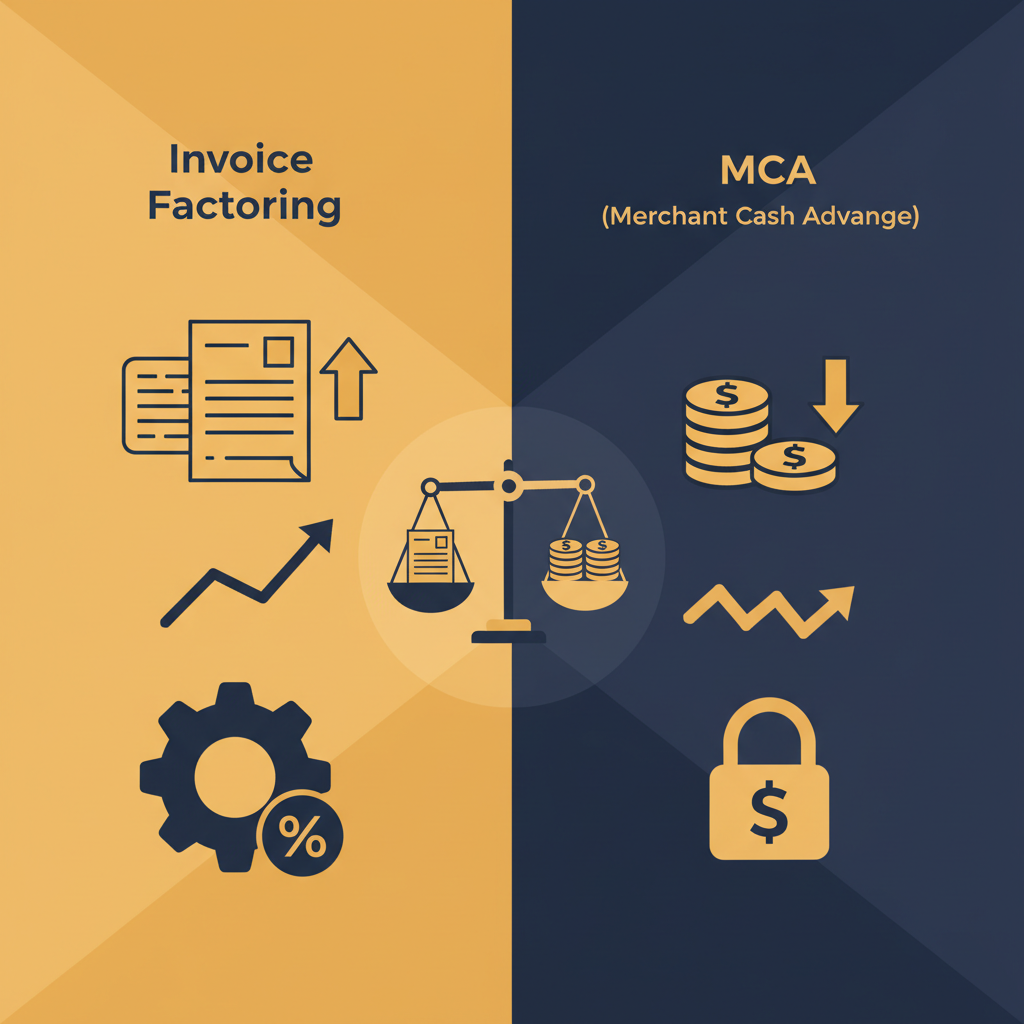
No, invoice factoring is not the same as a merchant cash advance (MCA). Invoice factoring is the sale of your existing unpaid B2B invoices to get immediate cash (typically 80-95% of the invoice value). An MCA is a lump-sum advance in exchange for a percentage of your future daily credit card and debit sales. Factoring is for B2B businesses with slow-paying clients, while MCAs are for B2C businesses with high daily sales volumes.
Advisor insight
"I tell every business owner the same thing: follow the money. Where does your cash come from? If it's from a credit card machine ringing up sales all day long, an MCA might fit. If it's from mailing an invoice and waiting 60 days for a check, you need to be looking at factoring. Using the wrong product is the fastest way to turn a cash flow problem into a crisis."
Key takeaways
Save this section — it summarizes the entire article.
- Factoring vs. MCA: They are not the same. Factoring sells existing invoices; an MCA sells future sales.
- Cash Source: Factoring turns accounts receivable into cash. MCAs provide an advance against future credit/debit card revenue.
- Repayment Method: Factoring is paid back when your customer pays their invoice. MCAs are repaid via an automatic daily or weekly deduction from your bank account.
- Ideal User: Factoring is for B2B businesses (e.g., construction, trucking) with 30-90 day payment terms. MCAs are for B2C businesses (e.g., restaurants, retail) with high daily sales.
- Cost Structure: Factoring has an advance rate (80-95%) and a weekly fee (0.5-3%). MCAs use a factor rate (1.18 to 1.5) on the advance amount.
- Approval Basis: Factoring approval depends heavily on your customers' creditworthiness. MCA approval is based on your business's daily sales history.
- Choosing Wrong is Costly: Mis-matching the product to your revenue model can trap you in a high-cost debt cycle that cripples cash flow.
Already know what you need?
Skip the research — get matched to real offers in 2 minutes.
Featured snippet answer
A Merchant Cash Advance (MCA) and invoice factoring are two entirely different funding products designed for different types of businesses. Here is the key insight: An MCA is a purchase of your company's *future* revenue, repaid with a percentage of your daily sales, while invoice factoring is a purchase of your *existing* unpaid invoices, repaid when your customer finally settles their bill. The right choice depends entirely on how your business makes money—through daily point-of-sale transactions or through invoiced B2B services.
Topics covered
Section 1
What is a Merchant Cash Advance (MCA) and How Does It Work?
First, let's be clear: a Merchant Cash Advance, or MCA, is not a loan. We see a lot of business owners get confused by this, which is understandable. It's a very specific tool designed for a very specific type of business, and understanding its structure is the first step to using it correctly.
A Merchant Cash Advance (MCA) is a financial transaction where a company purchases a portion of your future sales at a discount. You receive a lump sum of cash upfront—say, $50,000—and in return, the MCA provider gets an agreed-upon percentage of your daily or weekly credit and debit card sales until the advance is fully repaid. This repayment structure is what makes it so different from a traditional loan with fixed monthly payments.
The cost of an MCA is calculated using a 'factor rate,' not an interest rate. A factor rate is a simple multiplier, typically ranging from 1.18 to 1.50. For example, if you receive a $50,000 advance with a factor rate of 1.3, you will repay a total of $65,000 ($50,000 x 1.3). The $15,000 difference is the cost of the funding. This fixed cost doesn't change, whether you repay it in 6 months or 12 months.
Here is the key insight: The primary benefit of an MCA is its flexible repayment model. The provider takes a percentage of your sales (often called a 'holdback' or 'retrieval rate,' usually 8-15%). This means that on a slow sales day, you pay back less. On a busy day, you pay back more. This can be a lifesaver for businesses with seasonal or fluctuating revenue, as it prevents the crushing pressure of a fixed payment during a slow period, one of the biggest cash flow mistakes we see businesses make.
MCAs are best suited for business-to-consumer (B2C) companies with high volumes of daily credit card transactions. Think restaurants, retail stores, and auto repair shops. Because approval is based on your daily sales history—not your FICO score—it's one of the fastest funding options available, often delivering cash in 24-48 hours. This makes it a powerful tool for seizing sudden opportunities, like purchasing bulk inventory at a discount or launching an emergency marketing campaign.
Real-World Example: A Restaurant's Opportunity
Situation: Marla's Bistro, a popular Italian restaurant in Austin, TX, with $60,000 in monthly credit card sales, was offered a chance to buy the restaurant next door to expand. The bank said no due to her 620 FICO score. She needed $75,000 for the down payment and initial renovations within a week or the deal would fall through.
Outcome: BizBee Funding provided Marla with a $75,000 Merchant Cash Advance. The factor rate was 1.3, for a total payback of $97,500. With a 10% retrieval rate, her daily payments averaged around $200, which was manageable. The expansion doubled her seating capacity, and within 6 months, her monthly sales grew to over $110,000, allowing her to easily absorb the MCA cost and secure long-term success.
Merchant Cash Advance solutions
Deep dive into how our MCA products work
Restaurant funding options
See specialized funding for the food service industry
MCA vs. Term Loans Compared
Understand the differences between these two common funding types
Retail business funding
Learn about financing options for retail stores
Key takeaway
An MCA is a sale of future revenue, making it a powerful speed-and-convenience product for businesses with strong daily card sales but less-than-perfect credit.
MCA at a Glance
Typical MCA Profile
Common metrics for a Merchant Cash Advance at BizBee Funding.
Funding Amount
$10k - $500k
Based on monthly revenue
Factor Rate
1.18 - 1.50
Fixed cost of capital
Repayment Holdback
8% - 15%
Percentage of daily sales
Time to Fund
24-48 Hours
After approval
Section 2
What is Invoice Factoring and How Does It Work?
Now, let's shift gears completely. While an MCA looks at your future sales, invoice factoring is all about unlocking the cash you've *already earned* but haven't been paid for yet. This is a game-changer for any business that issues invoices and waits for payment.
Invoice factoring is a financial service where a business sells its accounts receivable (unpaid invoices) to a third-party company, known as a 'factor', at a discount. Here's what that looks like in practice: instead of waiting 30, 60, or 90 days for your client to pay a $20,000 invoice, you sell that invoice to a factoring company and get a large portion of its value—typically 80% to 95%—immediately.
The process is straightforward. First, you submit your outstanding invoices to the factoring company. They verify the invoices and assess the creditworthiness of your customers (the ones who owe you money). Once approved, they advance you a percentage of the invoice total, known as the 'advance rate'. For a $20,000 invoice with a 90% advance rate, you'd get $18,000 in your bank account, often within 24 hours.
The remaining 10% ($2,000 in this example) is held in reserve. The factoring company then collects the full payment from your customer. Once the invoice is paid in full, the factor releases the reserve amount back to you, minus their fee. Factoring fees, or 'discount rates,' typically range from 0.5% to 3% of the invoice value for every 30 days it's outstanding. So, if the fee was 2% and the customer paid in 30 days, their fee would be $400 ($20,000 x 0.02), and you'd receive the remaining $1,600 from the reserve.
Here is the key insight: With invoice factoring, the funding decision is based on the financial strength of your customers, not your own business credit or revenue history. This is why it’s a phenomenal tool for new or growing B2B companies that work with large, established clients but have little credit history of their own. If your customers are reliable payers, you can get funded. It directly solves the classic cash flow crunch of waiting to get paid while bills pile up.
Funding for the trucking industry
Learn about factoring and other solutions for trucking businesses
Fixing common cash flow mistakes
Read our guide on avoiding killer cash flow errors
Construction equipment financing
Explore options for financing your heavy equipment
How our funding process works
See a step-by-step overview of getting funded
Key takeaway
Invoice factoring turns your unpaid invoices into immediate working capital, making it the perfect solution for B2B businesses burdened by long payment cycles.
Tired of Waiting 30-90 Days to Get Paid?
Stop letting slow-paying clients dictate your cash flow. Turn your unpaid invoices into cash in as little as 24 hours.
Factoring at a Glance
Typical Invoice Factoring Profile
Common metrics for an Invoice Factoring facility at BizBee Funding.
Advance Rate
80% - 95%
Percentage of invoice value paid upfront
Factoring Fee
0.5% - 3%
Per 30 days invoice is outstanding
Funding Amount
$25k - $2M+
Scales with your accounts receivable
Time to First Fund
3-5 Days
Subsequent funding in 24 hours
Decision framework
Use this to make your choice.
MCA vs. Factoring: The Core Decision
Choose a Merchant Cash Advance if…
- You run a B2C business like a restaurant, retail store, or salon.
- At least $15,000+ of your monthly revenue comes from credit/debit card sales.
- You're facing an immediate opportunity or shortfall and need cash in 24-48 hours.
- Your revenue fluctuates, and you prefer a payment that adjusts with your sales volume.
- Your personal credit score is below 650, making traditional loans difficult to obtain.
- You're drowning in paperwork and need a simple application process based on bank statements.
Best for:
Business-to-consumer companies that need extremely fast capital and have consistent daily credit card sales.
Choose Invoice Factoring if…
- You run a B2B business like a construction company, trucking firm, or consulting agency.
- You have outstanding invoices from creditworthy business customers.
- Your customers take 30, 60, or even 90 days to pay, creating cash flow gaps.
- You need to make payroll or buy materials before a client pays their bill.
- Your own credit is less-than-perfect, but your clients are established businesses.
- You need a scalable solution that grows as your B2B sales grow.
Best for:
Business-to-business companies struggling with cash flow because of slow-paying commercial clients.
Section 3
Key Differences: Structure, Cost, and Repayment
This is where business owners get into trouble—they see two 'fast cash' options but don't grasp the fundamental differences in how they're built. Choosing wrong is like using a hammer to turn a screw; it's a messy, expensive mistake. Let's break it down side-by-side.
The most critical distinction lies in what is being sold. A Merchant Cash Advance is the sale of *future, unearned* revenue. You are selling a promise of sales that haven't happened yet. Invoice factoring is the sale of *existing, earned* revenue represented by a specific, verifiable invoice for work already completed. This isn't just semantics; it changes everything about qualification, risk, and repayment. An MCA's risk is based on projecting your future performance, while a factor's risk is based on your customer's documented ability to pay a current debt.
Repayment mechanics are polar opposites. Here is the key insight: an MCA is repaid by *you* directly from your daily operating cash flow, whereas invoice factoring is repaid by *your customer* when they pay their bill. With an MCA, money is debited from your bank account automatically every single business day. With factoring, you don't make any 'payments' at all. The factor waits for your client to pay them, and the transaction is settled. This means an MCA directly impacts your daily cash on hand, while factoring improves it without adding a new daily payment obligation.
Cost structures are also apples and oranges. An MCA uses a factor rate (e.g., 1.30), giving you a clear, fixed total payback amount from day one ($50,000 advance x 1.30 = $65,000 total payback). Invoice factoring uses a variable fee structure. The cost depends on how long your customer takes to pay. A 2% fee might sound low, but if the customer pays in 15 days, your effective cost is much lower than if they take 75 days. This makes comparing the 'price' directly tricky, as one is fixed and the other depends on third-party actions.
Because of these differences, mixing them up can be disastrous. We've seen businesses with B2B invoices take out a high-cost MCA because it seemed 'easier,' only to find the daily payments crippled their ability to operate. They had a perfectly good asset—their accounts receivable—that could have been used for lower-cost factoring. Understanding your revenue model is non-negotiable before you sign any funding agreement, especially when your bank said no and you're exploring alternatives.
| Attribute | Merchant Cash Advance (MCA) | Invoice Factoring |
|---|---|---|
| Speed to funding | 24-48 hours | 3-5 days for setup, then 24 hours per invoice |
| Typical rates | Factor rates of 1.18 - 1.50 | Fees of 0.5% - 3% per 30 days |
| Approval difficulty | Easier (based on daily sales) | Easy (based on customer credit) |
| Flexibility | High (payments flex with sales) | Moderate (tied to specific invoices) |
| Best for | B2C businesses with high card sales (restaurants, retail) | B2B businesses with slow-paying clients (construction, trucking) |
Negative Outcome: The Wrong Tool for the Job
Situation: Dynamic IT Solutions, a Dallas-based IT consulting firm with $40,000/mo revenue, was struggling with cash flow. Their corporate clients paid on Net-60 terms. Needing $25,000 fast to cover payroll, the owner, Kevin, saw an online ad for a 'business cash advance' and got a $25,000 MCA. Since he had very few daily card sales, the lender instead structured it as a daily ACH debit of $295 from his bank account for the next 6 months.
Outcome: The daily $295 debit was suffocating. His revenue came in large, infrequent chunks when clients paid, but the MCA payment came out every single day. Within two months, he was constantly overdrawn and struggling to pay vendors. He had essentially taken a payday loan against B2B invoices. He should have used invoice factoring, which would have advanced him ~$22,500 against his receivables with no daily payment, solving his payroll issue without strangling his daily operations.
Compare Bank and Fintech Lenders
Learn why alternative funders approve when banks don't
Our Funding Requirements
See the qualifications for our funding products
Understanding Revenue-Based Financing
Explore a modern alternative to traditional loans
Explore Term Loan Options
Learn about fixed-rate, fixed-term business loans
Key takeaway
The core difference is simple: MCAs sell future sales and are repaid by you daily, while factoring sells existing invoices and is repaid by your customer when they pay.
Cost Comparison
$50,000 Funding Example
An illustration of how costs differ between products.
MCA Cost
$10,000 - $20,000
Based on a 1.2 to 1.4 factor rate; cost is fixed
Factoring Cost
$1,500 - $4,500
Based on 1-3% fee for 30-90 days; cost is variable
Repayment Source
Your Sales vs. Their Payment
MCA: Your daily revenue. Factoring: Your customer's payment
Section 4
What Are the Ideal Use Cases for Each Product?
Now that you understand the mechanics, let's talk about strategy. As advisors, we a hundred times a day which product is 'better.' The answer is always: better for *what*? The right choice depends entirely on the problem you're trying to solve and the shape of your business.
A Merchant Cash Advance is purpose-built for speed and opportunity. Here is the key insight: businesses use an MCA when they need to spend money to make money *right now*. A classic example is a pizza shop getting a chance to buy a competitor's high-end oven for 50% off, but the offer is only good for 48 hours. They have the daily sales to support the repayment, but they don't have $10,000 in cash sitting around. An MCA gets them the cash in one day to seize that asset. Other common uses include launching a timely marketing campaign, loading up on seasonal inventory before a holiday rush, or covering an unexpected emergency repair without disrupting operations.
The ideal MCA candidate is a business that lives and breathes daily transactions. This includes most restaurants, bars, retail shops, salons, and auto service centers. Their revenue stream is a constant flow of small to medium-sized credit card purchases. This consistent, verifiable sales history is exactly what MCA providers look for. It allows them to confidently project future sales and structure a repayment plan that rises and falls with the natural rhythm of the business.
Invoice factoring, on the other hand, is a tool for stability and growth in the B2B world. It's not about seizing a sudden opportunity; it's about solving a structural cash flow problem. We see this constantly with construction companies. They have to pay for materials and labor for weeks or months before they can even issue an invoice, which then takes another 30-60 days to get paid. Factoring bridges that gap. It allows the company to take on a new, larger project by providing the working capital needed to start the job, confident that they can cash in the invoice as soon as it's issued.
The prime candidate for invoice factoring is any business that bills other businesses for its services and offers payment terms. This includes trucking companies waiting on payment from brokers, consulting firms with projects billed in phases, temporary staffing agencies that have to make weekly payroll while waiting on monthly client payments, and HVAC contractors working on large commercial installations. For these businesses, a business line of credit or factoring is almost always a better fit than an MCA.
Real-World Example: A Trucking Company Levels Up
Situation: Big Rig Logistics LLC in Fresno, CA, a small trucking company with five trucks, was generating about $1.2M in annual revenue. They had an opportunity to secure a major contract with a national grocery chain, but it required them to add three more trucks and drivers. The contract's Net-90 payment terms meant they would float nearly $200,000 in fuel and payroll costs for three months before seeing a dime.
Outcome: Instead of seeking a loan, they set up a $250,000 invoice factoring facility with BizBee. They were able to get an 85% advance ($170,000) on their first set of invoices to the grocery chain. This covered their initial operating expenses. As they completed more loads, they continued to factor the invoices, creating a steady stream of working capital. This allowed them to scale up for the big contract without taking on traditional debt or being crushed by cash flow delays.
Explore a Business Line of Credit
Learn about flexible, revolving credit for your business
HVAC Industry Funding
See funding options tailored for HVAC contractors
Is revenue-based funding right for you?
A deep dive into this modern funding model
Apply for funding today
Get started with our simplified application process
Key takeaway
Use an MCA for short-term, high-return opportunities fueled by daily sales; use factoring to solve long-term, systemic cash flow gaps caused by B2B payment terms.
Confused About Which Option Fits?
Don't guess with your company's finances. A 15-minute chat with a funding advisor can give you clarity and save you thousands.
Business Profiles
Who Uses Which Product?
Comparing the typical business profile for each funding type.
MCA User
Restaurant
$50k/mo in credit card sales
Factoring User
Trucking Co.
$100k in outstanding invoices
Primary Problem (MCA)
Sudden cash need
e.g., equipment failure, inventory deal
Primary Problem (Factoring)
Recurring cash gap
e.g., making payroll while waiting on clients
Content cluster
This article is part of a connected knowledge base.
Related resources in this cluster
How business funding works
Get a complete overview of the business funding landscape and how our process works from start to finish.
Apply for funding
Complete our simple application in minutes to see your funding options.
Talk to a funding advisor
Get expert, one-on-one advice on which funding product is right for you.
MCA vs Term Loans Explained
Compare the differences between a merchant cash advance and a traditional term loan.
Funding Requirements
See the minimum qualifications for our various funding products.
Why Your Bank Said No
Understand why fintech lenders like BizBee can approve you when traditional banks won't.
Construction Industry Funding
Explore specialized funding options for construction businesses.
FAQ
Questions business owners ask before applying
References
Sources cited in this article.
- [1]
SBA Guide to Financing Options
SBA.gov
- [2]
Federal Reserve Small Business Credit Survey
Federal Reserve
- [3]
- [4]
Next step
Ready to see what your business qualifies for?
BizBee Funding helps business owners compare real options quickly — with honest guidance on speed, cost, repayment, and fit. No pressure, no hidden agendas.
Take the next step
Funding products & guides
- Business line of creditRevolving access — interest only on what you draw.
- Business term loansLump-sum capital with predictable payments.
- Working capital loansCover payroll, inventory, and short-term gaps.
- How BizBee funding worksSoft pull, multiple offers, funded in 24–48 hours.
- Business loan FAQRates, credit, documents, and eligibility answered.
- More funding guidesBrowse the full library of owner-focused articles.