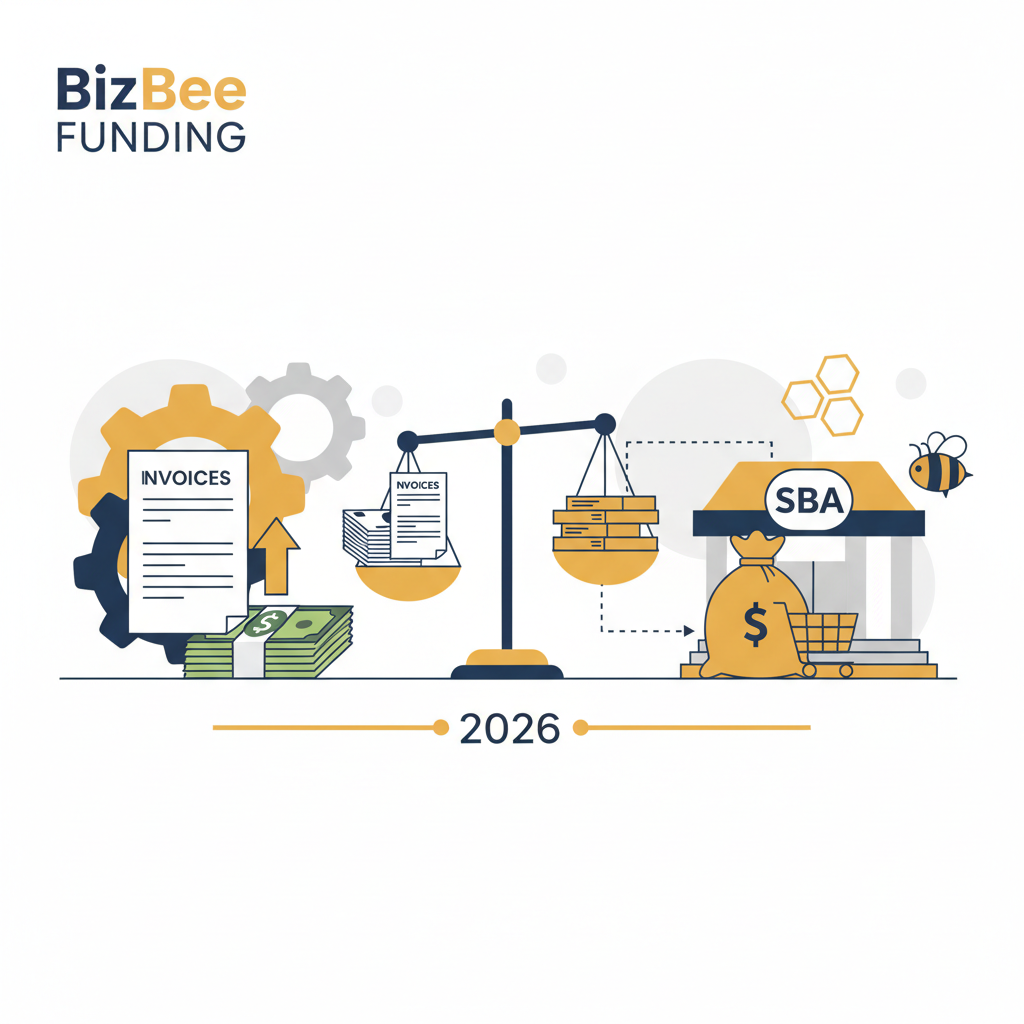
Invoice Factoring vs SBA Loan for Inventory Finance [2026]
Struggling to fund inventory? This guide compares invoice factoring vs. an SBA loan to help you decide between fast cash and low long-term cost.
By Chris Lewis — Senior Funding Advisor
12+ years • Small business working capital, lines of credit, and equipment financing
Quick answer
For inventory finance, choose invoice factoring for speed, getting 80-95% of your invoice value in 24-72 hours, ideal for urgent needs despite higher costs (1-3% fee per month). Choose an SBA loan for the lowest cost (7-11% APR) and long terms (up to 10 years), but only if you can wait 60-90+ days for funding and have strong credit (680+ FICO).
Advisor insight
"I tell clients the choice comes down to one question: Are you paying for speed or investing for the lowest cost? If a 2% factoring fee on a $50,000 invoice lets you land a $150,000 contract next week, it's a brilliant move. If you're just stocking up for a season that's 4 months away, the 90-day wait for a low-rate SBA loan is the smarter financial play."
Key takeaways
Save this section — it summarizes the entire article.
- Invoice factoring provides cash in 24-72 hours, while SBA loans take 60-90+ days to fund.
- SBA loans offer significantly lower costs, with APRs from 7-11%, compared to factoring fees that can equate to much higher annual costs.
- Factoring approval is based on your customers' credit, not yours, making it accessible for businesses with FICO scores below 650.
- SBA loans require a strong business and personal credit history (680+ FICO), extensive documentation, and often collateral.
- Here is the key insight: The choice is between paying a premium for speed (factoring) to seize an immediate opportunity or having the patience and qualifications to secure the lowest-cost capital for long-term growth (SBA).
- A negative outcome is common when businesses misjudge their timeline, applying for an SBA loan for an urgent need and missing the opportunity.
- Factoring can provide an advance of up to 95% on invoices, whereas an SBA loan can provide hundreds of thousands for broader working capital needs.
Already know what you need?
Skip the research — get matched to real offers in 2 minutes.
Featured snippet answer
Invoice factoring and SBA loans are both tools for inventory finance, but serve opposite needs. Invoice factoring offers rapid funding within 24-72 hours by advancing you up to 95% of your outstanding invoices, making it ideal for immediate inventory needs. However, it comes at a higher cost. Conversely, an SBA loan provides low-cost, long-term capital with rates often under 11% APR, but the application and funding process is slow, typically taking 60 to 90 days or more.
Topics covered
Section 1
The Core Dilemma: Immediate Inventory vs. Lowest Long-Term Cost
As a funding advisor, I see this scenario daily: a fantastic opportunity to buy inventory at a discount or fulfill a huge new order is on the table, but all your cash is tied up in unpaid invoices. You're stuck. The decision you make next will pivot on a single trade-off: speed or cost.
This is the central conflict when comparing invoice factoring against an SBA loan for inventory finance. One is a scalpel, designed for a quick, precise, and immediate problem. The other is a long-term investment in your company's financial health, built for stability and low cost over years. They are both valid tools, but using the wrong one for the job can be costly, either in fees or lost opportunities.
Invoice factoring provides immediate liquidity, typically within 24 to 72 hours, by advancing you cash against your outstanding B2B invoices. Here is the key insight: You are essentially selling your future revenue at a small discount to get cash today. This is perfect for bridging a temporary cash flow gap to buy inventory needed to complete a profitable order that's right in front of you. The cost is higher, but so is the speed.
An SBA loan, on the other hand, is one of the most affordable financing products available. With a government guarantee backing part of the loan, banks can offer incredibly low rates (often Prime + 2-4%) and long repayment terms of up to 10 years for working capital. The catch? The process is notoriously slow and documentation-heavy, often taking 60 to 90 days or more from application to funding. It’s designed for well-established businesses planning for future growth, not solving an urgent cash crunch.
We see business owners get this wrong all the time. They apply for an SBA loan because they want the low rate, completely underestimating the 3-month wait, and the big purchase order they needed the inventory for goes to a competitor. Conversely, some businesses get into a cycle of factoring when they really need a long-term capital injection, eroding their margins over time. Understanding your specific timeline and financial standing is the only way to make the right choice and avoid these common pitfalls.
5 Cash Flow Mistakes That Kill Businesses
Learn how to avoid common cash flow gaps.
How Business Funding Works
Get a foundational understanding of the funding process.
Compare Term Loans
See how traditional loans differ from these options.
Key takeaway
Your decision boils down to whether you are willing to pay a premium for speed to capture immediate profit or if you have the time and qualifications to secure the lowest possible cost of capital for future growth.
Inventory Finance Decision
Choosing Your Path
The fundamental trade-off for inventory funding.
Urgent Need (1-3 Days)
Invoice Factoring
Choose for speed
Planned Growth (2-3 Months)
SBA Loan
Choose for cost
Typical Cost Premium for Speed
5-10x
Factoring's effective APR can be much higher than an SBA loan
Section 2
What is Invoice Factoring? The Fast-Cash Engine for B2B
Let's be direct. You've done the work, you've delivered the product, and now you're waiting 30, 60, or even 90 days to get paid. Invoice factoring unlocks that trapped capital *now*, allowing you to fund your next move without taking on traditional debt.
Invoice factoring is a financial transaction where a business sells its accounts receivable (invoices) to a third party, known as a factor, at a discount. In practice, this means you get a large portion of the invoice value, typically 80% to 95%, upfront in cash within hours. The factoring company then owns the invoice and collects payment directly from your customer. Once your customer pays the invoice in full, the factor releases the remaining balance to you, minus their fee.
The fee, or discount rate, is the cost of factoring and typically ranges from 1% to 3% of the invoice value for every 30 days it remains outstanding. For example, on a $50,000 invoice with an 85% advance rate and a 2% monthly fee, you would receive $42,500 immediately. When your customer pays the full $50,000 in 30 days, the factor sends you the remaining $7,500 reserve, minus their $1,000 fee (2% of $50k), for a net of $6,500. You paid $1,000 to get $42,500 a month early.
One of the biggest advantages we see for clients is that approval isn't based on your credit score. Here is the key insight: The factor is more concerned with the creditworthiness of your customer—the one paying the invoice—than your own financials. This makes factoring a powerful tool for newer businesses or owners with less-than-perfect credit who might get an automatic 'no' from a traditional bank. If you do business with large, reliable companies, you are an excellent candidate for factoring.
This option is specifically designed for B2B companies in industries like trucking, manufacturing, wholesale, staffing, and professional services. If you sell directly to consumers (B2C), you won't have the invoices needed for this type of funding. Instead, you might explore alternatives like a Merchant Cash Advance, which leverages future credit card sales, or other forms of revenue-based financing.
Real-World Example: Landing a Major Retail Order
Situation: Artisan Totes, a Denver-based handbag manufacturer with $1.2M in annual revenue, received a $150,000 purchase order from a major department store. The problem? They only had $30,000 in the bank and needed $90,000 for raw materials immediately. All their capital was tied up in $200,000 of outstanding invoices from smaller boutiques with 60-day payment terms.
Outcome: Instead of declining the order, they worked with BizBee Funding to factor $100,000 of their existing invoices. They received an 85% advance, getting $85,000 in cash within 48 hours. This, combined with their on-hand cash, allowed them to buy all the materials. They paid a 2.5% fee ($2,500) but landed a new client worth over $500,000 annually. The speed of factoring was the only way to make it happen.
Trucking Industry Funding
See how factoring is used in the trucking industry.
Merchant Cash Advance
Explore an alternative for B2C businesses.
Revenue-Based Financing Guide
Learn about other financing tied to your sales.
See If You Qualify
Check our basic requirements for factoring.
Key takeaway
Factoring is not a loan; it's the sale of an asset (your invoice) that provides immediate cash flow based on your customers' credit, not your own.
Is Your Cash Trapped in Unpaid Invoices?
Stop waiting 30-90 days to get paid. Unlock the cash you've already earned and fund your next inventory purchase this week.
Invoice Factoring
The Factoring Process
How you get cash from invoices.
Time to Funding
24-72 Hours
After initial setup
Advance Rate
80% - 95%
Of invoice face value
Factor Fee
1% - 3%
Per 30 days outstanding
Decision framework
Use this to make your choice.
The Core Decision: Speed vs. Cost?
Choose Invoice Factoring if…
- You need cash to buy inventory in less than 7 days.
- Your cash is trapped in unpaid B2B invoices with 30-90 day terms.
- Your personal or business credit score is below 680.
- This is a short-term cash flow gap, not a permanent need for capital.
- The profit from the inventory purchase far outweighs the 1-3% factoring fee.
- You were told no by a bank and can't wait.
Best for:
Businesses with B2B invoices who need to capitalize on a time-sensitive inventory opportunity immediately.
Choose an SBA Loan if…
- You can wait 2-3 months for the funding to arrive.
- Your personal FICO score is 680 or higher.
- You have at least 2 years of profitable business history with strong financials.
- You are looking for $50,000 to $5 million for long-term growth, not just one inventory batch.
- You want the lowest possible interest rate and a long repayment term (up to 10 years).
- You have a detailed business plan and are prepared for a lengthy application process.
Best for:
Well-established, profitable businesses with strong credit who are planning for long-term inventory scaling and can afford to wait for the cheapest capital.
Section 3
Demystifying SBA Loans: The Marathon for Low-Cost Capital
When clients tell us they want the 'best rate possible' for a large, planned inventory expansion, our conversation almost always turns to SBA loans. Think of it as the gold standard for cheap, long-term business capital, but earning that gold medal requires serious training and preparation.
An SBA loan is a government-guaranteed small business loan issued by a private lender, like a bank or credit union, with favorable terms for the borrower. The Small Business Administration (SBA) doesn't lend the money directly; instead, it guarantees a significant portion of the loan (up to 85%), reducing the risk for lenders and encouraging them to provide capital at better rates and longer terms than they otherwise would.
For inventory, the most common option is the SBA 7(a) loan. Here is the key insight: An SBA 7(a) loan can be used for general working capital, which explicitly includes purchasing inventory and raw materials, for amounts up to $5 million. Repayment terms for working capital are typically up to 10 years, which creates a very low and manageable monthly payment compared to short-term alternatives. Interest rates are variable, quoted as a spread over the Prime Rate, and are among the lowest in the market.
The trade-off for these incredible terms is a demanding and lengthy application process. Lenders will scrutinize your business from every angle. You'll need at least two years of business and personal tax returns, detailed financial statements (P&L, balance sheet), a comprehensive business plan with financial projections, and a personal financial statement. Your personal credit score is also paramount; most lenders look for a FICO score of 680 or higher.
If you've ever heard complaints that 'my bank said no', the SBA process is often the final boss. It's not for the faint of heart or those in a hurry. From the moment you submit your initial application to the day the cash hits your account, you should realistically budget 60-90 days, and sometimes longer if the application is complex. This makes it completely unsuitable for seizing a sudden inventory opportunity but perfect for a well-planned, strategic stock-up for a future season.
Real-World Example: Strategic Inventory Expansion
Situation: GreenLeaf Botanicals, a well-established e-commerce brand in Austin, TX with $2.5M in annual revenue, wanted to expand its product line. They projected they needed $200,000 for a large-scale inventory purchase to prepare for the holiday season, which was still six months away. The owner had a 740 credit score and immaculate financial records.
Outcome: They started the SBA 7(a) loan process in May. It involved weekly calls with the bank, providing three years of financials, and a detailed business plan. The process took 78 days. In late July, they were approved for the full $200,000 at a 10.5% APR over a 10-year term. The monthly payment was only $2,700, preserving their cash flow. The long wait was stressful, but it allowed them to stock up for their busiest season at the lowest possible cost, leading to a record-breaking Q4.
Official SBA Loan Information
Learn the specifics of SBA-backed financing.
Why Your Bank Said No: Fintech vs. Banks
Understand why traditional banks are so slow.
How to Improve Your Business Credit Score
Get your credit report ready for an SBA application.
Construction Industry Funding
See how construction firms use long-term loans.
Key takeaway
An SBA loan is the cheapest money you can get for long-term growth, but it demands strong credit, deep documentation, and immense patience.
SBA Loans
The SBA Loan Gauntlet
Typical metrics for an SBA 7(a) working capital loan.
Time to Funding
60 - 90+ Days
From application to disbursement
Typical Interest Rate
Prime + 2.75% - 4.75%
Currently ~11.25% - 13.25% APR
Minimum FICO Score
680+
Personal credit is critical
Section 4
Which is Faster for Buying Inventory: SBA or Factoring?
When you're looking at a purchase order deadline, a direct comparison is what matters. Let's strip away the theory and put invoice factoring and SBA loans side-by-side on the metrics that directly impact your ability to acquire inventory and grow your business.
The single most significant difference between these two options is speed. Invoice factoring is designed for speed; you can go from application to having cash in your bank account in as little as 24 hours. The entire process hinges on the verification of your invoices, not a deep dive into your business history. This makes it an emergency response tool for your finances.
As we've discussed, SBA loans are the polar opposite. A 60-to-90-day timeline is standard. We had a client in the restaurant supply industry who found a great deal on used kitchen equipment but needed the cash in 10 days. An SBA loan was never a possibility, despite their great credit. Time is the defining factor, and for urgent needs, factoring is the undisputed winner.
Cost is the second major battleground. Here is the key insight: An SBA loan's cost is transparently expressed as an annual percentage rate (APR), typically ranging from 7% to 11% today. Factoring costs are expressed as a fee (1-3%) over a short period (30 days). While a '2% fee' sounds small, if your customer takes 60 days to pay, that becomes a 4% fee. When annualized, factoring costs can equate to a much higher APR than an SBA loan, which is the price you pay for speed and convenience.
Qualification criteria are also night and day. For factoring, you need creditworthy B2B customers and valid, unpaid invoices. Your own credit history is a minor factor. For an SBA loan, *you* are under the microscope. Lenders demand a strong personal credit score (680+), at least two years in business, proven profitability, and often some form of collateral. It's a high bar that many small businesses, especially younger ones, simply cannot clear.
| Attribute | Invoice Factoring | SBA Loan |
|---|---|---|
| Speed to funding | 24-72 hours | 60-90+ days |
| Typical rates | 1-3% fee per 30 days | 7% - 11% APR |
| Approval difficulty | Easy (based on customer credit) | Very Difficult (680+ FICO, 2+ years in business) |
| Flexibility | Cash can be used for anything | Funds must be used according to loan agreement |
| Best for | Urgent inventory needs, bridging short cash flow gaps. | Planned, long-term inventory growth for established businesses. |
Negative Outcome: Choosing the Wrong Tool for the Job
Situation: Dynamic IT Solutions, a Minneapolis-based reseller doing $950k in annual revenue, won a contract to supply a local school district with 200 laptops. The purchase order was for $120,000, and they needed to source the laptops within 30 days. The owner, wanting the 'cheapest money,' immediately applied for an SBA Express Loan, assuming 'Express' meant funds in a week or two.
Outcome: Despite the 'Express' name, the bank's underwriting process still required full documentation. After 25 days of back-and-forth, the owner was still waiting on the bank's final decision. The school district's deadline passed, and they awarded the contract to another vendor. Dynamic IT Solutions not only lost a $35,000 profit opportunity but also had a hard credit pull on their record from the failed application. They should have factored their existing invoices to get cash in 2 days and secure the deal. The slightly higher fee would have been a small price to pay for the profit they lost.
Apply Now for Fast Funding
See if you qualify for factoring in minutes.
Talk to a Funding Advisor
Get a free consultation to compare your options.
MCA vs. Term Loans
Compare other fast vs. slow funding options.
Restaurant Funding Solutions
Explore funding options for the food service industry.
Key takeaway
Factoring wins on speed and accessibility; the SBA loan wins decisively on cost and loan size, but only for those who can wait and qualify.
Don't Choose the Wrong Funding Path.
Your business opportunity has a deadline. Let our funding advisors analyze your timeline and financials to find the right product for your inventory needs.
At a Glance
Factoring vs. SBA: Key Metrics
A direct comparison of core features.
Winner for Speed (<72 hrs)
Invoice Factoring
No contest.
Winner for Lowest Cost
SBA Loan
Significantly lower APR.
Winner for Bad Credit (<650)
Invoice Factoring
Based on customer credit.
Section 5
How to Prepare Your Application for Either Path
Whether you choose the sprint of factoring or the marathon of an SBA loan, preparation is everything. From what we see, organized clients get funded faster and with better terms. Here’s what you need to have ready.
For invoice factoring, the process is focused on your receivables. You aren't being underwritten as heavily as your customers are. Your primary task is to get your paperwork in order to prove the validity of your invoices.
Here is the key insight: Assembling a clean, organized accounts receivable aging report is the single most important step for a fast factoring approval. This report should list all your open invoices, customer names, invoice amounts, and dates. Be prepared to provide copies of the actual invoices, along with any corresponding purchase orders or signed contracts. The cleaner your documentation, the faster the factor can verify them and advance your funds.
Preparing for an SBA loan application is a much more involved project. This is about proving the long-term viability and health of your entire business. You should begin gathering documents weeks before you even approach a lender.
You will absolutely need, at a minimum: the last 2-3 years of business and personal tax returns, a current profit & loss statement and balance sheet, a debt schedule listing all current business debts, and personal financial statements for all owners with 20% or more equity. Most importantly, you'll need a well-written business plan that clearly outlines how you will use the inventory funds and includes detailed financial projections for the next 1-3 years. If you don't have these documents ready, your application won't even get past the initial review.
- **For Factoring:** Create a detailed A/R aging report.
- **For Factoring:** Gather copies of invoices and related purchase orders.
- **For SBA:** Compile 2-3 years of business and personal tax returns.
- **For SBA:** Write a comprehensive business plan with financial projections.
- **For SBA:** Pull together current financial statements (P&L, Balance Sheet).
- **For Both:** Ensure your business registration and ownership documents are current.
Funding Application Requirements
View a checklist of required documents.
Business Line of Credit Guide
Consider this flexible alternative.
Retail Industry Funding
Learn about financing for retail businesses.
Understanding How Funding Works
Get a step-by-step overview of the process.
Key takeaway
For factoring, organize your invoices. For an SBA loan, organize your entire financial life.
Application Readiness
Document Checklist
Key items needed for each application.
Factoring Key Document
A/R Aging Report
Proves what you're owed
SBA Loan Key Document
Business Plan
Proves your future viability
Time Saved by Being Prepared
1-3 Weeks
For the SBA loan process
Content cluster
This article is part of a connected knowledge base.
Related resources in this cluster
How business funding works
Understand the fundamentals of different business funding solutions.
Apply for funding
Start our simple application to see your funding options in minutes.
Talk to a funding advisor
Get a free, no-obligation consultation to discuss your specific inventory needs.
SBA Loans Guide
Learn more about the pros and cons of government-backed loans.
MCA vs Term Loans Explained
Compare other funding products to understand the full landscape.
Funding Requirements
See the minimum qualifications for our various funding products.
Improve Your Business Credit Score
Learn actionable steps to strengthen your credit profile for better loan terms.
FAQ
Questions business owners ask before applying
References
Sources cited in this article.
- [1]
SBA 7(a) Loan Program Details
SBA.gov
- [2]
Federal Reserve Small Business Credit Survey
Federal Reserve
- [3]
- [4]
Next step
Ready to see what your business qualifies for?
BizBee Funding helps business owners compare real options quickly — with honest guidance on speed, cost, repayment, and fit. No pressure, no hidden agendas.
Take the next step
Funding products & guides
- Business line of creditRevolving access — interest only on what you draw.
- Business term loansLump-sum capital with predictable payments.
- Working capital loansCover payroll, inventory, and short-term gaps.
- How BizBee funding worksSoft pull, multiple offers, funded in 24–48 hours.
- Business loan FAQRates, credit, documents, and eligibility answered.
- More funding guidesBrowse the full library of owner-focused articles.