Is Factoring a Merchant Cash Advance? A Funding Advisor Explains
Wondering 'is factoring a merchant cash advance'? The definitive answer is no. Our funding advisors explain the critical differences in cost, mechanics, and use cases that could save your business thousands.
By Chris Lewis — Senior Funding Advisor
12+ years • Small business working capital, lines of credit, and equipment financing
Quick answer
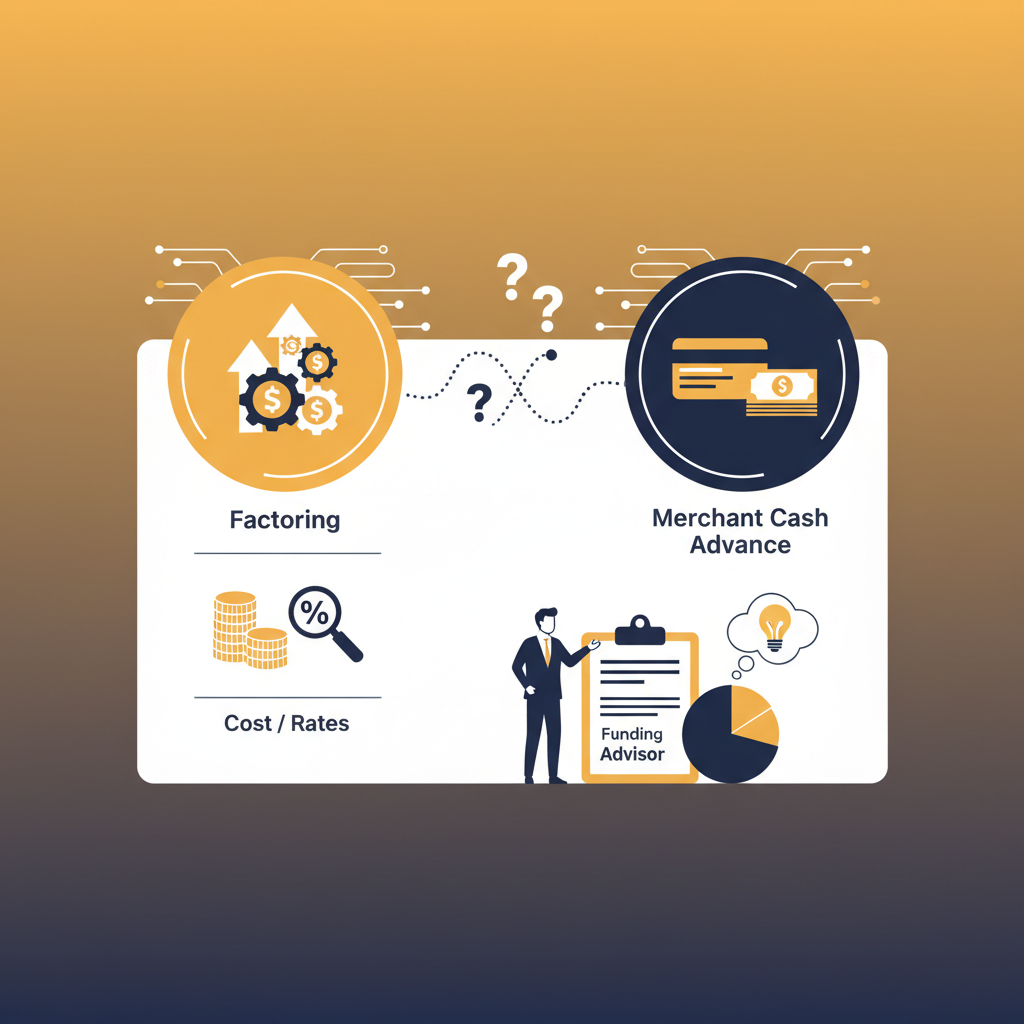
No, factoring is not the same as a merchant cash advance (MCA). Invoice factoring is the sale of existing unpaid invoices (accounts receivable) for immediate cash, typically with an advance of 80-95% of the invoice value. An MCA is the sale of a portion of your future sales revenue for a lump sum of cash. The core difference is that factoring unlocks cash you have already earned, while an MCA advances cash against sales you have yet to make.
Advisor insight
"I see business owners use 'factoring' and 'MCA' interchangeably, but here's the key difference: factoring unlocks cash you've already *earned*, while an MCA advances cash against money you *expect to earn*. Confusing the two can lead you to pay a 1.40 factor rate on future sales when a simple 2% fee on existing invoices was all you needed."
Key takeaways
Save this section — it summarizes the entire article.
- Factoring is NOT a Merchant Cash Advance: Factoring sells existing invoices, while an MCA sells future revenue.
- Cost Structures Are Different: Factoring uses a small fee (1-3% of invoice value), while MCAs use a factor rate (1.1 to 1.5), often leading to a much higher effective APR.
- Repayment Mechanics Vary: Factoring companies collect from your customer. MCAs are repaid via an automatic daily or weekly percentage of your sales (holdback).
- Ideal User Is Different: Factoring is for B2B businesses with slow-paying clients. MCAs are for B2C businesses with high daily credit card sales needing fast cash.
- Risk Profile Varies: A high-sales day with an MCA means a large repayment, potentially straining cash flow. Factoring repayment is not tied to your daily performance.
- Approval Is Based on Different Factors: Factoring approval hinges on your customers' creditworthiness. MCA approval depends on your business's daily revenue consistency and volume.
- Confusing the two can be a costly mistake, potentially leading to taking on a 1.40 factor rate product when a 3% fee product was the better fit.
Already know what you need?
Skip the research — get matched to real offers in 2 minutes.
Featured snippet answer
A Merchant Cash Advance (MCA) is not the same as invoice factoring. An MCA provides a business with a lump sum of cash in exchange for a percentage of its future sales. Repayment is typically an automated daily deduction from bank deposits. Invoice factoring involves selling existing, unpaid invoices to a factoring company for an immediate cash advance, usually 80-95% of the invoice value. Essentially, an MCA is an advance on future, unearned revenue, while factoring is unlocking the cash from revenue you have already invoiced.
Topics covered
Section 1
MCA vs. Factoring: The Critical Difference Business Owners Miss
As funding advisors, we see business owners use these terms interchangeably every day. Let me be direct: they are fundamentally different, and choosing the wrong one based on this confusion is one of the most expensive mistakes you can make.
Here is the key insight: A Merchant Cash Advance (MCA) is the sale of a business's future, unearned receivables for an immediate lump-sum payment. An MCA provider is buying a piece of your sales revenue for the next 6-12 months. In contrast, invoice factoring is the sale of existing, unpaid invoices (your accounts receivable) to a third party at a discount to get cash now, rather than waiting 30, 60, or 90 days for your customer to pay.
Think of it this way. An MCA is like getting paid today for all the coffees you expect to sell next month. Invoice factoring is like getting paid today for a large catering order you already delivered, but for which the client has 60 days to pay the invoice. One is based on a projection; the other is based on a completed transaction. This distinction drives every other difference, from cost to repayment mechanics.
The type of revenue your business generates is the primary dividing line. Businesses that get paid immediately by consumers (B2C), like restaurants, retail stores, and auto repair shops, are prime candidates for a Merchant Cash Advance. Their revenue comes from thousands of small, daily transactions. On the other hand, businesses that perform a service and then invoice another business (B2B), like construction contractors, consultants, and trucking companies, are built for invoice factoring. Their revenue is tied to large, specific invoices with payment terms.
We often hear from owners who are frustrated after their bank said no. They search for fast funding and see both options. The danger lies in a B2B business taking a high-cost MCA when a lower-cost factoring solution was available, or a retail shop trying to factor non-existent invoices. Understanding which bucket your business falls into is the first step toward finding the right capital and avoiding the common pitfalls of quick cash.
What is a Merchant Cash Advance?
Get a deep dive into how MCAs work.
Revenue-Based Financing Explained
Understand how financing tied to revenue can work.
Why Your Bank Said No
Learn why fintech lenders can approve when banks won't.
See Our Funding Requirements
Check if you qualify for our funding solutions.
Key takeaway
Confusing future revenue (MCA) with earned receivables (Factoring) can lock you into a funding product that is fundamentally mismatched with your business's cash flow cycle.
Core Concept
Future Sales vs. Existing Invoices
The fundamental difference lies in what you are selling for cash.
MCA Asset Sold
Future Sales
Money you expect to make
Factoring Asset Sold
Current Invoices
Money you've already earned
Ideal Business Model
B2C vs. B2B
Consumer sales vs. Business invoices
Section 2
How a Merchant Cash Advance Really Works (And Where It Hurts)
An MCA is known for speed, but that speed comes with a unique structure that can feel jarring if you're not prepared for it. Forget APR and interest; MCAs use factor rates and holdbacks, and you feel it every single day.
A Merchant Cash Advance's cost is determined by a factor rate, typically ranging from 1.10 to 1.50. This is not an interest rate. If you receive a $50,000 advance with a 1.30 factor rate, you will pay back a total of $65,000 ($50,000 x 1.30). The cost is a fixed $15,000, regardless of how quickly you pay it back. A faster payback period results in a higher effective APR, which is a common point of confusion for business owners comparing it to a term loan.
Repayment happens through a 'holdback' percentage. This is an agreed-upon percentage, usually 8% to 20%, of your daily credit card sales (or sometimes a fixed daily/weekly ACH debit from your bank account). If your holdback is 15% and you have a $3,000 sales day, the MCA company takes $450 that day. If you have a $500 sales day, they take $75. This automatic, daily collection is what makes owners feel the pain of an MCA. It's a constant drain on your operating cash, especially if your margins are already tight.
This is why MCAs are best suited for short-term, high-return opportunities. If you can use that $50,000 to buy inventory that you'll sell for a $100,000 profit within a few months, paying back $65,000 makes sense. But using it to cover payroll during a prolonged downturn can be dangerous. The constant repayment pressure can exacerbate the underlying cash flow mistakes that created the need for funding in the first place.
Here is the key insight: The biggest risk with an MCA is when your sales volume spikes, leading to a much larger daily repayment than anticipated, which can starve your business of the cash needed for daily operations. This is a trap we see many business owners fall into, especially in seasonal industries. It can lead to 'stacking'—taking a second MCA to cover the cash flow gap created by the first one—a cycle that is extremely difficult to escape.
Real-World Scenario: The Stacking Trap
Situation: Brenda's Boutique, a clothing store in Scottsdale, AZ with $500k in annual revenue, was struggling with cash flow. She took a $40,000 MCA with a 1.40 factor rate (payback of $56,000) and a 15% daily holdback to buy new inventory. A month later, a pipe burst, requiring a $15,000 emergency repair. With her daily cash being squeezed by the first MCA, she felt her only option was to take a second, more expensive 'stacked' MCA for $20,000 at a 1.45 factor rate.
Outcome: Now, Brenda owed two funders. Her daily holdback effectively became over 25% of her sales. On a good $2,000 day, over $500 was gone before she could even pay her staff. She had no capital to buy for the next season and was at risk of default. Confusing an MCA for a flexible line of credit created a debt spiral that threatened her entire business. She had to talk to a funding advisor to restructure the debt into a single, more manageable term loan, but the process was stressful and costly.
Get Fast Funding with an MCA
Apply for a Merchant Cash Advance online.
MCA vs. Term Loans
Compare the cost structures of MCAs and traditional loans.
Fix These 5 Cash Flow Mistakes
Learn how to manage your business cash flow more effectively.
Trucking Industry Funding
See financing options for trucking companies.
Key takeaway
The fixed cost and daily repayment of an MCA can create a cash flow crunch if not used for a specific, profit-generating purpose.
Tired of Juggling Multiple Payments?
The pressure of daily debits and multiple funders can be overwhelming. Let our advisors help you find a single, clear path forward.
MCA Mechanics
Understanding MCA Costs
How a $30,000 advance translates into daily payments.
Advance Amount
$30,000
Cash received
Factor Rate
1.35
Total payback is $40,500
Daily Holdback
15%
Percentage of daily sales
Decision framework
Use this to make your choice.
The Advisor's Choice: MCA or Invoice Factoring?
Choose a Merchant Cash Advance if…
- You are a B2C business (restaurant, retail, salon) with high daily credit/debit card sales.
- You are drowning in a cash flow emergency and need funds in 24-48 hours.
- Your personal credit score is below 650, and you were told no by the bank.
- You need $10,000 to $75,000 for a short-term opportunity or inventory purchase.
- You don't issue invoices to other businesses.
- You prefer a payment that adjusts with your daily sales volume.
Best for:
Business owners who need immediate cash based on their consistent daily revenue and can't qualify for or wait for traditional loans.
Choose Invoice Factoring if…
- You are a B2B business (construction, manufacturing, consulting, trucking) that invoices other companies.
- You have creditworthy customers who take 30, 60, or 90 days to pay.
- You are feeling the pain of making payroll while waiting on $50,000+ in receivables.
- You don't need cash tomorrow and can wait 3-5 business days.
- Your customers' credit is strong, even if yours isn't perfect.
- You want to unlock cash you've already earned, not borrow against future sales.
Best for:
B2B companies looking to solve cash flow problems caused by slow-paying clients without taking on traditional debt.
Section 3
MCA vs. Invoice Factoring: A Side-by-Side Comparison
When we put these two products on the whiteboard for a client, the differences become crystal clear. It's not about which one is 'better' overall, but which one is dramatically better for *your specific situation*.
Let's break down the core mechanics in a direct comparison. A Merchant Cash Advance provides funding in as little as 24 hours, which is its main appeal. Invoice factoring is slightly slower, typically taking 3-5 days to set up and fund the first batch of invoices. This speed difference is often the deciding factor for businesses in a true emergency.
The cost structure is where the paths diverge sharply. An MCA uses a factor rate, as we've discussed, leading to a fixed payback amount that can represent a high effective APR, often over 50%. Invoice factoring uses a factoring fee (or discount rate), which is a small percentage of the invoice's value, typically 1% to 3% per 30 days the invoice is outstanding. For a $100,000 invoice paid in 30 days, a 2% fee means your cost is just $2,000—a stark contrast to the potential cost of an MCA for the same amount.
Approval difficulty is another key difference. MCA approval is primarily based on your daily sales volume and consistency; a low personal credit score isn't usually a deal-breaker. This is a lifeline for owners who need to improve their business credit score. Factoring approval, however, is almost entirely dependent on the creditworthiness of the customers who owe you money. If you have invoices out to large, stable companies like Walmart or General Electric, you can likely get them factored even if your own business financials are weak.
Here is the key insight: Invoice factoring provides non-recourse and recourse options, which affects risk. In non-recourse factoring, the factoring company assumes the risk if your customer fails to pay. This is more expensive. In recourse factoring (the more common option), you are ultimately responsible if your customer defaults. An MCA is a sale of assets, so if your business sales decline significantly or you close, the collections usually stop, as it is not technically a loan. However, you should always consult a funding advisor to understand the specific terms of any agreement.
| Attribute | Merchant Cash Advance (MCA) | Invoice Factoring |
|---|---|---|
| Speed to funding | 24-72 hours | 3-7 business days |
| Typical rates | Factor rates of 1.10 - 1.50 | 1-3% fee of invoice value per month |
| Approval difficulty | Easier (based on sales volume) | Moderate (based on customer credit) |
| Flexibility | Use funds for anything | Tied to invoice values |
| Best for | B2C (Retail, Restaurants) needing fast cash | B2B (Construction, Trucking) with slow-paying clients |
Talk to a Funding Advisor
Get a free, no-obligation consultation on your options.
How to Improve Your Business Credit Score
Take steps to improve your creditworthiness.
Explore Term Loans
See if a traditional term loan is a better fit.
Funding for Construction Companies
Learn about financing options for contractors.
Key takeaway
The right choice depends on whether your biggest asset is consistent daily sales (MCA) or strong outstanding invoices (Factoring).
At a Glance
MCA vs. Factoring: Core Metrics
How the two products stack up on key decision points.
Typical Funding Speed
24 hours (MCA)
vs. 3-5 days for Factoring
Basis for Approval
Your Sales (MCA)
vs. Your Customer's Credit (Factoring)
Typical Cost on $50k
$10k-$20k+ (MCA)
vs. $1k-$2.5k (Factoring)
Section 4
What is a Merchant Cash Advance Used For? The Decision Framework
Now that you understand the mechanics, the question becomes: when do you actually use each one? We advise clients to think of these as specialized tools. You wouldn't use a hammer to saw a board. The same logic applies here.
A Merchant Cash Advance is used for speed and opportunity. The ideal use case is when a short-term, high-ROI need arises. For example, a restaurant owner gets a chance to buy a competitor's prime location for $50,000, but the deal closes in three days. They know the new location will generate $20,000/month in profit. An MCA gets them the cash almost overnight to seize the opportunity. The higher cost is justified by the massive return. It's also a vital tool for businesses that simply cannot get approved elsewhere, perhaps due to a recent dip in credit or if the bank said no.
We also see MCAs used effectively for emergency repairs that would otherwise shut down a business. Think of a pizza shop whose main oven breaks down. A new one costs $15,000. Every day without it costs them $2,000 in lost sales. Waiting a week for a bank loan isn't an option. An MCA provides the capital in 24 hours, saving the business from a week of lost revenue. It's a pragmatic solution when speed is the most critical factor. This is a common scenario for many in the retail and healthcare funding spaces.
Conversely, Invoice Factoring is a strategic tool for managing cash flow. It's not for emergencies, but for solving a structural problem: you do good work, but your clients take too long to pay. Here is the key insight: A business with $500,000 in annual revenue but $80,000 tied up in outstanding 60-day invoices has a cash flow problem, not a sales problem. Factoring solves this by unlocking that $80,000 now, enabling them to make payroll, buy materials for the next job, and bid on more projects. It transforms accounts receivable from a number on a page into working capital.
Think of a growing HVAC company that keeps winning larger commercial contracts. The jobs are profitable, but they have to pay for labor and equipment upfront, while the client pays 90 days later. This is a classic 'growing broke' scenario. Invoice factoring provides a scalable solution. As they win more contracts and their receivables grow, their factoring line can grow with them, providing a predictable source of cash flow that fuels expansion. It's less about a one-time cash injection and more about creating a sustainable financial operating system.
Real-World Scenario: Factoring to Fuel Growth
Situation: Precision Assembly LLC, an electronics manufacturer in Dallas with $2M in annual revenue, had a great problem: they landed a massive new contract with a major retailer. The problem was the retailer's net-90 payment terms. Precision needed to spend $150,000 on materials and overtime pay immediately, but wouldn't see a dime for three months. They were feeling the pain of being cash-poor but opportunity-rich.
Outcome: Instead of a high-cost advance, they worked with a funding advisor to set up an invoice factoring facility. They submitted their first $200,000 invoice and received an 85% advance ($170,000) within 48 hours. This covered their upfront costs with room to spare. The factoring company collected the payment from the retailer 90 days later and remitted the remaining 15% ($30,000) minus their 4.5% total fee ($9,000). For a cost of $9,000, they unlocked $170,000 in working capital, secured the contract, and positioned themselves for more growth.
Apply for Business Funding Now
Start your application and see what you qualify for.
Business Line of Credit Guide
Explore another flexible funding option.
HVAC Industry Funding
Find financing solutions for HVAC contractors.
How Our Process Works
Learn the simple steps to getting funded.
Key takeaway
Use an MCA for fast, high-ROI opportunities or emergencies; use Factoring to solve systemic cash flow gaps caused by slow-paying B2B customers.
Ready to Stop the Cash Flow Bleeding?
Don't let slow-paying customers dictate your business's future. Unlock the cash sitting in your receivables today.
Use Case Scenarios
The Right Tool for the Job
Matching the funding product to the business need.
MCA Use Case
Emergency Repair
Time-sensitive, high cost of inaction
Factoring Use Case
Making Payroll
Systemic cash flow gap
Payback Horizon
3-12 Months (MCA)
vs. Ongoing facility (Factoring)
Section 5
Choosing Correctly: A Positive MCA Outcome
While we've highlighted the risks, a Merchant Cash Advance, when used correctly, can be a powerful tool for growth that simply isn't available anywhere else. It’s all about a clear-eyed assessment of cost versus benefit.
A Merchant Cash Advance is a strategic transaction, not a loan. Seeing it this way is crucial for using it successfully. The question isn't 'What's the APR?' but rather 'What is the ROI on this capital?' If an MCA costs you $10,000 but enables a project that nets $30,000 in profit you'd otherwise miss, it's an incredibly smart business decision. This is the mindset of our most successful MCA clients.
They treat it like a short-term business partner. For example, a food truck needs $20,000 for the rights to a prime spot at a 3-day music festival. No bank will fund that fast enough. They take a $20,000 MCA with a 1.25 factor rate, owing $25,000. Over the festival weekend, they do $40,000 in sales, far more than their usual location. The MCA is half paid back in days. They pay a $5,000 fee to generate an incremental $20,000+ in profit. That's a win.
Here is the key insight: The success of a Merchant Cash Advance hinges on deploying the capital into an activity with a return on investment that substantially exceeds the factor rate cost within a short timeframe (typically 3-6 months). Unlike a traditional term loan which might be used for slower, long-term growth, an MCA's cost structure demands immediate, high-impact use.
This is why a detailed conversation with a funding advisor is so important. We can help you pencil out the math. We'll ask the hard questions: What is the specific plan for this capital? What is the realistic, conservative estimate of the return? How does the daily repayment fit into your current cash flow? Answering these questions honestly is the difference between a successful MCA and a cautionary tale.
Real-World Scenario: A Restaurant's Smart MCA Play
Situation: Angelo's Trattoria, an Italian restaurant in Philadelphia with $800k in annual revenue, had an opportunity to build an outdoor patio. The estimated cost for construction and furniture was $60,000. Angelo calculated the patio would increase his seating by 40% and boost summer revenue by at least $100,000. He had a 680 credit score but couldn't wait 60+ days for an SBA loan decision and miss the summer season.
Outcome: Angelo worked with BizBee Funding and secured a $60,000 MCA with a 1.28 factor rate, for a total payback of $76,800. He received the funds in two days. The patio was built in three weeks, just as the weather turned warm. The new seating was an instant hit, and his summer revenue increased by $120,000, with a net profit of $45,000 from the expansion. The $16,800 cost of the MCA was easily covered, making it a highly profitable strategic decision that a slower loan would have prevented.
See If an MCA is Right For You
Get a personalized assessment of your MCA options.
Funding for Restaurants
Learn about specific funding products for food service businesses.
SBA Loan Options
Consider government-backed loans as an alternative.
Retail Industry Funding
Find capital solutions for retail stores.
Key takeaway
A successful MCA outcome happens when the ROI from the capital is significantly higher and faster than its fixed cost.
Smart Capital
The MCA Success Formula
Calculating the ROI on a $20,000 advance.
Capital Deployed
$20,000
The advance amount
Total Cost (1.3 Factor)
$6,000
Total payback is $26,000
Required Net Profit
>$6,001
To make the transaction profitable
Content cluster
This article is part of a connected knowledge base.
Related resources in this cluster
How business funding works
Understand the entire landscape of business funding from A to Z.
Apply for funding
Get a funding decision in minutes without impacting your credit score.
Talk to a funding advisor
Get personalized guidance on the right funding product for your business.
MCA vs Term Loans Explained
Compare the costs and benefits of a merchant cash advance and a traditional term loan.
Funding Requirements
See the minimum qualifications for different types of business funding.
Restaurant Funding Solutions
Explore funding options specifically designed for the restaurant industry.
Construction Funding Options
Find capital solutions tailored for construction businesses and contractors.
FAQ
Questions business owners ask before applying
References
Sources cited in this article.
- [1]
- [2]
- [3]
2023 Small Business Credit Survey
Federal Reserve
- [4]
Next step
Ready to see what your business qualifies for?
BizBee Funding helps business owners compare real options quickly — with honest guidance on speed, cost, repayment, and fit. No pressure, no hidden agendas.
Take the next step
Funding products & guides
- Business line of creditRevolving access — interest only on what you draw.
- Business term loansLump-sum capital with predictable payments.
- Working capital loansCover payroll, inventory, and short-term gaps.
- How BizBee funding worksSoft pull, multiple offers, funded in 24–48 hours.
- Business loan FAQRates, credit, documents, and eligibility answered.
- More funding guidesBrowse the full library of owner-focused articles.