MCA vs Invoice Factoring for Cash Flow: The Advisor's Guide
Struggling with erratic cash flow? This advisor guide breaks down merchant cash advance vs invoice factoring, helping you choose the right funding to stabilize your business fast.
By Chris Lewis — Senior Funding Advisor
12+ years • Small business working capital, lines of credit, and equipment financing
Quick answer
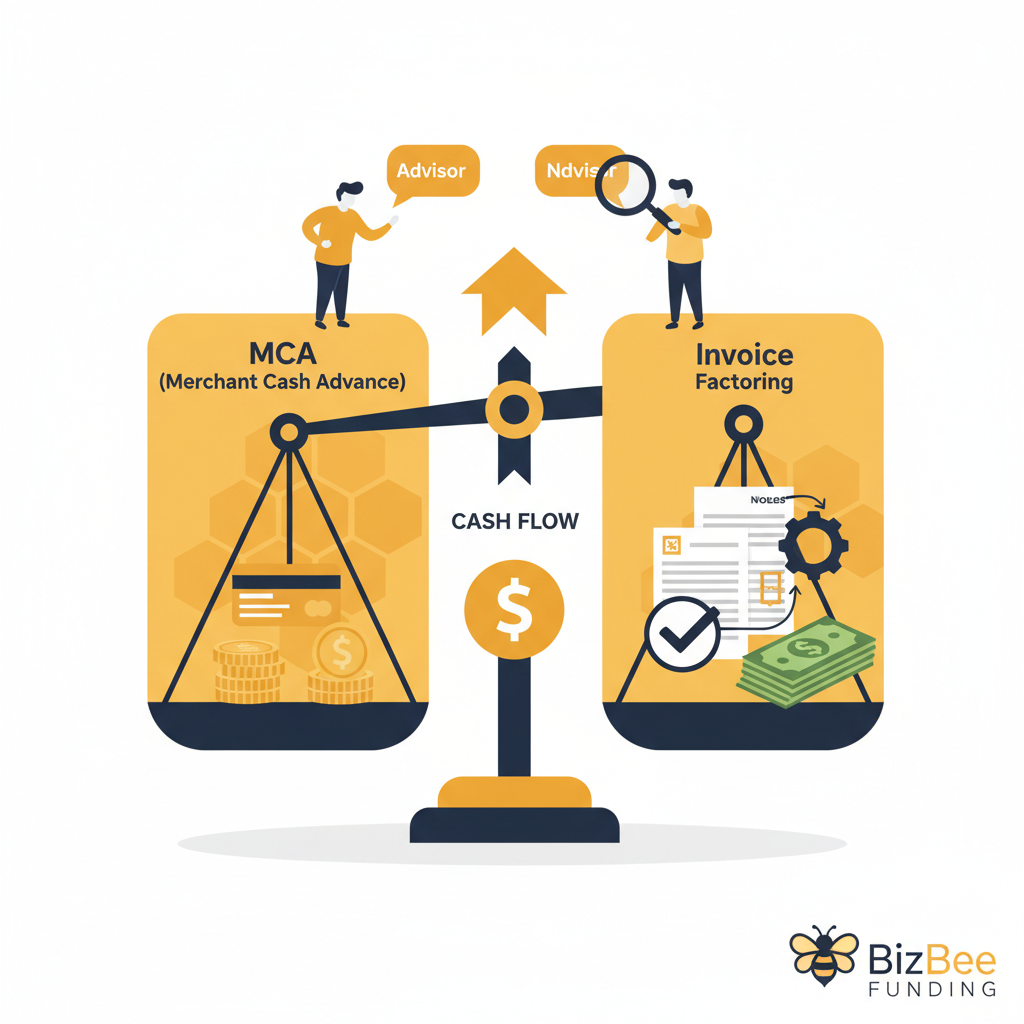
A Merchant Cash Advance (MCA) provides a lump sum for a percentage of future sales, funding in 24-48 hours with factor rates from 1.10 to 1.50. It's ideal for B2C businesses with high card sales. Invoice Factoring advances up to 90% of your unpaid B2B invoices in 3-5 days, with discount rates of 1-4% per 30 days. It's for B2B companies whose customers have good credit. Your choice depends on your revenue source: daily sales (MCA) or large invoices (Factoring).
Advisor insight
"If you have B2B invoices, factoring will almost always cost half what an MCA does — MCAs make sense only when you're B2C or have no receivables to leverage."
Key takeaways
Save this section — it summarizes the entire article.
- A Merchant Cash Advance (MCA) is best for B2C businesses like restaurants or retail with consistent credit card sales of over $15,000 per month.
- Invoice Factoring is designed for B2B companies in sectors like trucking or consulting that issue invoices with Net 30-90 day terms.
- MCAs offer funding in as little as 24 hours, while invoice factoring typically takes 3-5 days for the initial setup and funding.
- MCA costs are a fixed factor rate (e.g., a $50k advance at 1.30 costs $15k), whereas Factoring costs are a discount rate (e.g., 2% per month on a $50k invoice costs $1k/mo).
- Here is the key insight: Approval for an MCA depends on your sales history, while approval for factoring depends on your customer's creditworthiness, not your own.
- A negative outcome we see is MCA 'stacking'—taking multiple advances—which can create a debt spiral with effective APRs over 150%, crippling cash flow.
- The right choice directly aligns with your business model: high-volume, small transactions favor MCAs; low-volume, large invoices favor factoring.
Already know what you need?
Skip the research — get matched to real offers in 2 minutes.
Featured snippet answer
Choosing between a merchant cash advance vs invoice factoring for cash flow depends entirely on your business model. A Merchant Cash Advance (MCA) provides an upfront cash sum (e.g., $50,000) in exchange for a percentage of your future daily sales, funding within 24 hours. This is ideal for B2C businesses with high card sales volume. Invoice Factoring lets you sell your unpaid B2B invoices for an immediate cash advance of up to 90% of their value. It's for B2B businesses waiting on creditworthy clients to pay. The MCA cost is a fixed factor rate (1.10-1.50), while factoring fees are 1-4% of the invoice value per month.
Topics covered
Section 1
The Cash Flow Crisis: Drowning in Payments vs. Waiting for Payouts
We see it every single day at BizBee Funding. A fundamentally strong business—a popular restaurant, a skilled contractor, a growing e-commerce store—is being held hostage by cash flow. The stress is immense. You know you have a great business, but the timing of money in versus money out is threatening to sink the whole ship.
Cash flow gaps occur when a business's outgoing expenses exceed its incoming revenue over a specific period, creating a working capital deficit. This isn't a sign of failure; it’s a standard challenge of growth. Maybe you have a huge project that requires a $40,000 materials outlay today, but the client won't pay for 90 days. Or perhaps a sudden refrigerator failure in your restaurant costs $15,000 you don't have liquid. These are the moments when owners feel like they're failing, but what they really have is a timing problem.
The traditional route of going to a bank is often a dead end. We hear constantly from clients how their 'bank said no' after a grueling, weeks-long application process. Banks are risk-averse; they want perfect credit, years of profitability, and extensive collateral. They aren't built for the speed and urgency that a real cash flow crisis demands. This is where alternative financing becomes a lifeline, not just a plan B.
Today, we're not talking about just any funding. We are laser-focused on two powerful tools we use to solve immediate cash flow problems for our clients: the Merchant Cash Advance (MCA) and Invoice Factoring. These are not loans in the traditional sense, and understanding their differences is critical. Picking the right one can feel like getting a life raft in a storm. Picking the wrong one can feel like adding an anchor.
Here is the key insight: The fundamental difference between an MCA and Invoice Factoring is the asset they leverage—an MCA leverages your future sales, while Factoring leverages your current unpaid invoices. This is the single most important distinction. Your business model and the *source* of your cash flow problem (too few sales today vs. waiting for payment on past sales) will dictate which solution is the right fit. Choosing correctly is the first step to taking back control.
common cash flow mistakes
Learn about the five most common cash flow errors.
why your bank said no
Compare the advantages of fintech lenders over traditional banks.
our funding process
See how our simple funding process works from start to finish.
talk to an expert
Get free advice from a business funding advisor.
Key takeaway
Your cash flow problem isn't a sign of a bad business; it's a timing issue that requires the right specialized funding tool to solve.
Cash Flow Killers
Common Causes of a Cash Crunch
Data from our client intake forms shows where cash flow pressure originates.
Avg. Invoice Aging
52 Days
for B2B clients before funding
Avg. Unexpected Expense
$12,500
equipment failure, etc.
Seasonal Revenue Dip
20-40%
in off-peak months
Section 2
Merchant Cash Advance (MCA): The Rocket Fuel for Sales-Driven Businesses
Let's be direct. An MCA isn't a loan. It's a purchase of your future sales at a discount. We use this tool for one specific type of business: one that has a high volume of daily sales, primarily through credit cards. Think restaurants, retail stores, and busy service providers.
A Merchant Cash Advance (MCA) provides an upfront sum of cash in exchange for a percentage of the business's future sales. Here's how it plays out in the real world: We look at your last 4-6 months of bank statements to verify your monthly sales volume. If you're doing, say, $50,000 a month in revenue, we might advance you $40,000. Instead of a fixed monthly payment, you'll pay back a small, fixed percentage (called a holdback, usually 10-15%) of your daily sales until the total agreed-upon amount is repaid.
The beauty of this model is its flexibility. On a big sales day where you do $3,000, your payment might be $300 (at 10%). On a slow day where you only do $800, your payment is just $80. This protects your cash flow in a way a fixed-payment term loan cannot. The number one reason business owners love this is the speed. From application to cash in your bank account, we are often talking 24 hours. When a walk-in freezer dies on a Friday, that speed is everything.
Approval is based almost entirely on your business's sales history, not your personal credit score. This is a game-changer for owners who have a thriving business but a less-than-perfect credit history, often due to past struggles. We regularly secure MCAs for clients with FICO scores as low as 500, as long as they can demonstrate at least $15,000 per month in consistent revenue. It's a funding solution based on your business's current health, not your past.
However, you must understand the cost. The cost is represented by a factor rate, not an interest rate. A $40,000 advance with a 1.25 factor rate means you'll pay back a total of $50,000 ($40,000 x 1.25). The $10,000 difference is the cost of the capital. While convenient, this makes MCAs a more expensive form of capital, which is why they are best used for short-term, high-ROI needs, not long-term financing.
Real-World Scenario: How an MCA Saved a Pizzeria
Situation: Bella's Brick Oven, a popular pizzeria in Austin, TX with $55,000 in monthly revenue, faced a catastrophe. Their custom-built brick oven, the heart of their business, cracked and needed a $28,000 emergency replacement. They were losing over $1,500 in sales daily and their bank quoted a 4-week loan process. The owner, Maria, was panicking.
Outcome: Maria contacted BizBee Funding. We analyzed her last three months of sales and approved her for a $35,000 Merchant Cash Advance within 3 hours. The funds were in her account the next morning. She ordered the new oven immediately. The payback was structured as 12% of her daily credit card sales. This allowed her to get back to business without facing a crippling fixed monthly payment, saving her business from an extended closure that would have cost her over $40,000 in lost revenue.
Merchant Cash Advance
Learn the details of our MCA product.
Compare MCAs and Term Loans
See a side-by-side comparison of these two popular options.
funding for restaurant owners
Explore funding solutions tailored for the restaurant industry.
funding for retail stores
Discover capital options for retail businesses.
Key takeaway
An MCA is your fastest path to cash if you have strong daily sales, acting as a flexible partner whose payments rise and fall with your revenue.
Is Your Bank Account Running on Fumes?
Turn your future sales into the cash you need right now. An MCA can be in your bank account by tomorrow. See if you qualify in 2 minutes, no impact on your credit score.
MCA At-a-Glance
Merchant Cash Advance Profile
Key metrics for a typical Merchant Cash Advance.
Funding Time
24-48 Hours
from approval
Min. Monthly Revenue
$15,000+
verified by bank statements
Factor Rate Range
1.10 - 1.50
determines total payback
Decision framework
Use this to make your choice.
MCA or Factoring: Which Path Ends Your Cash Flow Stress?
Choose a Merchant Cash Advance if…
- You're drowning in daily expenses and need cash in the next 24-48 hours, not next week.
- You run a B2C business (restaurant, retail, salon) with at least $15,000 in monthly credit card sales.
- Your personal or business credit score is below 650 and the bank already said no.
- Your revenue fluctuates, and you need a payment that adjusts with your daily sales.
- The funding is for a short-term opportunity or emergency, like buying inventory for a flash sale or an emergency repair.
Best for:
The sales-driven business owner who needs immediate capital and values speed and flexibility over the lowest cost.
Choose Invoice Factoring if…
- Your stress comes from waiting 30, 60, or 90 days for large B2B clients to pay their invoices.
- Your customers are established, creditworthy businesses (e.g., large corporations, government agencies).
- Your own business credit isn't perfect, but your clients' credit is strong.
- You need to bridge a cash flow gap to take on a larger project or cover payroll while waiting for payment.
- You prefer a solution with a clearer fee structure tied directly to the invoices you're funding.
Best for:
The B2B business owner who needs to unlock the cash trapped in their accounts receivable to stabilize operations and fuel growth.
Section 3
Invoice Factoring: Unlock the Cash Trapped in Your Receivables
Now, let’s pivot. If you're staring at a pile of unpaid invoices from other businesses and your bank account is empty, you don't have a sales problem—you have a timing problem. This is where we deploy invoice factoring. It's designed for B2B companies whose cash is locked up for 30, 60, or even 90 days.
Invoice factoring allows a business to sell its unpaid B2B invoices to a third party, a 'factor', at a discount to receive immediate cash. Imagine you're a trucking company and you've just completed a $20,000 haul for a major retailer, but their terms are Net 60. You can't wait two months for that cash. With factoring, you can sell that invoice to a company like BizBee Funding. We would verify the invoice and then advance you up to 90% of its value—$18,000—within a few days.
Here is the key insight: The approval for invoice factoring hinges on the creditworthiness of your customer, not your own business or personal credit. If you're doing business with large, reliable companies like Walmart, Home Depot, or government agencies, you are a prime candidate for factoring, even if your own business is new or has a spotty credit history. The factor's primary concern is whether your customer is likely to pay the invoice.
Once your customer pays the invoice in 60 days, the factoring company receives the full $20,000. They then release the remaining 10% ($2,000) back to you, minus their fee. The fee, called a discount rate, is typically 1-4% of the invoice face value for every 30 days it's outstanding. In this case, for a 60-day period at a 1.5% monthly rate, the total fee would be 3% of $20,000, or $600. So, you would receive the final $1,400. You paid $600 to get access to $18,000 two months early, allowing you to cover fuel, maintenance, and payroll.
This is a powerful tool for any business in an industry with long payment cycles, such as construction, manufacturing, trucking, or consulting. It turns your accounts receivable from a static number on a balance sheet into a dynamic source of working capital, smoothing out cash flow and enabling you to take on new, larger projects without fear of a cash crunch. We see many clients use this as a permanent cash flow management strategy.
Real-World Scenario: Factoring Fuels a Manufacturer's Growth
Situation: Precision Engineering LLC, a Detroit-based parts manufacturer with $2.5M in annual revenue, landed a game-changing $300,000 order from a major automotive company. The problem: the contract was on Net 90 terms, and they needed $150,000 upfront for raw materials and overtime pay. Their bank line of credit was maxed out.
Outcome: They turned to BizBee Funding for invoice factoring. Because the end customer was a blue-chip company, we established a factoring facility within 5 days. Upon issuing the first $100,000 invoice, we advanced them $85,000 (an 85% advance rate). This allowed them to purchase materials and start production. They continued to factor invoices as the project progressed, maintaining healthy cash flow. The ability to unlock capital from their invoices allowed them to successfully deliver the huge order and positioned them for even larger contracts in the future.
B2B financing options
Explore financing tailored for B2B business models.
funding for trucking companies
See specialized funding solutions for the trucking industry.
construction business funding
Learn about financing options for construction contractors.
our funding requirements
Check the detailed criteria for our funding products.
Key takeaway
Factoring transforms your unpaid B2B invoices into on-demand working capital, with approval based on your customer's strength, not your own.
Factoring At-a-Glance
Invoice Factoring Profile
Key metrics for a typical Invoice Factoring facility.
Advance Rate
80% - 95%
of invoice face value
Discount Rate (Fee)
1% - 4%
per 30 days outstanding
Ideal Client Invoice
$5,000+
to creditworthy businesses
Section 4
The True Cost: A Side-by-Side Breakdown You Won't Get Elsewhere
Let's cut through the sales talk. The most damaging mistake we see business owners make is misunderstanding or miscalculating the true cost of their funding. Here is the blunt, advisor-level breakdown of an MCA vs. Invoice Factoring for a $50,000 funding need.
The total cost of a Merchant Cash Advance is calculated by multiplying the advance amount by a fixed factor rate, typically ranging from 1.10 to 1.50. Let’s say you take a $50,000 MCA at a 1.30 factor rate. Your total repayment amount is fixed at $65,000 ($50,000 x 1.30). The cost of this capital is $15,000, regardless of whether you pay it back in 6 months or 12 months. Because the repayment speed depends on your sales, the effective APR can vary wildly and is often over 80%. It's simple, fast, but expensive.
The cost of invoice factoring is a discount rate, usually 1% to 4% of the invoice face value for every 30 days it remains outstanding. Let's say you factor a $50,000 invoice and get an 90% advance, which is $45,000. Your factor charges a 2% fee every 30 days. If your customer pays in 30 days, your fee is $1,000 (2% of $50k). If they take 60 days, your fee is $2,000. You're paying for the time it takes your customer to pay. This structure is generally much less expensive than an MCA for the same dollar amount, especially on shorter-term invoices.
Here is the key insight: An MCA charges a large, fixed fee for speed and accessibility, while Factoring charges a smaller, variable fee based on time. Think of an MCA as a sprinter—incredibly fast for short distances but burns a lot of energy. Think of Factoring as a marathon runner—efficient and built for the long haul of a B2B sales cycle. One is not inherently 'better,' but they are built for entirely different races.
The danger lies in using the wrong tool for the job. We've seen business owners take out expensive MCAs to cover payroll while waiting on a huge invoice to be paid. They could have used factoring for a fraction of the cost. The reverse is also true; a restaurant can't factor its dinner receipts. Understanding this fundamental cost and use-case difference is the bedrock of responsible business funding.
Negative Scenario: The MCA 'Stacking' Trap
Situation: Dynamic Digital Marketing in Scottsdale, AZ, a web design firm with $30,000 in monthly revenue, was experiencing lumpy cash flow. To cover payroll during a slow month, the owner, Kevin, took a $20,000 MCA. It was fast and easy. Two months later, facing another crunch, a different funder proactively offered him another $15,000 MCA. Seeing it as easy money, he took it, a practice called 'stacking'.
Outcome: Kevin was now having over $750 debited from his bank account *daily* to service both MCAs. His cash flow was completely choked. He had to let a key employee go and started missing payment deadlines to vendors. The combined effective APR on his stacked advances was over 200%. He was in a debt spiral, created by using a short-term tool for a chronic structural problem. He called us for help, but at that point, the options were limited and painful. This is the most common and devastating misuse of MCAs we see.
revenue-based vs. other financing
Understand how revenue-based options compare to loans.
improve your business credit
Learn how a better credit score can lower your funding costs.
our transparent funding process
See how we ensure you understand all costs upfront.
discuss costs with an advisor
Get a free, personalized cost analysis for your business.
Key takeaway
An MCA has a high fixed cost for convenience, while factoring has a lower variable cost tied to time; matching this to your need is non-negotiable.
Confused By Factor Rates and Discount Fees?
You are not alone. These products can be complex. Schedule a free 15-minute call with a BizBee Funding advisor to get a clear, honest breakdown of what these options would cost for YOUR business.
Cost of Capital
Cost Comparison: $50,000 Funding Need
A simplified cost analysis for two different funding scenarios.
MCA Total Cost
$15,000
on a $50k advance at 1.30 factor rate
Factoring Total Cost
$2,000
on a $50k invoice paid in 60 days (2% fee/30d)
MCA Effective APR
60-150%+
highly dependent on payback speed
Section 5
The Final Verdict: How to Choose for Your Business Model
We've covered the mechanics and the costs. Now it comes down to you, standing at a fork in the road. The right funding product isn't just about getting cash; it's about getting the *right kind* of cash that aligns with how your business actually makes money.
The ideal funding choice fundamentally depends on your business's primary revenue source: high-volume daily sales (MCA) or invoiced B2B transactions (Factoring). If you own a bustling cafe, a retail boutique, or an auto repair shop where dozens or hundreds of customers swipe their cards each day, your cash flow rhythm matches an MCA. Your revenue is granular and daily, so a funding product with a daily payback percentage makes intuitive and practical sense.
Conversely, if you run a B2B operation—a marketing agency, a temp agency, a small-scale manufacturer, or a commercial HVAC company—your revenue arrives in large, infrequent chunks. Your life is governed by 'Net 30/60/90'. Your cash flow problem isn't a lack of business; it's the lag between doing the work and getting paid. For you, invoice factoring is the purpose-built solution. It directly addresses the source of your pain by monetizing the very assets (your invoices) that are causing the delay.
Here is the key insight: Choosing the wrong product creates friction, while the right one reduces it. Trying to use an MCA when your revenue comes from three big invoices a month is a recipe for disaster; the daily debits will drain your account an kill your cash flow before your client pays. Trying to find an invoice to factor when you run a cash-and-carry business is impossible. The decision is less about which product is 'better' and more about which product's DNA matches your company's DNA.
At BizBee Funding, our advisory approach starts here. Before we even talk numbers, we ask: 'How does your business make money?' 'Who pays you, and how long does it take?' Answering these questions honestly will almost always point you directly to the correct financial tool. The goal is to find a solution that feels like a natural extension of your business operations, not a foreign element you constantly have to wrestle with.
ready to apply?
Start our simple application and get a decision fast.
line of credit
Explore another flexible funding option.
specifics for HVAC companies
See funding options tailored to the HVAC industry.
business line of credit guide
Learn how a business line of credit differs from other options.
Key takeaway
Your business model is your compass: high-volume daily transactions point to an MCA, while large B2B invoices point directly to factoring.
Decision Matrix
Which Product Fits Your Profile?
A summary of the ideal candidate for each funding type.
MCA: Business Type
B2C (80%)
Restaurants, Retail, Services
Factoring: Business Type
B2B (95%)
Trucking, Construction, Consulting
MCA: Key Asset
Future Sales
Based on bank/processing statements
Factoring: Key Asset
Current Invoices
Based on accounts receivable aging
Content cluster
This article is part of a connected knowledge base.
Related resources in this cluster
How business funding works
Understand the entire business funding process from application to approval.
Apply for funding
Our streamlined application process gets you a decision in hours.
Talk to a funding advisor
Get a free, no-obligation consultation with a dedicated funding expert.
Improve Business Credit Score
Learn actionable strategies to boost your business credit in 90 days.
MCA vs Term Loans Explained
Compare the differences between a merchant cash advance and a traditional term loan.
Funding Requirements
See the minimum qualifications for various funding products.
Construction Industry Funding
Find specialized funding solutions for construction businesses.
FAQ
Questions business owners ask before applying
References
Sources cited in this article.
- [1]
- [2]
Federal Reserve: Small Business Credit Survey
Federal Reserve
- [3]
- [4]
Next step
Ready to see what your business qualifies for?
BizBee Funding helps business owners compare real options quickly — with honest guidance on speed, cost, repayment, and fit. No pressure, no hidden agendas.
Take the next step
Funding products & guides
- Business line of creditRevolving access — interest only on what you draw.
- Business term loansLump-sum capital with predictable payments.
- Working capital loansCover payroll, inventory, and short-term gaps.
- How BizBee funding worksSoft pull, multiple offers, funded in 24–48 hours.
- Business loan FAQRates, credit, documents, and eligibility answered.
- More funding guidesBrowse the full library of owner-focused articles.