MCA vs Revenue Based Financing: Which is Best for Retail?
Struggling to choose between a Merchant Cash Advance and Revenue-Based Financing for your retail business? We break down the real costs, risks, and which funding is right for your specific sales cycle.
By Chris Lewis — Senior Funding Advisor
12+ years • Small business working capital, lines of credit, and equipment financing
Quick answer
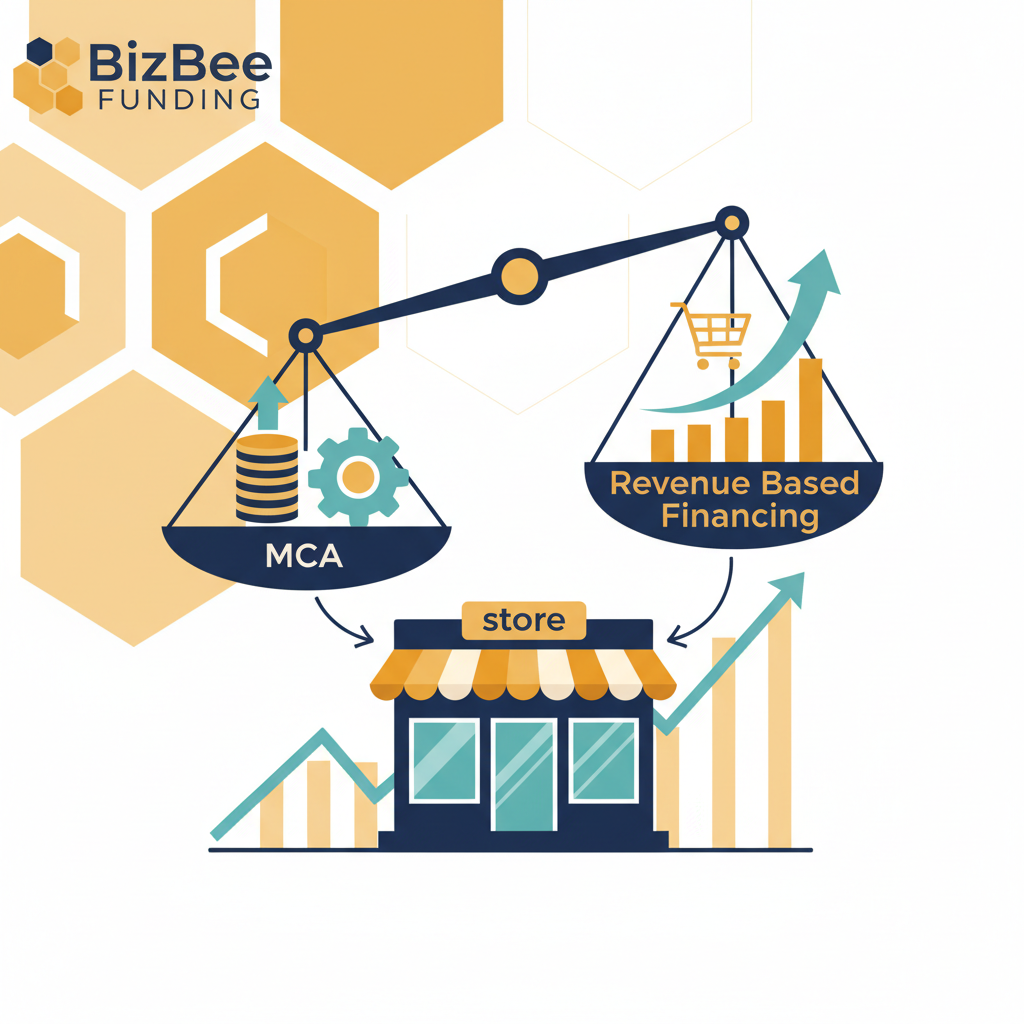
For retail businesses, a Merchant Cash Advance (MCA) is best for fast funding ($5k-$250k in 24-48 hours) repaid via a fixed percentage of daily credit card sales. It's ideal for needs tied to card transaction volume. Revenue-Based Financing (RBF) is better for strategic growth, offering $50k-$2M+ repaid from a small percentage of total monthly revenue, making it more flexible for stores with diverse sales channels (cash, online, etc.) and seasonal fluctuations.
Advisor insight
"We see retail clients grab a $40,000 MCA for a quick inventory pop before a holiday, and it works beautifully. But for larger, six-figure expansion projects, the flexibility of an RBF that flexes with their seasonal sales is almost always the smarter long-term play—it prevents those white-knuckle cash flow moments in a slow Q1."
Key takeaways
Save this section — it summarizes the entire article.
- An MCA draws repayments from daily credit card sales, while RBF draws from total monthly gross revenue.
- MCAs offer faster funding, often within 24 hours, for amounts typically between $5,000 and $250,000.
- RBF provides larger funding amounts, from $50,000 to over $2,000,000, for long-term growth initiatives.
- MCA costs are defined by a factor rate (e.g., 1.1 to 1.5), resulting in a fixed total repayment amount.
- RBF repayment is more flexible, adjusting with your monthly revenue; you pay less in slow months and more in busy ones.
- Here is the key insight: For a retail business where 80%+ of sales are via credit card, an MCA can be straightforward. If cash, invoices, or online payments are significant, RBF offers more balanced and less disruptive repayment.
- Incorrectly choosing an MCA when you have low card sales can lead to severe cash flow shortages, as high daily holdbacks are taken from a small portion of your total income.
Already know what you need?
Skip the research — get matched to real offers in 2 minutes.
Featured snippet answer
The primary difference between a Merchant Cash Advance (MCA) and Revenue-Based Financing (RBF) for retail businesses lies in the repayment source. A Merchant Cash Advance provides fast capital repaid through a fixed percentage (10-20%) of your daily credit card sales. Revenue-Based Financing is repaid via a smaller percentage (2-8%) of your total monthly gross revenue from all sources—cards, cash, online, etc. RBF payments fluctuate with your sales, offering significant relief during slow months, while MCA payments are tied only to card volume, which can be restrictive for some retailers.
Topics covered
Section 1
Merchant Cash Advance (MCA): The Sprint for Quick Capital
As advisors, we see retail owners turn to MCAs when speed is the absolute priority. You have an opportunity or a problem that needs cash *today*, and you're willing to pay a premium for that velocity.
A Merchant Cash Advance (MCA) provides a lump sum of cash in exchange for a percentage of your business's future credit card sales. It's not a loan; it's a sale of future receivables at a discount. A provider advances you, for example, $40,000, and in return, they purchase $52,000 of your future credit card revenue. They collect that amount by taking a small, fixed percentage—called a 'holdback'—of your daily card transactions until the $52,000 is fully repaid.
Here is the key insight: The total cost of an MCA is determined by a factor rate, not an APR, which typically ranges from 1.10 to 1.50. To calculate your total repayment, you simply multiply the advance amount by the factor rate. For that $40,000 advance with a 1.3 factor rate, your total repayment would be $40,000 x 1.3 = $52,000. This fixed cost structure can be appealing because you know the exact total payback amount from day one, unlike variable-rate loans.
For a retail store, this structure has clear pros and cons. The primary advantage is speed and accessibility. If your credit card processor shows consistent sales of over $5,000-$10,000 per month, you can often get funded for $25,000 to $75,000 in under 24 hours. We've seen clients get approved in the morning and have funds by evening to snag a time-sensitive inventory deal. This is especially true for businesses that a traditional bank might deem too risky or when even a fintech [term loan](/solutions/term-loans) feels too slow.
However, the reliance on credit card sales is also its biggest pitfall. If your retail shop does significant business in cash or through invoices, an MCA only looks at a fraction of your revenue picture. This can create a mismatch. Furthermore, the daily repayment schedule can be a relentless drain on cash flow. While the percentage is fixed, the daily debit happens every single day you process cards, regardless of your other expenses like payroll or rent. This is a critical factor we urge retailers to model out before committing. We can help you understand how this will impact your specific business and what to look for in our [funding requirements](/requirements).
- **Funding Speed:** Typically 24-48 hours.
- **Funding Amount:** $5,000 to $250,000+.
- **Repayment:** Fixed percentage (10-20%) of daily credit card sales.
- **Cost Structure:** Factor rate (1.10 - 1.50), not APR.
- **Ideal Use Case:** Urgent needs like inventory purchases or emergency repairs.
- **Main Drawback:** Daily payments and reliance solely on credit card revenue can strain cash flow.
Real-World Example: An MCA Saves the Season
Situation: 'The Velvet Hanger,' a clothing boutique in Austin, TX, with $450,000 in annual revenue (90% via credit card), faced a crisis. A supplier offered a 40% discount on a popular line of summer dresses—a $60,000 value for just $36,000—but the offer was only good for 48 hours. The owner had only $10,000 in liquid cash and couldn't wait for a bank loan.
Outcome: They secured a $40,000 MCA from BizBee Funding in under 24 hours. The 1.35 factor rate meant a total repayment of $54,000. The 15% daily holdback was manageable given their high card volume. They bought the inventory, which sold out in six weeks, generating over $75,000 in revenue and $39,000 in profit—far outweighing the $14,000 cost of the advance. The MCA provided the velocity needed to seize a profitable opportunity.
Our Merchant Cash Advance solution
Learn about the features and benefits of BizBee's MCA product.
Why the bank said no
Understand why fintech lenders are often a better fit for retail businesses.
Compare MCAs and Term Loans
See how MCAs stack up against another common form of business debt.
Key takeaway
An MCA is a powerful tool for short-term, urgent capital needs in retail, but its daily repayment structure demands careful consideration of your store's specific cash flow cycle.
MCA Snapshot
Typical MCA for Retail
Key metrics for a common MCA scenario for a retail business.
Advance Amount
$40,000
For a seasonal inventory purchase
Factor Rate
1.35
Represents the total payback multiple
Holdback %
15%
Of daily credit card sales
Total Repayment
$54,000
The cost of capital is $14,000
Section 2
Revenue-Based Financing (RBF): The Marathon for Strategic Growth
When we talk with established retailers about scaling—opening a second location, launching a big e-commerce push, or a major renovation—the conversation almost always shifts to Revenue-Based Financing. It's capital designed to grow *with* you, not drain you.
Revenue-Based Financing (RBF) offers capital in return for a percentage of a company's total gross revenue over time. A funder gives you a lump sum, and you agree to pay them back through a small, fixed percentage of your top-line monthly revenue—from all sources, including credit cards, cash, bank transfers, and online payments. This continues until a pre-agreed total repayment amount, called a repayment cap, is reached.
The repayment cap in RBF is the total amount you will ever repay, usually expressed as a multiple of the initial funding, like 1.25x to 2.5x. For a $100,000 investment with a 1.5x cap, you would repay a total of $150,000. The key difference is that the repayment timeline is flexible. If you have a great month and do $80,000 in revenue, and your repayment rate is 5%, you'd pay $4,000 that month. If the next month is slow and you only do $40,000, your payment automatically drops to $2,000. This built-in flexibility is a game-changer for businesses with seasonal ebbs and flows, like many in the [retail industry](/industries/retail).
Here is the key insight: RBF is a true growth partnership, aligning the funder's success with your own. Since their return is tied to your top-line revenue, they are inherently invested in your growth. This is fundamentally different from a loan, which demands a fixed payment no matter what, or an MCA that only cares about card sales. This makes RBF an excellent choice for scaling initiatives, as seen in our complete [guide to revenue-based financing](/blog/revenue-based-financing).
The qualification process is more involved than an MCA but less stringent than an [SBA loan](/solutions/sba-loans). Funders will want to see at least 12-24 months of operating history, stable or growing revenues (typically $20k+/month), and healthy gross margins. They’ll analyze your bank statements to understand your total cash flow, not just your credit card processing. This deeper dive allows for larger funding amounts, often from $50,000 to over $2 million, making it suitable for significant expansion projects.
This is an ideal solution when owners want to avoid the common [cash flow mistakes](/blog/cash-flow-mistakes) that can sink a business during a growth phase. By tying payments to performance, you're never at risk of a fixed payment wiping out your operating cash during a slow period.
- **Funding Speed:** Typically 5-10 business days.
- **Funding Amount:** $50,000 to $2,000,000+.
- **Repayment:** Fixed percentage (2-8%) of total monthly gross revenue.
- **Cost Structure:** Repayment Cap (1.25x - 2.50x multiple of funding).
- **Ideal Use Case:** Strategic growth like expansion, marketing, or major renovations.
- **Main Benefit:** Payments flex with your revenue, protecting cash flow during slow months.
Is RBF right for you?
Get a comprehensive breakdown of revenue-based financing.
Check out our Business Line of Credit
Another flexible option for managing ongoing cash flow needs.
Funding for Retail Businesses
See specific funding options tailored to the retail sector.
How our funding process works
Understand the step-by-step process of securing funding.
Key takeaway
RBF is the funding choice for strategic, long-term retail growth, offering a flexible repayment structure that protects your cash flow through seasonality.
RBF Snapshot
Typical RBF for Retail
Key metrics for a common RBF scenario for a growing retail business.
Funding Amount
$150,000
For an e-commerce platform build-out
Repayment Cap
1.4x
Total payback is a multiple of the advance
Retrieval Rate
5%
Of total monthly gross revenue
Total Repayment
$210,000
Paid back flexibly over time
Decision framework
Use this to make your choice.
MCA or RBF: Which Is Right for Your Retail Store?
Choose a Merchant Cash Advance (MCA) if…
- You're facing an immediate, urgent need like an inventory stock-out or emergency repair.
- Over 75% of your total sales are processed through credit cards.
- You need funding extremely fast, typically under $100,000 within 24-48 hours.
- You don't want a long-term loan on your books and prefer a short-term sale of future receivables.
- Your personal or business credit score is below 650 and you're struggling to meet traditional requirements.
Best for:
The retail owner who needs an immediate cash injection to solve a pressing problem and has high credit card sales volume.
Choose Revenue-Based Financing (RBF) if…
- You are executing a strategic growth plan, like opening a new location or launching a major marketing campaign.
- Your revenue is a mix of credit cards, cash, and online payments, and you want repayments tied to total performance.
- You're terrified of fixed daily payments crippling you during a slow season.
- You need a larger amount of capital, typically $75,000 or more.
- You have a stable business history (12+ months) and want a funding partner aligned with your growth.
Best for:
The established retailer looking for a flexible, growth-oriented capital partner without the pressure of fixed daily payments.
Section 3
Cost & Repayment Showdown: A Head-to-Head Comparison
When clients sit down with us, this is where we spend the most time: the numbers. Let's break down how the actual cost and cash flow impact differ between an MCA and RBF, because the sticker price isn't the whole story.
The cost of a Merchant Cash Advance is defined by its factor rate. If you take a $50,000 advance with a 1.4 factor rate, you will repay exactly $70,000. Your cost of capital is a fixed $20,000. That repayment is collected through a daily holdback on your credit card sales. If the holdback is 15% and you have a strong day with $4,000 in card sales, $600 is remitted to the funder. On a slow day with $1,000 in card sales, only $150 is taken. While the amount varies daily, the collection is relentless.
Revenue-Based Financing costs are defined by a repayment cap, which functions similarly to a factor rate. A $50,000 investment with a 1.6x cap means you'll repay a total of $80,000. The cost of capital is $30,000. However, the collection method is completely different. RBF takes a percentage of your *total gross revenue* on a *monthly* basis. With a 6% retrieval rate, if your store grosses $60,000 in June, your payment is $3,600. If July is slow and you only gross $30,000, your payment automatically drops to $1,800.
Here is the key insight: The effective APR of an MCA can be very high, often exceeding 100%, because the repayment period can be very short (4-9 months). RBF, while still more expensive than a bank loan, typically has a longer, more manageable repayment horizon (12-36 months), resulting in a lower effective APR. The true cost isn't just the fee; it's the impact on your daily and monthly cash flow. We often advise clients to choose the slightly more 'expensive' RBF option if it means they can avoid the cash flow stress of daily MCA payments. If you're considering your options, it's wise to work on ways to [improve your business credit score](/blog/improve-credit-score) to unlock better rates in the future.
Let's put this into a real-world context for a retailer. Imagine you own a gift shop that does $500,000 in annual revenue. 60% of that revenue is from November and December sales. An MCA with a 15% daily holdback would be manageable in December but could become crippling in February when sales drop by 80%. Your daily payment might drop, but it's still being pulled from a much smaller sales volume. An RBF structure, however, would see your payment drastically decrease in February, giving you the breathing room needed to operate until sales pick back up. This is a crucial distinction for any seasonal business, from [HVAC contractors](/industries/hvac) to [restaurants](/industries/restaurants).
- **MCA Repayment:** Daily, based on credit card sales only. High velocity, high pressure.
- **RBF Repayment:** Monthly, based on total gross revenue. Lower pressure, adapts to sales.
- **MCA Cost:** Fixed dollar amount via factor rate (e.g., $50k becomes $70k).
- **RBF Cost:** Fixed multiple via repayment cap (e.g., $50k becomes $80k).
- **Effective Speed:** MCAs repay faster (4-9 months), increasing effective cost.
- **Effective Flexibility:** RBF repays slower (12-36+ months), aligning with business health.
Talk to a funding advisor
Get a free cash flow analysis for your business.
Manage cash flow mistakes
Learn to avoid common pitfalls that hurt profitability.
Improve Your Business Credit Score
Unlock better rates and terms by improving your credit profile.
Key takeaway
Don't just compare the factor rate to the repayment cap; analyze the repayment method—daily vs. monthly—to understand the true impact on your retail store's cash flow.
Feeling Crushed by Inconsistent Sales?
Daily payments can be a nightmare during slow seasons. Discover flexible funding that adapts to your revenue, giving you breathing room when you need it most.
Cash Flow Impact
MCA vs. RBF ($50k Funding Example)
Comparing a busy month vs. a slow month for a typical retail business.
MCA Payment (Busy Month: $40k Card Sales)
$6,000
Assuming 15% holdback
MCA Payment (Slow Month: $15k Card Sales)
$2,250
Still a significant daily drain
RBF Payment (Busy Month: $60k Total Revenue)
$3,600
Assuming 6% retrieval rate
RBF Payment (Slow Month: $25k Total Revenue)
$1,500
Payment drops significantly, preserving cash
Section 4
Scenario Analysis: When to Choose MCA vs. RBF
Theory is one thing, but seeing how these products perform in the real world is everything. We've seen hundreds of retailers use both, and the outcome often comes down to choosing the right tool for the right job. Let's look at a few examples.
The key difference for retail is that an MCA targets only credit card sales, while RBF addresses all revenue sources. This single distinction is the most important factor when choosing between them. If your business, like many modern boutiques or online stores, processes over 80% of its transactions via credit or debit cards, the mechanics of an MCA align well with your cash flow. The daily holdback will be a fairly consistent and predictable percentage of your total income.
However, if you own a business with a more diverse payment profile—like a furniture store that takes large bank transfer deposits, a convenience store with significant cash sales, or a service-based retailer who invoices clients—an MCA can be dangerous. It places the entire repayment burden on a fraction of your revenue stream. This is a common situation we see with clients in industries like [construction](/industries/construction) or [trucking](/industries/trucking), where credit card sales are minimal.
For these diverse-revenue businesses, RBF is almost always the superior choice. By drawing a smaller percentage from your total monthly revenue, it ensures the repayment burden is spread evenly across all your income streams. Your payments reflect your actual business performance month-to-month, preventing the cash flow crunch that an imbalanced MCA can create. Before applying, always check the baseline [funding requirements](/requirements) to see which product you're likely to qualify for.
Ultimately, your choice depends on a candid assessment of your revenue model and the nature of your capital need. Is this a short-term emergency or a long-term strategic investment? Is your revenue heavily concentrated in card sales or spread across multiple channels? Answering these questions honestly will lead you to the right product and prevent costly mistakes. For another perspective, you can also consider a flexible [business line of credit](/solutions/line-of-credit) for ongoing needs.
Negative Scenario: The MCA Mismatch
Situation: 'Cornerstone Mart,' a convenience store in Chicago with $300,000 in annual revenue, needed $25,000 to replace a failing refrigeration unit. The owner, panicked, took the first quick offer: an MCA. The problem? Only 40% of his sales ($120,000/year) were from credit cards; the rest was cash. The MCA's 18% holdback was applied only to that small slice of card revenue.
Outcome: The effect was devastating. On a typical day with $330 in card sales, the MCA took $59. But this represented a huge portion of his daily card intake. While he was collecting $820 in total daily revenue, the MCA felt disproportionately large and left him with very little operating cash from his card deposits. He struggled to pay suppliers who required electronic payment and was constantly stressed about cash flow. An RBF with a 4% monthly withdrawal from his total revenue would have been a far more manageable and sustainable solution.
Get a consultation
Discuss your specific business scenario with an expert.
Funding for Construction Businesses
See how funding works for industries with different payment models.
Explore a Business Line of Credit
Consider another flexible funding alternative.
Check funding requirements
See if you qualify for MCA, RBF, or other options.
Key takeaway
Matching your funding product to your store's specific revenue composition—credit card-heavy vs. diversified—is the single most important decision you'll make.
Retail Revenue Mix
Which Path to Choose?
Your revenue composition is the key indicator for choosing MCA vs. RBF.
If 80%+ of Sales = Credit Card
MCA
Repayment aligns with cash flow
If Sales = Mix of Card, Cash, ACH
RBF
Spreads repayment across all income
Need < $75k in < 48 Hours
MCA
Optimized for speed
Need > $75k for Growth
RBF
Optimized for strategic scale
Section 5
How to Make the Right Choice for Your Store
So, the moment of truth. You have the facts, you've seen the scenarios. How do you, the business owner, make the final call? Here's the framework we walk our clients through to ensure they choose a funding partner, not just a product.
First, define the 'job' the money needs to do. Is it for a 'defensive' purpose, like covering an unexpected payroll gap or an emergency repair that's halting operations? Or is it an 'offensive' move, like investing in a marketing campaign or purchasing equipment for a new service? Here is the key insight: Defensive, time-sensitive needs under $75,000 often point toward a Merchant Cash Advance due to its sheer speed. Offensive, strategic investments over $75,000 are typically better suited for the flexible, partnership-oriented model of Revenue-Based Financing.
Second, be brutally honest about your revenue streams. Download the last 12 months of sales data. What percentage comes from your credit card terminal versus other sources? If the credit card portion is less than 70%, you should have a strong bias toward RBF to avoid the cash flow squeeze we saw with 'Cornerstone Mart'. Don't let the promise of '24-hour funding' from an MCA blind you to the potential pain of mismatched repayment. Patience of a few extra days for an RBF application can save you months of financial stress.
Third, consider your long-term goals. If this is a one-time capital need and you don't foresee needing more funding soon, the short-term nature of an MCA can be attractive. However, if you're building a brand and anticipate future capital needs for growth, starting a relationship with an RBF provider is smarter. They function more like a partner, and successful repayment of your first round of funding often leads to easier access to larger amounts in the future. This is a stark contrast to some MCA shops that you may only interact with once.
Finally, never be afraid to ask for help. The world of alternative finance can be complex, and the difference between similar-sounding products can be massive. Speaking with a funding advisor who understands the nuances between an MCA, RBF, a [term loan](/solutions/term-loans), and a [line of credit](/solutions/line-of-credit) can provide clarity and confidence. A 15-minute call can prevent a 12-month headache. This is especially true if you are new to the funding world because the bank said no.
Real-World Example: RBF Fuels Smart Expansion
Situation: 'Hearth & Home Goods,' a successful online retailer in Portland, OR, with $1.2M in annual revenue, wanted to launch a major digital marketing campaign and expand into a new product line. The project required $150,000. Their revenue was a mix of Shopify Payments, PayPal, and some direct invoicing for custom orders. A fixed daily MCA payment during a potential ad-testing slump felt too risky.
Outcome: They worked with BizBee Funding to secure a $150,000 RBF deal with a 1.4x repayment cap ($210,000 total) and a 4% retrieval rate. The first month, while ramping up ads, their revenue was $90,000, so their payment was $3,600. By the fourth month, the campaign was firing on all cylinders, revenue hit $150,000, and the payment became $6,000. The flexible structure allowed them to invest confidently, and within a year, the new product line helped increase their annual revenue by 30%.
Apply Now
Start your secure application to see your options.
Talk to an Advisor for Free
Get a no-pressure consultation on your specific needs.
Term Loans vs. MCAs
Explore another key funding comparison.
Why Your Bank Said No
Understand the advantages of working with fintech lenders.
Key takeaway
Choosing the right funding isn't just a financial decision; it's a strategic one that should align with the specific job, your revenue reality, and your long-term growth ambitions.
Ready to Stop Guessing and Get Clarity?
Don't let confusing terms and hidden risks derail your business. A 15-minute chat with a BizBee Funding Advisor can give you a clear path forward.
Decision Checklist
Your Final 4-Point Check
Ask these four questions before signing any agreement.
The Job
Urgent Fix or Strategic Growth?
Urgency points to MCA; Strategy to RBF
The Revenue
Card-Heavy or Diversified?
Mix-revenue businesses favor RBF
The Goal
One-Time Fix or Long-Term Partner?
RBF builds a growth relationship
The Confidence
100% Sure?
If not, talk to an advisor
Content cluster
This article is part of a connected knowledge base.
Related resources in this cluster
How business funding works
Learn the fundamentals of how different funding products operate for small businesses.
Apply for funding
Start your application and get a decision in minutes.
Talk to a funding advisor
Get a free, no-obligation consultation on your funding options.
Funding requirements
See the minimum qualifications for various funding products.
Retail industry funding
Explore funding solutions tailored specifically for the retail sector.
Revenue-Based Financing Guide
Take a deep dive into how RBF works.
MCA vs Term Loans
Compare MCAs with another popular funding option.
FAQ
Questions business owners ask before applying
References
Sources cited in this article.
- [1]
- [2]
Federal Reserve 2023 Small Business Credit Survey
Federal Reserve
- [3]
- [4]
Next step
Ready to see what your business qualifies for?
BizBee Funding helps business owners compare real options quickly — with honest guidance on speed, cost, repayment, and fit. No pressure, no hidden agendas.
Take the next step
Funding products & guides
- Business line of creditRevolving access — interest only on what you draw.
- Business term loansLump-sum capital with predictable payments.
- Working capital loansCover payroll, inventory, and short-term gaps.
- How BizBee funding worksSoft pull, multiple offers, funded in 24–48 hours.
- Business loan FAQRates, credit, documents, and eligibility answered.
- More funding guidesBrowse the full library of owner-focused articles.