MCA vs SBA Microloan: Which is Better for Your Business?
Struggling to choose between a fast Merchant Cash Advance and a low-cost SBA Microloan? We break down the real costs, speeds, and use cases to help you make the right funding choice.
By Chris Lewis — Senior Funding Advisor
12+ years • Small business working capital, lines of credit, and equipment financing
Quick answer
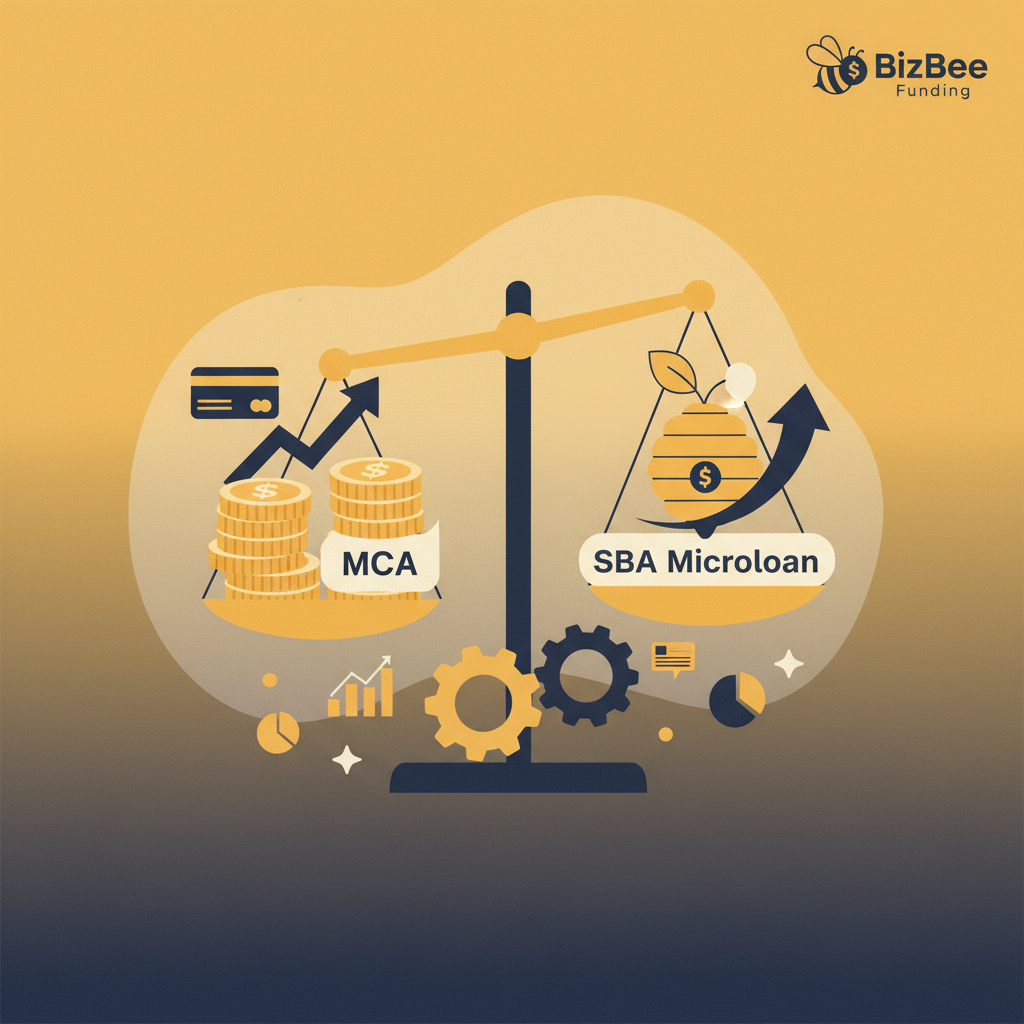
A Merchant Cash Advance (MCA) is better for businesses needing immediate cash (under 24 hours) with lower credit scores (500+) and strong daily sales, despite higher costs with factor rates from 1.14 to 1.50. An SBA Microloan is better for established businesses or startups with good credit (680+) and a solid business plan who can wait 30-90 days for lower-cost funds (6-13% APR) up to $50,000. Choose an MCA for speed and approval odds; choose an SBA loan for cost savings.
Advisor insight
"We see business owners get into trouble when they treat an MCA like a loan. The key is this: an MCA should solve a problem that pays for the cost of the advance within 60-90 days. If the ROI isn't clear and immediate, you are much better off fighting through the SBA process for cheap capital, no matter how painful the wait feels."
Key takeaways
Save this section — it summarizes the entire article.
- An MCA provides funds in under 24 hours, while an SBA Microloan application and funding process takes 30-90 days.
- SBA Microloans offer significantly lower interest rates (6-13% APR) compared to MCA factor rates, which can have an equivalent APR of 40% or more.
- MCA qualification is primarily based on monthly revenue (at least $10,000), whereas SBA Microloans require strong personal credit (680+), a detailed business plan, and often collateral.
- The maximum SBA Microloan amount is $50,000; MCAs can provide funding up to $250,000 or higher based on sales volume.
- MCA repayments are a percentage of future sales, which flexes with your cash flow. SBA Microloans have fixed, predictable monthly payments.
- If your bank said no, an MCA is often the most accessible option for businesses needing funds immediately.
- Using an MCA for a long-term, low-ROI project can lead to a debt cycle; they are best for short-term opportunities.
Already know what you need?
Skip the research — get matched to real offers in 2 minutes.
Featured snippet answer
Deciding between a Merchant Cash Advance (MCA) and an SBA Microloan depends entirely on your priorities: speed versus cost. An MCA is better if you need cash extremely fast—often within 24 hours—and have strong sales but weaker credit. Its cost is higher, with factor rates of 1.14-1.50. An SBA Microloan is better if your primary goal is the lowest possible cost. It offers bank-like interest rates (6-13% APR) but requires excellent credit (680+), extensive paperwork, and a 30-90 day waiting period for funding up to $50,000.
Topics covered
Section 1
The Fundamental Trade-Off: Immediate Speed vs. Long-Term Cost
When we talk to business owners, the choice between an MCA and an SBA Microloan almost always boils down to one question: 'What's more painful right now, a lack of cash or a high cost of capital?' Your answer to that question will point you directly to the right product.
A Merchant Cash Advance (MCA) is a purchase of a business's future receivables, providing funds in as little as 24 hours, whereas an SBA Microloan is a traditional government-backed loan that can take 30 to 90 days to fund. This difference in timing is the single most important factor. If your primary piece of equipment breaks down or a can't-miss inventory deal lands on your desk, waiting a month or more isn't an option. The speed of an MCA is its defining feature and primary benefit, designed specifically for these urgent scenarios.
We see the stress this causes every day. A restaurant owner with a broken walk-in freezer is losing thousands in spoiled food and closed doors. For them, the slightly higher cost of an MCA is insignificant compared to the cost of inaction. In contrast, an owner planning a dining room expansion six months from now has the luxury of time. They can afford to endure the lengthy SBA process to secure a 7% APR instead of a 1.35 factor rate, saving tens of thousands over the life of the financing.
It's crucial to understand that an MCA isn't technically a loan. It's a commercial transaction—the sale of your future revenue at a discount. This is why it doesn't have an 'interest rate' but a 'factor rate'. It's also why approval is based on your sales history, not just your credit score. This structure is a key reason that when your bank said no due to credit or lack of collateral, a fintech provider like BizBee can often say yes. The SBA Microloan, on the other hand, is a debt instrument with a fixed term and interest rate, just like a traditional bank loan.
Ultimately, this isn't just a financial decision; it's a strategic one. Are you plugging a hole in a sinking ship to get to shore (MCA), or are you building a new, better ship in the harbor (SBA Microloan)? Both are valid strategies, but using the wrong one can be disastrous. Using high-cost, short-term capital for a long-term, slow-return project is a common cause of the cash flow mistakes that can cripple a business.
Real-World Example: An Emergency Repair Saves a Restaurant
Situation: ‘Nonna’s Table,’ a popular Italian restaurant in Philadelphia, PA with $60,000 in monthly revenue, faced a crisis when their main dual-deck pizza oven failed on a Tuesday. A replacement oven and installation cost $22,000. Waiting for a bank loan would take weeks, forcing them to turn away a significant portion of their customers and potentially lose $20,000-$30,000 in revenue.
Outcome: The owner applied for a Merchant Cash Advance through BizBee Funding. Within 24 hours, they received a $25,000 advance. The oven was ordered Wednesday and installed by Friday. They lost minimal business and were fully operational for the weekend rush, which brought in $11,000. The MCA solved a problem that would have cost them far more than the financing itself.
Explore Merchant Cash Advances
Learn about the speed and flexibility of an MCA.
Understand SBA Loan Options
See if you have the time and qualifications for an SBA loan.
Why Your Bank Said No
Discover the advantages of fintech funding solutions.
How Business Funding Works
Get a high-level overview of your options.
Key takeaway
Your decision should be dictated by your timeline; if you need money this week, the MCA is your only viable path, but if you can wait two months, the SBA Microloan will always be cheaper.
At a Glance
MCA vs. SBA Microloan: Key Differences
A direct comparison of the most critical product features.
Funding Time
24 Hrs vs. 60 Days
Median time to funding
Typical Cost (APR Equiv.)
40%+ vs. 6-13%
Illustrative annual percentage rate
Max Amount
$250k+ vs. $50k
Based on sales vs. program limit
Section 2
Deep Dive: How a Merchant Cash Advance Really Works
Let's peel back the layers on the MCA. We see hundreds of businesses use these every month, so here's the advisor's perspective on when they are a brilliant tool and when they become a trap.
The cost of a Merchant Cash Advance is calculated using a factor rate, typically ranging from 1.14 to 1.50, which is multiplied by the advance amount to determine the total payback. Here is the key insight: a $20,000 MCA with a 1.25 factor rate means you will pay back a total of $25,000 ($20,000 x 1.25). The $5,000 difference is the cost of the capital. This fixed cost never changes, no matter how long it takes to pay back.
Repayment is where the MCA truly differs from a loan. Instead of a fixed monthly payment, a small, agreed-upon percentage of your daily sales (called a 'holdback') is automatically remitted to the funder. If you have a huge sales day, you pay back more. If you have a slow day, you pay back less. This flexibility is what prevents the cash flow crunches often caused by large, fixed loan payments. For a retail business with seasonal highs and lows, this can be a lifesaver.
MCAs get a bad reputation, and sometimes it's deserved. The danger lies in 'stacking'—taking out a second or third MCA before the first is paid off. We advise clients against this strongly. Each new advance eats further into your daily revenue until there's nothing left. An MCA should be a single, strategic transaction to generate a return that far exceeds its cost. It's not a revolving line of credit and using it like one is a fast path to financial distress, which is a key reason we encourage clients to talk to a funding advisor before committing.
The best use cases we see are for short-term, high-ROI needs. A construction contractor gets a $40,000 advance to buy materials for a new $100,000 job. A retail store gets a $15,000 advance to buy deeply discounted holiday inventory they can sell for a 3x markup. In these cases, the MCA is a bridge to immediate profit. It's less about the 'cost' and more about the 'net gain' from the opportunity it unlocks.
Negative Scenario: The Trucking Company's Debt Spiral
Situation: ‘Big Rig Logistics,’ a small trucking company in Dallas, TX with $40,000 average monthly revenue, was struggling with rising fuel costs. The owner, David, took out a $30,000 MCA with a 1.30 factor rate ($39,000 payback) to cover expenses, resulting in daily payments of about $325. However, two of his trucks then required unexpected major repairs. Panicked by the downtime, he 'stacked' a second $20,000 MCA from another company.
Outcome: David was now paying over $600 per day from his deposits to two different funders. This consumed nearly 50% of his daily revenue, leaving him unable to cover payroll. His cash flow evaporated, and within three months, he was forced to sell one of his trucks just to settle the advances. He avoided default, but the misuse of MCAs for operational shortfalls without a clear ROI plan crippled his company's growth for over a year.
Is an MCA Right for You?
Deep dive into MCA mechanics and use cases.
Explore Revenue-Based Financing
Learn about funding that is tied to your sales performance.
Compare MCAs and Term Loans
See how MCAs stack up against another popular option.
Funding for Restaurants
See financing options common in the food service industry.
Key takeaway
The MCA is a powerful tool for speed, but its cost demands a clear and immediate path to generating a return on the capital.
Tired of Juggling Multiple High Payments?
An MCA is powerful but risky if misused. Talk to a funding advisor who can model the real cost for your specific sales volume and see if a term loan or other option is a better fit.
MCA Example
Cost Breakdown: $20,000 Advance
Visualizing the fixed cost of a typical MCA.
Advance Amount
$20,000
Cash received by business
Factor Rate
1.25
Typical rate for a healthy business
Total Payback Amount
$25,000
$20,000 x 1.25
Total Cost of Funds
$5,000
The fixed fee for the advance
Decision framework
Use this to make your choice.
MCA or SBA Microloan: The 2-Minute Decision Framework
Choose a Merchant Cash Advance if…
- You are drowning in a cash flow emergency and need funds in your account within 24-48 hours, not next quarter.
- Your personal credit score is under 650, which automatically disqualifies you for most bank and SBA loans.
- You have consistent daily credit card or bank deposit revenue of at least $10,000 per month.
- You have an immediate, high-return opportunity, like buying discounted inventory that will be gone by next week.
- The thought of assembling a 50-page business plan and waiting months for a 'maybe' feels like a waste of time.
- You have been in business for at least 6 months.
Best for:
Business owners who must prioritize speed and high approval odds over cost to solve an urgent problem.
Choose an SBA Microloan if…
- Your top priority is securing the lowest possible interest rate to protect your long-term profitability.
- You have a strong personal credit score of 680 or higher and a clean financial history.
- Your funding need is $50,000 or less.
- You have the patience to navigate a 30 to 90-day application and underwriting process.
- You have a detailed business plan, financial projections, and personal financial statements ready to be scrutinized.
- You have some form of collateral or are willing to sign a personal guarantee.
Best for:
Patient, well-prepared business owners and startups focused on minimizing borrowing costs for planned growth.
Section 3
Deep Dive: What the SBA Microloan Process Demands
Now for the other side of the coin: the government-backed SBA Microloan. It's the gold standard for low-cost capital, but from what we've seen, the process can feel like training for a marathon you didn't know you signed up for.
SBA Microloans offer up to $50,000 with interest rates typically between 6% and 13% and are administered by non-profit, community-based intermediary lenders. A common misconception is that you apply directly to the SBA. In reality, the SBA guarantees a portion of the loan, which reduces the risk for the intermediary lender (often a local Community Development Financial Institution) who actually provides the capital and services the loan.
Here is the key insight: qualification for an SBA Microloan is a test of your business's historical health and future planning. Lenders will scrutinize your personal credit score, demanding a 680 or higher in most cases. You'll need a comprehensive business plan, 2-3 years of business and personal tax returns, and detailed financial projections. If your bookkeeping is messy or your plan is just an idea on a napkin, you will not get approved. This is the exact reason many businesses turn to fintech alternatives.
The timeline is the biggest hurdle for businesses in need. From initial application to funding, you should realistically budget for 30 to 90 days. The process involves multiple stages: application submission to the intermediary, a lengthy underwriting review, SBA approval, and finally, the loan closing. There can be back-and-forth requests for additional documentation at every stage. We tell our clients: if you can't patiently wait at least two months, the SBA path will only lead to frustration.
These loans are perfect for planned, strategic growth. We've seen clients use them to add a new service line to their healthcare practice, for a contractor to buy their first piece of heavy construction equipment, or for a successful e-commerce store to fund a major inventory expansion for a new product line. The low, fixed monthly payment and long repayment term (up to 6 years) make it easy to budget for and preserve precious working capital.
Real-World Example: A Patient Entrepreneur's Smart Growth
Situation: ‘Bloom & Grow,’ a floral design startup in Portland, OR, wanted to expand from a home-based business to a small retail and workshop space. The owner, Sarah, had a 740 credit score and a meticulously detailed business plan. She needed $35,000 for the lease deposit, store build-out, and a large initial cooler and flower inventory.
Outcome: Instead of seeking fast, expensive cash, Sarah applied for an SBA Microloan through a local CDFI. The process took 55 days. She was approved for the full $35,000 at a 7.5% interest rate with a 6-year term. Her monthly payment was a predictable $595. This low, fixed payment allowed her to manage her new overhead comfortably and reinvest profits into marketing, leading to a profitable first year. Her patience saved her over $10,000 in financing costs compared to an equivalent MCA.
Official SBA Microloan Information
Learn the specifics of the SBA program.
How to Improve Your Business Credit Score
A low score is a major barrier to SBA loans. Start fixing it now.
See All Funding Requirements
Compare the checklist for an SBA loan to other products.
Talk to an Advisor About Your Plan
Get help preparing for a rigorous application process.
Key takeaway
The SBA Microloan's unbeatable low cost is earned through a slow, meticulous process that rewards business owners with pristine credit and impeccable documentation.
SBA Process
Typical SBA Microloan Timeline
A realistic view of the time investment required.
Application & Documentation
1-2 Weeks
Gathering tax returns, business plan, etc.
Intermediary Underwriting
2-4 Weeks
Lender review and follow-up questions
SBA Approval & Closing
1-2 Weeks
Final guarantee and loan funding
Total Estimated Time
30-90 Days
From start to cash-in-hand
Section 4
Qualification Showdown: Who Actually Gets Approved?
Approval isn't a mystery; it's a checklist. Let's put the checklists for an MCA and an SBA Microloan side-by-side. For 9 out of 10 business owners we talk to, this is the chart that makes the decision for them.
MCA approval primarily depends on verifiable business revenue of at least $10,000 per month and a minimum of 6 months in business. This is the most important takeaway. Funders are buying your future sales, so the health and consistency of those sales are paramount. They will verify this by analyzing your last 3-6 months of bank statements. A low credit score can increase your factor rate, but it's rarely an automatic denial if your revenue is strong. We regularly secure MCAs for owners with credit scores in the mid-500s.
SBA Microloan approval hinges on the owner's personal credit score (ideally 680+), a comprehensive business plan, and often requires collateral. Here is the key insight: the SBA process is designed to vet the *borrower* as much as the business. They want to see a history of responsible credit use, a clear and plausible vision for the future, and a personal stake in the game (collateral or a personal guarantee). If you have a 610 credit score and no business plan, your chances of approval are effectively zero.
Documentation requirements highlight the difference in philosophy. For an MCA, the application is often one page, and all you need are your last 3 months of business bank statements. The entire process can be completed online in a few hours. For an SBA Microloan, the document list is extensive: a full business plan, 2-3 years of business and personal tax returns, interim financial statements (P&L, Balance Sheet), a personal financial statement, and resumes for all key personnel. It's a significant administrative lift.
Time in business is another key differentiator. Most MCA providers require just 6 months of operation. SBA intermediary lenders, while open to startups, heavily favor businesses with a 2-year track record of profitability. A startup can get an SBA Microloan, but the business plan and the owner's industry experience must be exceptionally strong to overcome the perceived risk of a new venture.
Check Our Funding Requirements
See the minimum criteria for our top funding products.
Steps to Improve Your Credit Score
Start improving your credit to qualify for better rates.
Get Pre-qualified in Minutes
A fast and easy way to see what you're eligible for.
Trucking Industry Funding Solutions
See financing options tailored for logistics companies.
Key takeaway
If your business has strong revenue but you have weak credit or no time for paperwork, the MCA is designed for you; if you have great credit and a solid plan, the SBA is your cheaper path.
Stop Guessing. Know What You Qualify For.
Feeling overwhelmed by the requirements? Our simple online application gives you a clear picture of what you can actually get approved for in minutes. It's free and won't affect your credit score.
Head-to-Head
Approval Checklist: MCA vs. SBA Microloan
Comparing the core requirements for each funding type.
Minimum Credit Score
500+
MCA: Revenue is key
Minimum Credit Score
680+
SBA: Character is key
Required Documents
3 Mos. Bank Statements
MCA: Simple & Fast
Required Documents
Full financial package & plan
SBA: Extensive & Slow
Section 5
Use Case Analysis: Matching the Funding to the Job
Using the wrong tool for the job is an expensive mistake we see all too often. A hammer is great for nails, but terrible for screws. Let's assign these funding products to the specific business needs where they excel.
A Merchant Cash Advance is best used for short-term, high-ROI needs like emergency equipment repair, seizing a bulk inventory discount, or bridging a seasonal cash flow gap. Here is the key insight: if the money you get today can generate more profit in the next 30-60 days than the total cost of the advance, it's a smart business move. We see this constantly in industries like construction and retail.
For example, an HVAC contractor in Phoenix needs $10,000 immediately to buy three commercial AC units for an emergency installation project that will pay $25,000 upon completion next week. Waiting for a loan means losing the job. An MCA is the perfect tool. Similarly, a clothing boutique gets an offer to buy $30,000 worth of designer overstock for just $8,000, but the offer expires in 48 hours. An MCA makes that profitable purchase possible.
Conversely, an SBA Microloan is ideal for long-term strategic investments such as purchasing new, non-emergency equipment, a planned business expansion, or securing stable working capital for a new business. Think of it as financing for planned projects, not panicked problems. The low interest rate and long term make the monthly payments small and manageable, which is crucial for investments that take months or even years to pay off.
We've helped clients secure SBA Microloans to finance the build-out of a new dental operatory in a growing healthcare practice or for a landscaping company to buy a new $40,000 mini-excavator to expand its service offerings. In both cases, the owners had months to plan. They weren't in a rush. They chose the slow, methodical, and cheap tool for a slow, methodical, and long-term project. Trying to fund that same excavator with a high-cost MCA would strain cash flow unnecessarily.
Financing for Construction Equipment
Learn about funding options for heavy machinery.
Term Loans for Planned Purchases
Explore another option for predictable, long-term financing.
Funding for HVAC Businesses
See financing tailored to HVAC contractors' needs.
Retail Industry Funding Guide
Understand the capital needs of retail businesses.
Key takeaway
Match the funding's timeline to the project's return timeline: use fast money for fast returns, and slow money for slow returns.
Right Tool for the Job
Ideal Use Cases
Where each funding type shines.
MCA Best For:
Emergency Repairs
e.g., Broken restaurant freezer
MCA Best For:
Opportunity Capital
e.g., Deeply discounted inventory
SBA Loan Best For:
Planned Expansion
e.g., Adding a second location
SBA Loan Best For:
New Equipment Purchase
e.g., Buying a new truck
Content cluster
This article is part of a connected knowledge base.
Related resources in this cluster
How business funding works
Get a foundational understanding of the entire business funding landscape.
Apply for Funding
Start our simple application to see your options in minutes.
Talk to a Funding Advisor
Get expert, one-on-one advice for your specific situation.
MCA vs Term Loans Explained
Compare two of the most common funding products.
Funding Requirements
See the minimum qualifications for all our funding solutions.
Construction Industry Funding
Explore financing options tailored for contractors.
Bank vs Fintech Lenders
Understand why alternative lenders can approve when banks won't.
FAQ
Questions business owners ask before applying
References
Sources cited in this article.
- [1]
- [2]
Federal Reserve Small Business Credit Survey
Federal Reserve
- [3]
- [4]
Next step
Ready to see what your business qualifies for?
BizBee Funding helps business owners compare real options quickly — with honest guidance on speed, cost, repayment, and fit. No pressure, no hidden agendas.
Take the next step
Funding products & guides
- Business line of creditRevolving access — interest only on what you draw.
- Business term loansLump-sum capital with predictable payments.
- Working capital loansCover payroll, inventory, and short-term gaps.
- How BizBee funding worksSoft pull, multiple offers, funded in 24–48 hours.
- Business loan FAQRates, credit, documents, and eligibility answered.
- More funding guidesBrowse the full library of owner-focused articles.