MCA vs Term Loan: Which is Right for Your Business in 2026?
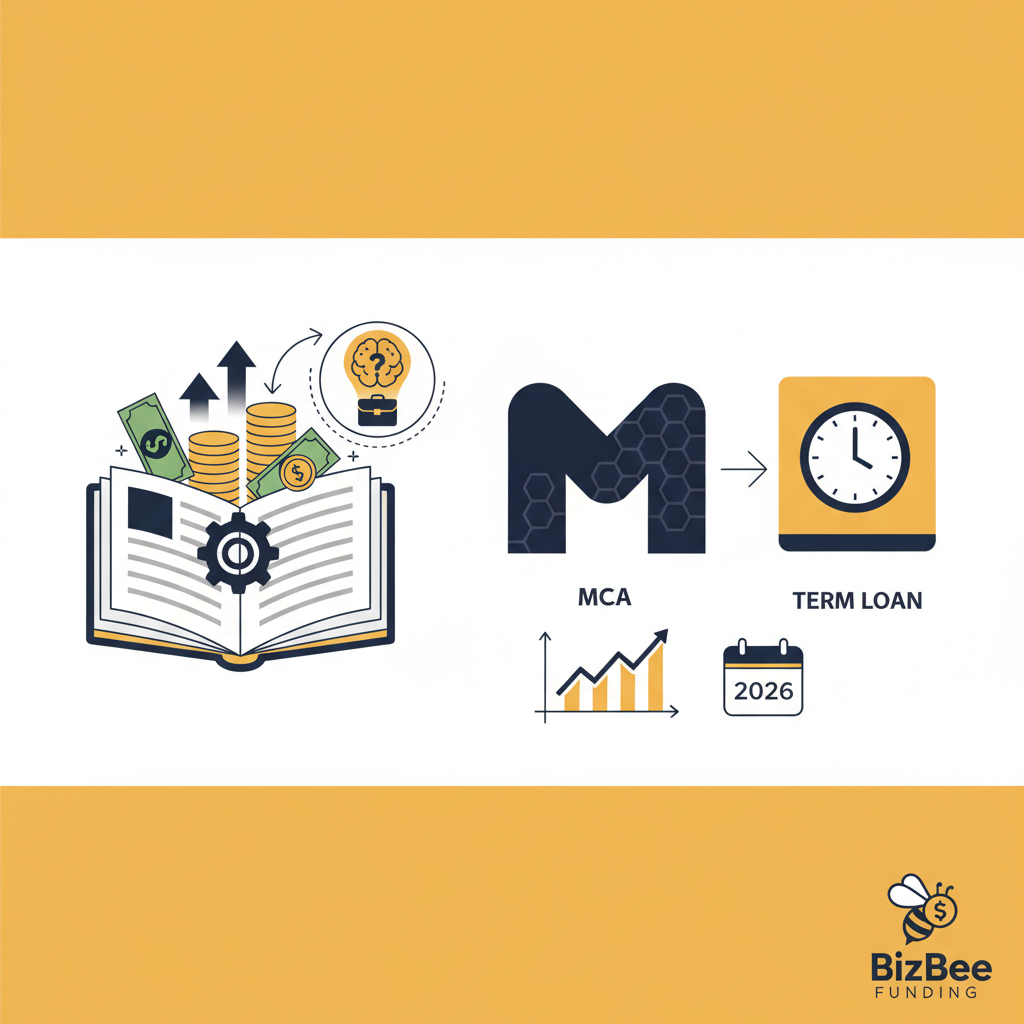
Choosing between an MCA vs term loan is a critical decision for your business's health. A Merchant Cash Advance offers unparalleled speed for urgent needs, while a term loan provides structured capital for long-term growth. We'll break down which is right for you.
By Chris Lewis — Senior Funding Advisor
12+ years • Small business working capital, lines of credit, and equipment financing
Quick answer
A Merchant Cash Advance (MCA) provides fast cash, typically in 24-48 hours, in exchange for a percentage of future sales, making it ideal for urgent needs or businesses with lower credit scores (550+). A business term loan offers a larger lump sum of capital with a fixed interest rate (7%-30% APR) and a structured repayment schedule over 2-10 years, which is best for planned growth and businesses with strong credit and financials.
Advisor insight
"If you can qualify for a term loan, take it — MCAs cost 2-4x more on an APR basis. MCAs only make sense when speed or credit issues block cheaper options."
Key takeaways
Save this section — it summarizes the entire article.
- Speed vs. Structure: MCAs fund in 24-48 hours, while Term Loans take 1-4 weeks.
- Cost Model: MCAs use factor rates (1.10 - 1.50), while Term Loans use Annual Percentage Rates (APR) (7% - 30%).
- Repayment Method: MCAs are repaid via a percentage of daily sales; Term Loans have fixed daily, weekly, or monthly payments.
- Best Use Case for MCA: Covering unexpected shortfalls, capitalizing on a quick opportunity, or when you need cash immediately.
- Best Use Case for Term Loan: Large, planned investments like equipment purchases, expansion, or real estate with a clear ROI.
- Credit Impact: Term loans can build your business credit score when paid on time. MCAs typically do not report to credit bureaus.
- Qualification: MCAs are easier to qualify for (550+ credit, $15K/mo revenue), while Term Loans have stricter requirements (680+ credit, 2+ years in business, strong profits).
Already know what you need?
Skip the research — get matched to real offers in 2 minutes.
Featured snippet answer
A Merchant Cash Advance (MCA) offers fast access to a lump sum of capital by selling a portion of your future revenue at a discount. Funding can happen in 24-48 hours, with repayment tied to your daily sales. In contrast, a business term loan provides a lump sum that you repay over a set period with a fixed interest rate (APR). Term loans are better for long-term projects and building credit but have stricter requirements and a longer application process (1-4 weeks).
Topics covered
Section 1
Deep Dive: The Merchant Cash Advance (MCA)
Let's be direct. When business owners come to us desperate for cash *yesterday*, a Merchant Cash Advance is often the tool we reach for. It’s not a traditional loan; it's a sale of your future revenue for immediate capital.
Here is the key insight: A Merchant Cash Advance (MCA) provides a lump sum of cash in exchange for a percentage of your future sales. It is one of the fastest forms of [fast business funding](/solutions/merchant-cash-advance) available. Instead of an interest rate (APR), the cost is determined by a factor rate. For example, if you receive $50,000 with a 1.30 factor rate, you'll pay back a total of $65,000 ($50,000 x 1.30).
The primary benefit we see clients rave about is speed. The application is simple, documentation is minimal (usually just bank statements), and funding can land in your account in 24 to 48 hours. This is a lifesaver when an essential piece of equipment breaks or payroll is due Friday and it's already Wednesday. This speed is why many owners choose this path even after [their bank said no](/blog/bank-vs-fintech) due to a lengthy process.
Repayment is where an MCA really differs. Instead of a fixed payment that can cripple you during a slow week, repayment is an agreed-upon percentage of your daily credit card sales (called a 'holdback'). If you have a huge sales day, you pay back more. If sales are slow, you pay back less. This flexible repayment structure automatically adjusts to your cash flow, which is a massive relief for businesses with fluctuating revenue, like those in the [restaurant](/industries/restaurants) or retail sectors.
However, that speed and flexibility come at a cost. When converted to an equivalent APR, MCAs can be significantly more expensive than traditional loans. They are a powerful tool for short-term needs, not a cheap solution for long-term financing. It's crucial to understand the total payback amount and ensure the return on the capital justifies the cost. Before taking one, it's wise to review common [cash flow mistakes](/blog/cash-flow-mistakes) to ensure the MCA solves a problem, rather than creating a new one.
- Funding Speed: 24-48 hours
- Cost Structure: Factor Rate (e.g., 1.15 - 1.50)
- Repayment: Percentage of daily sales (e.g., 10% - 20%)
- Credit Requirement: Generally 550+
- Best For: Urgent cash needs, covering revenue gaps, businesses with inconsistent sales.
Real-world scenario: An HVAC emergency
Situation: John's HVAC, a thriving business in Phoenix with $750,000 in annual revenue, faced a crisis. Two of his main service vans broke down simultaneously during a 110-degree heatwave. He needed $35,000 for repairs and loaner vehicles immediately to avoid losing thousands in daily service calls. His credit was fair (650) and he had no time to wait for a bank loan.
Outcome: John spoke to a BizBee [funding advisor](/funding-advisor) and secured a $35,000 MCA with a 1.25 factor rate within 36 hours. The total payback was $43,750. The daily payment was tied to his credit card receipts from service calls, so it was manageable. This quick injection of cash allowed him to get his vans serviced and back on the road in two days, saving an estimated $20,000 in lost business. For him, the $8,750 cost of the MCA was a smart investment.
Merchant Cash Advance Details
Learn more about how an MCA works.
Revenue-Based Financing Guide
Explore the broader category of financing tied to your revenue.
Why Your Bank Said No
Understand why fintech lenders can approve when banks won't.
Our Funding Requirements
Check the specific qualifications for an MCA.
Key takeaway
An MCA is your 'break glass in case of emergency' funding—incredibly fast and flexible, but designed for short-term problems, not long-term strategy.
MCA at a Glance
Merchant Cash Advance: Key Metrics
An MCA is defined by its speed and flexible repayment.
Time to Funding
24-48 Hours
vs. 1-4 weeks for loans
Typical Factor Rate
1.18 - 1.45
Total payback amount
Minimum Credit Score
550+
Focus is on revenue
Section 2
Deep Dive: The Business Term Loan
The business term loan is what most people picture when they think of 'business funding'. It’s structured, predictable, and, for the right business, the most cost-effective way to finance significant growth.
A business term loan provides a lump sum of capital that is repaid over a fixed period with a fixed interest rate. Here is the key insight: The primary benefit of a term loan is its predictability, with fixed payments over a set term, typically ranging from 2 to 10 years. You know exactly what you'll pay each month and exactly when the loan will be paid off. This structure is ideal for budgeting and long-range financial planning.
Term loans are the workhorses for planned expansion. We see clients use them to buy major assets, like the owner of a [construction](/industries/construction) company financing a new $200,000 crane or a healthcare practice buying a new MRI machine. Because the purpose is a long-term asset, the financing matches it. You can explore our specific options for [construction equipment financing](/blog/construction-equipment) to see how this works.
The cost is expressed as an Annual Percentage Rate (APR), which includes the interest rate and any fees. This makes it easier to compare offers apples-to-apples. For a qualified business, APRs can range from 7% to 30%. The tradeoff for this lower cost is a more stringent application process. We'll need to see at least two years of business history, strong revenue, profitability, and a good personal and business credit score (ideally 680+).
Unlike an MCA, making consistent, on-time payments on a [term loan](/solutions/term-loans) will be reported to business credit bureaus. This is a powerful way to [improve your business credit score](/blog/improve-credit-score) over time, which opens doors to even better funding options in the future. The entire process, from application to funding, typically takes between one and four weeks, so this isn't a solution for immediate emergencies.
- Funding Speed: 1-4 weeks
- Cost Structure: Annual Percentage Rate (APR) (e.g., 7% - 30%)
- Repayment: Fixed daily, weekly, or monthly payments
- Credit Requirement: Generally 680+
- Best For: Planned investments, equipment purchase, expansion, building business credit.
Business Term Loans Overview
Get an in-depth look at our term loan products.
How to Improve Your Business Credit
Learn strategies for boosting your credit to get better loan terms.
Construction Equipment Financing
See a specific use case for term loans in the construction industry.
How It Works at BizBee
Understand our application and funding process.
Key takeaway
A term loan is a strategic tool for established businesses to finance growth with predictable costs and credit-building benefits.
Planning a Big Move? Fund it the Smart Way.
A term loan provides the predictable, low-cost capital you need for expansion. See if you qualify for our competitive rates.
Term Loan at a Glance
Business Term Loan: Key Metrics
A term loan is defined by its structure and predictability.
Time to Funding
1-4 Weeks
Requires full underwriting
Typical APR
7% - 30%
Based on credit & cash flow
Minimum Credit Score
680+
Strong financials required
Decision framework
Use this to make your choice.
MCA or Term Loan: Which One Solves Your Problem?
Choose a Merchant Cash Advance if…
- You need cash in your account in under 48 hours for an emergency or opportunity.
- Your revenue is strong ($15K+/month) but your credit score is below 680.
- You've been told 'no' by your bank and can't afford to wait.
- Your sales are seasonal, and a fixed payment would be crippling in slow months.
- The cost of *not* getting the money today is higher than the cost of the funds.
Best for:
Business owners who need immediate cash to solve an urgent problem and value speed and flexible repayment over the lowest possible cost.
Choose a Term Loan if…
- You are making a large, planned investment with a predictable return on investment.
- Your business has been operating for 2+ years with strong, consistent profits.
- You have a good-to-excellent credit score (680+).
- You want a predictable, fixed monthly payment and the lowest possible interest rate.
- You have time (1-4 weeks) to go through a more detailed underwriting process.
Best for:
Established business owners with strong financials who want to finance long-term growth with a structured, low-cost loan.
Section 3
Head-to-Head: Cost, Speed, and Repayment
When you're under pressure, the details can get blurry. Let's put the MCA and term loan side-by-side on the three factors that matter most to your bottom line and your sanity: speed, cost, and how you pay it back.
Here is the key insight: The fundamental difference in the MCA vs term loan debate is speed versus cost. An MCA delivers capital in 1-2 days at a higher cost, while a term loan takes 1-4 weeks but offers a much lower cost via an APR. Your choice depends entirely on which of those factors is more important for your specific situation. There is no single 'better' option; there is only the right tool for the job at hand.
Let's talk cost, because this is where most business owners get confused. The total cost of an MCA is calculated using a factor rate, typically ranging from 1.10 to 1.50. This is simple multiplication: $100,000 advance x 1.40 factor rate = $140,000 total payback. A term loan uses APR. A $100,000 loan at 12% APR over 3 years will have a total payback of around $119,571. While the APR is a more familiar metric, a factor rate gives you a clear, fixed total cost upfront. The danger lies in misunderstanding how quickly you'll pay back that MCA, which can make its effective APR very high.
Repayment structure is the next critical battleground. A term loan’s fixed payment is great for predictability but can be a nightmare if your revenue drops. We’ve seen businesses struggle to make a $2,500 weekly loan payment during a slow month. An MCA’s repayment, a percentage of sales, is a built-in shock absorber. This is particularly valuable for [retail funding](/industries/retail), where holiday peaks are followed by January slumps. That said, the daily withdrawals from an MCA can feel like a constant drain on cash flow for businesses not accustomed to it.
Finally, qualification is a major fork in the road. Term loans are reserved for businesses that look great on paper: 2+ years in business, strong profits, and a 680+ credit score. Our [funding requirements page](/requirements) goes into more detail. An MCA is accessible to a much broader range of businesses, including newer ones (6+ months) and those with bruised credit (down to 550), as long as they have consistent monthly revenue of at least $15,000. It's often the most viable option when you need a flexible alternative financing solution.
Real-world negative outcome: The MCA stacking trap
Situation: Sarah, owner of 'The Cozy Corner Bookstore' in Portland with $400,000 annual revenue, wanted to do a $30,000 renovation. Panicked by a slow quarter and a 620 credit score, she took a $30,000 MCA with a 1.40 factor rate ($42,000 payback). The daily payment of $250 was more than she expected. Two months later, cash flow was so tight from the daily debits that she took another $20,000 MCA from a different company just to make payroll. This is called 'stacking'.
Outcome: Now, Sarah had two daily payments totaling over $450. Her cash flow was completely choked. Within six months, her business was insolvent. She had turned a manageable $30,000 funding need into a crippling $75,000+ debt obligation she couldn't escape. Had she spoken to an advisor, she might have explored a smaller, more strategic MCA or a [business line of credit](/solutions/line-of-credit) to manage the project in phases, avoiding the death spiral of stacking.
MCA vs Term Loans Blog
This very article is the central hub for this comparison.
Business Line of Credit Guide
Explore a third option that combines flexibility with a more traditional structure.
Retail Industry Funding
See how financing works for businesses with seasonal revenue.
Funding Requirements
Compare the qualification criteria for different products side-by-side.
Key takeaway
Choosing correctly means honestly assessing if you need to prioritize immediate access to cash or the lowest long-term cost.
Comparison Matrix
MCA vs. Term Loan: The Core Differences
Visualizing the key tradeoffs between the two products.
Typical Funding Amount
$10k - $250k (MCA) vs. $25k - $2M (Loan)
Scope of projects
Repayment Frequency
Daily/Weekly (MCA) vs. Weekly/Monthly (Loan)
Impact on cash flow
Primary Approval Factor
Revenue (MCA) vs. Credit/Profit (Loan)
What underwriters look for
Section 4
The Right Tool for the Right Job: Application Scenarios
As funding advisors, our main job is to match the problem to the solution. Using an MCA for a 10-year expansion plan is like using a hammer to turn a screw. Here’s when we see smart business owners choose each option.
Choose a Merchant Cash Advance when speed is your primary concern. Here is the key insight: An MCA is the ideal tool when the cost of *not* having money today is greater than the cost of the funds themselves. This applies to emergency repairs, covering unexpected payroll gaps, or seizing a time-sensitive inventory opportunity. For example, a [trucking company](/industries/trucking) that needs an immediate $15,000 engine repair to get a truck back on the road can't afford to wait two weeks for a loan—the lost revenue would be far more than the MCA's factor rate.
Another prime use case for an MCA is for businesses with inconsistent or highly seasonal revenue. Think of a landscaping company or a coastal [restaurant](/industries/restaurants). Their revenue in July is massive, but in January it's a trickle. A fixed term loan payment would be a disaster in the off-season. An MCA's repayment ebbs and flows with their sales, providing critical breathing room during lean times while paying down the balance faster during peak season.
Choose a Term Loan for planned, strategic investments with a clear and calculable return. Here is the key insight: A term loan is best used to purchase an asset or fund a project that will increase revenue or efficiency over the long term. This is 'growth capital'. Examples we see daily include a manufacturing plant buying a new CNC machine to increase output by 30%, a dental practice expanding its office, or a [construction firm](/industries/construction) acquiring a smaller competitor.
A term loan is also the superior choice when your primary goal is to build a strong financial foundation for your business. By securing a loan and making timely payments, you're building a credit history that will unlock larger, cheaper funding options down the line, including bank-rate [SBA loans](/solutions/sba-loans). It's a stepping stone. If you have the time and the financial strength to qualify, a term loan is almost always the more prudent choice for financing long-term growth.
Real-world scenario: The strategic term loan for growth
Situation: Dynamic Design & Print, a commercial printing company in Charlotte with $1.5M in annual revenue, wanted to purchase a new digital press for $250,000. The owner, Mark, had a 740 credit score and 5 years of profitable tax returns. The new press was projected to increase his capacity by 40% and open up a new line of high-margin business.
Outcome: Mark worked with BizBee Funding to prepare a loan package. It took three weeks, but he was approved for a $250,000 [term loan](/solutions/term-loans) at an 8.5% APR over 7 years. His monthly payment was a predictable $3,945. Within 18 months, the new press had generated over $400,000 in new revenue, easily covering the loan payments and significantly boosting his company's bottom line and valuation. He used the right tool for a strategic, long-term investment.
Talk to a Funding Advisor
Get personalized advice on which product fits your specific business need.
Trucking Industry Funding
See funding options for businesses with high-cost, high-urgency repairs.
SBA Loans Information
Learn about the next step up in business financing.
Business Line of Credit
Consider a flexible alternative that can cover both short-term and long-term needs.
Key takeaway
Match the funding timeline to the project timeline: use short-term funding (MCA) for short-term problems and long-term funding (Term Loan) for long-term growth.
Feeling Stuck Between Speed and Cost?
You don't have to guess. Our funding advisors can analyze your situation in a free, no-obligation call and map out the best path forward.
Use Case Analysis
When to Use Which Funding
Matching the business scenario to the correct financial product.
MCA: Best Scenario
Emergency Repair
e.g., A broken-down delivery truck
Term Loan: Best Scenario
Asset Purchase
e.g., Buying new medical equipment
Gray Area
Inventory Purchase
Depends on urgency and ROI
Section 5
A Realistic Look at Qualification: MCA vs. Term Loan
The best funding option in the world doesn't matter if you can't get approved. Here's what we, as underwriters, actually look for when you apply for an MCA versus a term loan. It comes down to what you're asking us to bet on.
When you apply for a Merchant Cash Advance, we are primarily betting on your future revenue. Here is the key insight: The most important factor for MCA approval is consistent monthly sales, typically requiring a minimum of $15,000 per month for at least 6 months. Your credit score is secondary. We regularly approve clients with credit scores as low as 550 because we can see strong, reliable daily deposits in their bank account. The application focuses on your last 4-6 months of bank statements and credit card processing statements. That’s it. It’s a health check-up on your business’s current cash flow.
We also look at your industry. Certain industries, like [restaurants](/industries/restaurants), retail, and auto repair, are a natural fit for MCAs because they have high volumes of credit card transactions, making repayment simple. The time in business requirement is also much lower, often just 6-12 months. This makes MCAs an accessible entry point to business funding for newer companies who haven't had time to build up years of financial history required by most [bank vs. fintech](/blog/bank-vs-fintech) lenders.
For a business term loan, we are betting on the long-term stability and profitability of your entire enterprise. Here is the key insight: Qualifying for a term loan requires at least two years in business, a personal credit score above 680, and demonstrable annual profitability. We're not just looking at revenue; we need to see that you manage expenses well and retain profit at the end of the year. Your application will require more documentation: 2 years of tax returns (business and personal), profit & loss statements, balance sheets, and a debt schedule.
Your credit history is paramount for a term loan. A strong track record of paying debts on time proves you are a low-risk borrower, which is how you secure a low APR. If your score is low, your first step should be to focus on how to [improve your business credit score](/blog/improve-credit-score). While we can sometimes find term loans for scores in the mid-600s, the rates will be significantly higher, often 20%+, blurring the cost advantage over other products like a [business line of credit](/blog/business-line-of-credit).
Detailed Funding Requirements
See a full breakdown of what you'll need to apply.
Start Your Application
Our simple online form can pre-qualify you in minutes.
How to Improve Your Business Credit Score
Take steps now to qualify for better financing tomorrow.
Bank vs. Fintech Lenders
Learn why our requirements differ from a traditional bank.
Key takeaway
MCA qualification is about proving your *current* revenue; Term Loan qualification is about proving your *past* profitability and creditworthiness.
Qualification Checklist
Who Gets Approved?
A side-by-side look at the key approval criteria for each product.
Minimum Time in Business
6 Months (MCA) vs. 2 Years (Loan)
Proven track record
Minimum Monthly Revenue
$15,000 (MCA) vs. $25,000+ (Loan)
Loan requires higher volume
Key Document
Bank Statements (MCA) vs. Tax Returns (Loan)
Current cash flow vs. long-term profit
Content cluster
This article is part of a connected knowledge base.
Related resources in this cluster
How business funding works
Get a foundational understanding of the entire business funding landscape and how it all fits together.
Apply for funding
Start our simple application to see what funding options you qualify for in minutes.
Talk to a funding advisor
Schedule a free consultation with an expert to discuss your specific situation.
Funding requirements
See the baseline qualifications for our various funding products.
Improve Business Credit Score
Learn actionable steps to boost your business credit and qualify for better rates.
Restaurant Funding Solutions
Discover funding options specifically designed for the unique challenges of the restaurant industry.
Why Your Bank Said No
Understand the differences between traditional banks and modern fintech lenders.
FAQ
Questions business owners ask before applying
References
Sources cited in this article.
- [1]
- [2]
Federal Reserve: Small Business Credit Survey
Federal Reserve
- [3]
- [4]
Next step
Ready to see what your business qualifies for?
BizBee Funding helps business owners compare real options quickly — with honest guidance on speed, cost, repayment, and fit. No pressure, no hidden agendas.
Take the next step
Funding products & guides
- Business line of creditRevolving access — interest only on what you draw.
- Business term loansLump-sum capital with predictable payments.
- Working capital loansCover payroll, inventory, and short-term gaps.
- How BizBee funding worksSoft pull, multiple offers, funded in 24–48 hours.
- Business loan FAQRates, credit, documents, and eligibility answered.
- More funding guidesBrowse the full library of owner-focused articles.