Working Capital Loan vs Term Loan: The 2026 Advisor's Guide
Choosing between a working capital loan vs a term loan is critical for your business's financial health. We break down which to use for short-term needs versus long-term growth.
By Chris Lewis — Senior Funding Advisor
12+ years • Small business working capital, lines of credit, and equipment financing
Quick answer
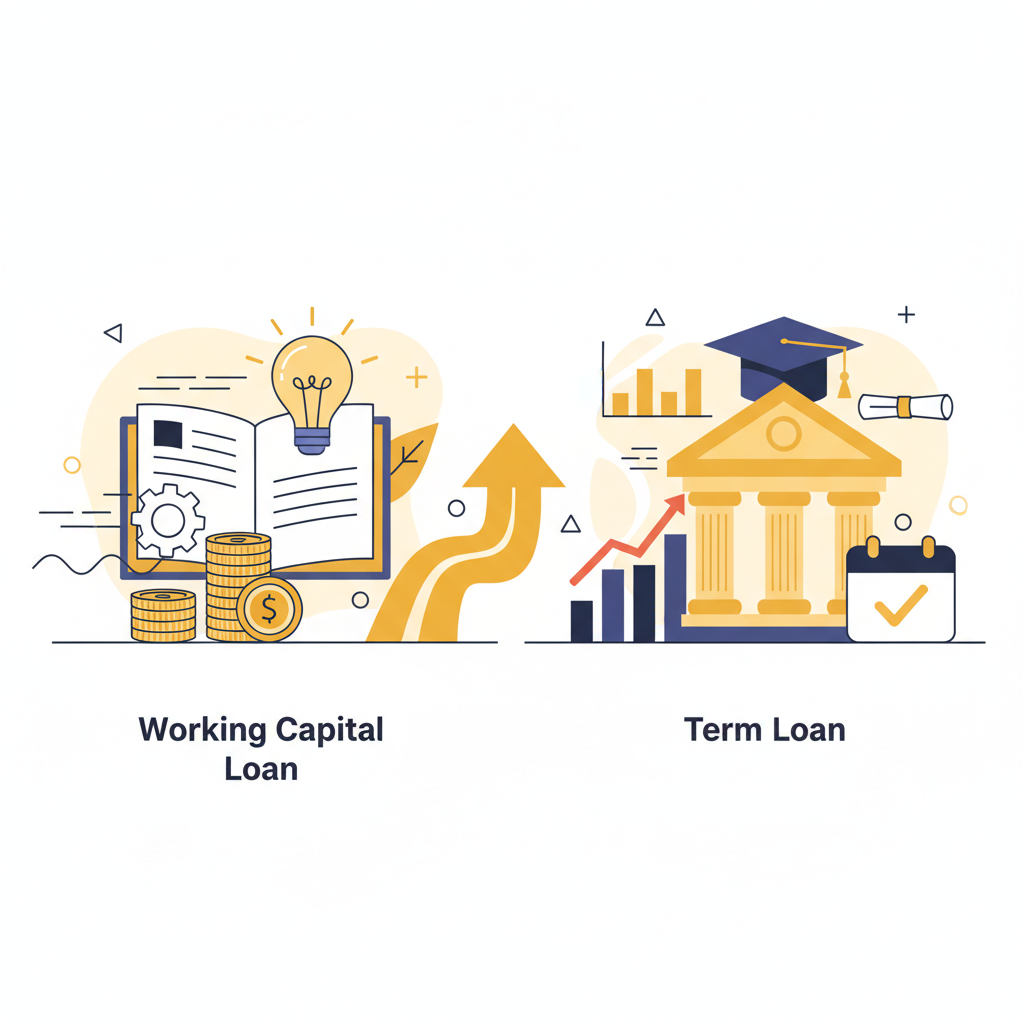
A working capital loan is short-term (3-18 months) financing used for daily operations like payroll or inventory, with faster funding and more frequent payments. A business term loan is long-term (2-10 years) financing for large, one-time investments like equipment or real estate, featuring lower rates and fixed monthly payments. The choice depends entirely on your specific business need and expected return on the capital.
Advisor insight
"I tell every business owner the same thing: don't get mesmerized by a low interest rate on a term loan if your problem is a cash flow gap you need to solve in 48 hours. The most expensive loan is the one that's wrong for the job."
Key takeaways
Save this section — it summarizes the entire article.
- Working capital loans are for short-term needs (3-18 months); term loans are for long-term investments (2-10 years).
- Use working capital for recurring expenses like payroll and inventory. Use term loans for singular, large purchases like equipment or expansion.
- Expect to repay working capital loans with daily or weekly payments, whereas term loans use standard monthly payments.
- Funding speed is a major difference: working capital can be funded in 24-48 hours, while term loans can take several weeks.
- Interest rates are typically higher on working capital loans (starting around 15% APR) than on term loans (often 7-12% APR) due to the shorter term and higher risk.
- Mismatching the loan type to the need is a costly mistake; never use a long-term loan for a short-term problem.
- Your business's cash flow pattern should dictate your choice: fluctuating daily revenue suits working capital, while stable monthly profits can support a term loan.
Already know what you need?
Skip the research — get matched to real offers in 2 minutes.
Featured snippet answer
A working capital loan provides short-term funds (typically $10,000 to $500,000) for daily business operations, repaid over 3 to 18 months. A term loan provides a lump sum of capital (often $50,000 to $2 million) for long-term investments like equipment or expansion, repaid over 2 to 10 years with fixed monthly payments. The primary difference is the use of funds: working capital smooths out cash flow, while term loans finance growth assets.
Topics covered
Section 1
The Anatomy of a Working Capital Loan: Your Business's Lifeline
As advisors, we see business owners turn to working capital loans when they're in a tight spot. This isn't a 'growth' loan; it's a 'survival and opportunity' loan. It's the tool you use to bridge the gap between accounts receivable and accounts payable.
A working capital loan is a short-term financing instrument designed specifically to cover a business's everyday operational expenses. Think of it as a cash flow buffer, not a source for major expansion. The primary purpose is to ensure you have enough cash on hand to manage payroll, purchase inventory, pay rent, and handle other immediate costs while you wait for customer payments to come in. We typically see these loans range from $10,000 to $500,000, with repayment terms between 3 and 18 months.
The repayment structure is a key differentiator. Unlike the predictable monthly payments of other loans, working capital financing, such as a Merchant Cash Advance, often involves more frequent payments—either daily or weekly. Here is the key insight: this structure is designed to align with your business's daily cash flow, taking a small, manageable percentage of sales rather than a large chunk from your monthly profits. This helps avoid the cash flow crunches that can cripple a business, a common issue we help clients navigate from their past [5 cash flow mistakes that kill small businesses](/blog/cash-flow-mistakes).
Speed is the single greatest advantage. When a critical piece of equipment fails or a huge, unexpected order comes in, you don't have weeks to wait for a bank's decision. We consistently see clients receive approvals for working capital products within hours and have funds—often up to $250,000—in their account in as little as 24 hours. This speed is what allows you to solve problems and seize opportunities instantly, something a traditional bank simply can't offer, which is why when your [bank said no, fintech is better](/blog/bank-vs-fintech).
It's important to understand the cost. Because these loans are short-term, higher-risk, and unsecured, the rates are higher than a traditional term loan. Instead of a simple APR, you'll often see a factor rate (e.g., 1.25), meaning you'd repay $1.25 for every $1 borrowed. While the APR equivalent can seem high, the focus should be on the return on investment. If a $20,000 loan to buy quick-turn inventory generates $50,000 in revenue, the cost of capital is easily justified. For businesses with fluctuating income, [revenue-based financing](/blog/revenue-based-financing) is an excellent alternative that serves a similar purpose.
- **Best For:** Covering payroll, purchasing inventory, marketing campaigns, bridging cash flow gaps.
- **Loan Amounts:** Typically $10,000 - $500,000.
- **Repayment Term:** 3 - 18 months.
- **Repayment Schedule:** Daily or weekly automated debits.
- **Funding Speed:** As fast as 24-48 hours.
- **Credit Requirement:** More flexible, often accessible for scores of 550+.
Real-World Scenario: Restaurant Recovers from a Slump
Situation: Carla, owner of 'The Saffron Table,' a popular restaurant in Austin, TX with $750,000 in annual revenue, faced a sudden crisis. Her main walk-in freezer died on a Monday, and a slow sales month left her with only $4,000 in the bank. The replacement cost was $18,000. Without it, she'd lose thousands in inventory and couldn't operate for the upcoming weekend, which typically brought in $15,000 in sales.
Outcome: Carla applied with BizBee Funding on Monday afternoon. By Tuesday morning, she was approved for a $25,000 working capital loan. The funds were in her account by Tuesday evening. She purchased the new freezer, saved her inventory, and had a record-breaking weekend. The loan was structured with a daily repayment of roughly $150 over 10 months, a tiny fraction of her daily sales that she barely noticed. Here is the key insight: The speed of the working capital loan saved her at least $15,000 in lost revenue for a total cost of capital of around $6,000.
Merchant Cash Advance
Learn about MCA, a popular type of working capital financing.
Business Line of Credit
Explore another flexible option for managing cash flow.
cash flow mistakes
Understand common financial pitfalls to avoid.
Restaurant industry funding
See funding options tailored for restaurant owners.
Key takeaway
Working capital loans are a strategic tool for managing short-term operational needs, valued for their speed and alignment with daily revenue cycles.
Working Capital Loan
Typical Loan Profile
Key metrics for a standard working capital advance.
Funding Time
24-72 Hours
For amounts up to $500k
Typical Term
6-12 Months
Short-term focus
Repayment
Daily/Weekly
Based on sales volume
Section 2
Deconstructing the Business Term Loan: Fuel for Major Growth
When a client comes to us with a detailed business plan for a major, long-term investment, we immediately start the conversation about term loans. This is your classic loan: borrow a large sum, pay it back monthly over several years, and use it to acquire an asset that will generate value for the long haul.
A business term loan is a lump sum of capital that you borrow and repay over a set period with fixed monthly payments. This is the financing structure most people think of when they hear 'business loan.' These loans are designed for significant, planned investments that will increase your company's value or revenue-generating capacity over time. We see these loans used for things like buying commercial real estate, undertaking a major renovation, or financing expensive, long-lasting equipment.
The loan amounts and terms are substantially different from working capital. Term loans typically start around $25,000 and can go into the millions, with repayment periods ranging from 2 to 10 years, and sometimes even longer for real estate. An SBA 7(a) loan, a popular type of government-backed term loan, can have terms up to 25 years. This long-term structure results in a lower, more predictable monthly payment, making it easier to budget for over the long run compared to the fluctuating payments of [revenue-based financing](/blog/revenue-based-financing).
Here is the key insight: The qualification criteria for term loans are much stricter than for working capital loans. Lenders are taking a bigger risk over a longer period. They'll want to see at least 2-3 years of business history, strong and consistent annual revenues (usually $250,000+), solid profitability, and good personal and business credit scores (typically 680+). The application process is more involved, requiring a full business plan, financial statements, and tax returns. The entire process from application to funding can take anywhere from two weeks to two months, a stark contrast to quick working capital. If your credit is a concern, learning how to [improve your business credit score in 90 days](/blog/improve-credit-score) should be your first step.
The primary benefit of a term loan is its lower cost of capital. With strong qualifications, businesses can secure term loans with APRs ranging from 7% to 12%. This makes them ideal for large purchases where a high interest rate would erase the potential profit. For example, a trucking company financing a new $150,000 rig will find the monthly payments on a 5-year, 9% APR term loan far more manageable than any short-term option. Knowing the difference between an [MCA vs term loan](/blog/mca-vs-term-loans) is fundamental to making a smart financing decision for your company's future.
- **Best For:** Buying real estate, major equipment purchases, business acquisition, expansion projects.
- **Loan Amounts:** Typically $25,000 - $2,000,000+.
- **Repayment Term:** 2 - 10 years (or more for real estate).
- **Repayment Schedule:** Fixed monthly payments.
- **Funding Speed:** 2 - 8 weeks.
- **Credit Requirement:** Stricter, typically 680+ FICO and strong financials required.
Term Loans
Review the features and benefits of our term loan products.
SBA Loans
Learn about government-backed term loan options.
how to improve credit score
Get actionable tips for boosting your business credit.
MCA vs Term Loans Explained
Read our in-depth comparison of these two funding types.
Key takeaway
Term loans provide the affordable, long-term capital necessary for significant business investments, but require a strong financial history and a longer application process.
Planning a Big Move? Let's Build a Plan.
A term loan can fuel your biggest ambitions. Our advisors can help you navigate the process and structure the right loan for your expansion or equipment purchase.
Business Term Loan
Typical Loan Profile
Key metrics for a standard long-term business loan.
Funding Time
2-8 Weeks
Due to extensive underwriting
Typical Term
3-7 Years
For long-term assets
Repayment
Monthly
Fixed, predictable payments
Decision framework
Use this to make your choice.
Which loan is right for your immediate need?
Choose a Working Capital Loan if...
- You are facing a temporary cash flow gap and need to cover payroll or inventory.
- You need funding in under 72 hours to seize an opportunity or solve a problem.
- The revenue-generating activity will happen in the next 3-12 months.
- You have strong daily or weekly sales but inconsistent monthly profits.
- You're struggling with multiple, high-cost cash advances and need to consolidate.
- Your personal credit score is below 680, making traditional loans difficult to secure.
Best for:
Businesses needing fast, flexible cash for immediate operational expenses and opportunities.
Choose a Term Loan if...
- You are buying a major asset (equipment, vehicle, real estate) that will last for years.
- You are planning a major business expansion or renovation project.
- You have at least 2 years in business and strong, consistent monthly profitability.
- You can wait 2-6 weeks for the funding process to complete.
- Your business and personal credit scores are both above 700.
- You want a predictable, fixed monthly payment over a multi-year period.
Best for:
Established businesses making a significant, long-term investment in growth assets.
Section 3
The Wrong Tool for the Job: Why Use-of-Funds is Everything
Here is the single most important piece of advice we give clients: you must match the financing tool to the job at hand. Using a long-term loan for a short-term problem is like using a sledgehammer to hang a picture frame. It creates more problems than it solves and can put your business in serious jeopardy.
The core difference in the working capital loan vs term loan debate boils down to one question: what will you do with the money? A working capital loan is designed for expenses that cycle through your business quickly. Here is the key insight: The capital is used for an activity (like buying inventory) that generates revenue within the loan's short 3-18 month term, allowing the loan to essentially pay for itself. The goal is to smooth out the lumpy, unpredictable nature of cash flow common in industries like [retail](/industries/retail) or restaurants.
A term loan, conversely, is for acquiring assets. The asset itself—be it a new building, a CNC machine, or a fleet of trucks—is the long-term value generator. The loan's extended 2-10 year term is designed to match the useful life of that asset. You're making a calculated bet that the asset will generate enough new, sustained profit over many years to more than cover the fixed monthly loan payments. This is the standard financing model for predictable, capital-intensive businesses like [construction](/industries/construction) or [trucking](/industries/trucking).
The danger lies in the mismatch. Let's say you take a $50,000, 5-year term loan to make payroll during a slow quarter. Your monthly payment might be a manageable $1,000. The immediate problem is solved. But now, for the next 60 months, you have a $1,000 payment obligation tied to an expense that produced no long-term value. That capital is gone. This is a common path to what we call 'debt stacking,' where businesses take on successive loans to cover the payments from previous, mismatched loans.
On the flip side, using a high-cost, short-term working capital loan to buy a major piece of equipment is equally foolish. You'd be stuck with massive weekly payments for an asset that might not generate its full revenue potential for years. The high cost of capital would eat away at your margins, and the aggressive repayment schedule would strangle your cash flow. Understanding this fundamental principle is the first step in our '[how business funding works](/how-it-works)' educational process with new clients.
- **Working Capital Use Case:** A coffee shop spends $15,000 on beans and milk, which they sell for $45,000 over the next 30 days.
- **Term Loan Use Case:** The same coffee shop gets a $75,000 term loan to build a drive-thru, which will increase sales by 20% annually for the next 10 years.
- **The Mismatch Risk:** Using a term loan for inventory results in long-term debt for a short-term need.
- **The ROI Principle:** The return on the funded activity must exceed the cost of the capital within the loan's term.
- **Advisor Question:** 'Will this money be gone in 90 days, or will it still be making you money in 3 years?' The answer tells you which loan you need.
Negative Outcome: A Landscaper's Term Loan Mistake
Situation: Frank, owner of 'GreenScape Pro' in Charlotte, NC, had a successful landscaping business doing $400,000 annually. He hit a temporary cash crunch in the spring due to delayed client payments and needed $30,000 to cover payroll and buy fertilizer for Q2 jobs. Instead of a working capital loan, his local bank offered him a $50,000 5-year term loan at 8% APR because his credit was good. He took it, thinking the low rate was a great deal.
Outcome: Frank used $30,000 for the immediate needs and, with no plan for the other $20,000, bought some non-essential tools. The immediate crisis was averted, but now he was saddled with a $1,005 monthly payment for the next 60 months. The payroll money was gone, and the fertilizer was used up by July. By winter, when business slowed down, the $1,005 monthly payment became a huge burden, choking his cash flow and forcing him to seek a high-cost cash advance just to cover the term loan payments. He traded a 3-month problem for a 5-year headache.
How business funding works
A high-level overview of the funding process.
Construction Equipment Financing
See how term loans apply to specific equipment needs.
Talk to a funding advisor
Get expert guidance on matching your need to the right product.
HVAC industry funding
Funding solutions for HVAC contractors.
Key takeaway
The purpose of the funds—short-term operations vs. long-term assets—is the single most critical factor in deciding between a working capital loan and a term loan.
Matching Loan to Need
Use of Funds Decision Matrix
Aligning your business expense with the correct financing tool.
Expense Type
Operational (e.g., payroll)
-> Use Working Capital Loan
Expense Type
Asset (e.g., equipment)
-> Use Term Loan
ROI Timeline
< 18 Months
-> Use Working Capital Loan
ROI Timeline
> 2 Years
-> Use Term Loan
Section 4
By the Numbers: Rates, Speed, and Qualification
When we lay out the options for a client, we put the numbers on the table side-by-side. The differences in cost, speed, and requirements are not subtle. Understanding these metrics is key to managing your expectations and making a financially sound decision for your business.
Interest rates and overall cost are often the first thing business owners look at, and the contrast is stark. A business term loan, especially an SBA-backed one, can have an Annual Percentage Rate (APR) as low as 7-12% for well-qualified borrowers. Here is the key insight: The long-term, secured nature of these loans reduces the lender's risk, which translates to a lower rate for you. Working capital loans, including MCAs, are priced differently. They typically use a factor rate, and their equivalent APRs can range from 20% to over 80%. This isn't 'good' or 'bad'—it's a reflection of risk and speed. The higher cost buys you immediate access to unsecured capital with flexible qualifications.
Funding speed is the second major battleground in the working capital loan vs term loan comparison. If you need money by Friday, a term loan is not an option. The underwriting process for a term loan is exhaustive, involving deep dives into your financials, credit history, and business plan. A typical timeline is 2 to 8 weeks. Conversely, a [working capital loan](/solutions/merchant-cash-advance) can be secured in as little as 24 hours. Our online application takes minutes, approval can happen the same day, and funds are often wired by the next business day. This speed is a crucial strategic advantage for businesses that need to be nimble.
Finally, let's talk about what it takes to get approved. The [funding requirements](/requirements) are worlds apart. For a term loan, lenders demand a near-perfect profile: 2+ years in business, personal FICO score above 680 (often 720+ for the best rates), strong annual revenue ($250k+), and detailed financial documentation. For a working capital loan, the barrier to entry is much lower. We primarily look at the health of your daily cash flow. Businesses can often qualify with just 6 months in business, annual revenues of $100,000, and a FICO score as low as 550. This opens up financing to a much broader range of businesses, including newer companies or owners who have had past credit challenges.
It's a classic tradeoff. If you have time and a stellar financial profile, a term loan offers the cheapest capital. If you have an urgent need and less-than-perfect credit, or your business is newer, a working capital loan provides the speed and access you need, at a higher cost. Neither is inherently superior; they are simply different tools for different situations. A conversation with a [funding advisor](/funding-advisor) can quickly clarify which path makes the most sense for you.
- **APR:** Term loans (7-12%) vs. Working Capital (20-80%+ equivalent).
- **Funding Speed:** Term loans (2-8 weeks) vs. Working Capital (1-3 days).
- **Credit Score:** Term loans (680+) vs. Working Capital (550+).
- **Time in Business:** Term loans (2+ years) vs. Working Capital (6+ months).
- **Documentation:** Term loans (full financials, tax returns, business plan) vs. Working Capital (bank statements, credit card statements).
Funding Requirements
Check the detailed qualification criteria for each loan type.
fast funding
Discover our fastest funding options for urgent needs.
Talk to a funding advisor
Get a personalized assessment of your qualifications.
Why Your Bank Said No
Learn why fintech lenders have more flexible requirements.
Key takeaway
The choice between these loans is a direct trade-off: term loans offer lower costs for strong, patient borrowers, while working capital loans offer speed and access for those with urgent needs or less-perfect financials.
Tired of Juggling Payments and Paperwork?
Stop wondering if you'll get approved. Our simple application takes 5 minutes and gives you a clear picture of your funding options without impacting your credit score.
Side-by-Side Comparison
Loan Metrics at a Glance
Comparing the core features of each funding type.
Typical APR
7-12% (Term) vs 20-80% (WC)
Cost vs. Speed
Min. FICO Score
680+ (Term) vs 550+ (WC)
Accessibility
Time to Fund
Weeks (Term) vs Hours (WC)
Urgency
Section 5
Making the Right Choice: Scenarios from the Field
Theory is one thing, but seeing how these decisions play out for real businesses is what truly matters. We've guided thousands of owners through this exact choice. Here's what we've learned and what you can learn from their experiences.
The right financing can be transformative, while the wrong choice can be a significant setback. Here is the key insight: The most successful business owners we work with are brutally honest about their needs and timelines before they even look at rates. They separate 'wants' from 'needs' and 'investments' from 'expenses'. This clarity is the foundation of a smart funding strategy that propels growth rather than creating a new financial burden.
Consider the case of a rapidly growing e-commerce brand. A well-timed working capital loan can be a massive growth lever. For example, a client of ours, 'Apex Outdoor Gear,' specializing in hiking equipment, saw a competitor unexpectedly go out of business. They had a one-time opportunity to buy $100,000 of inventory at a 70% discount. They knew they could sell it through their website within 90 days for a profit of over $150,000. Waiting for a term loan was not an option. They took a $100,000 working capital loan with a total payback of $128,000 over 6 months. It was a high-cost loan, but it enabled a net profit of over $120,000 that would have been impossible otherwise.
Now, let's contrast that with a capital-intensive business like a [trucking](/industries/trucking) company. 'J&L Logistics,' a fleet owner in Pennsylvania with $3M in annual revenue, needed to add two new semi-trucks to meet demand from a new contract. The total cost was $320,000. These trucks are assets with a useful life of 10+ years. Using a short-term, high-cost loan would have been disastrous, with weekly payments potentially exceeding $5,000. Instead, they worked with our team to secure an SBA-backed term loan for $320,000 over 7 years at an 8.5% APR. Their monthly payment was a predictable $4,900, which was easily covered by the new contract's revenue. The long-term, low-cost structure perfectly matched the long-term, revenue-generating nature of the asset.
Ultimately, this decision requires a clear-eyed assessment of your business's current state and future goals. Are you plugging a leak in the boat, or are you building a bigger boat? The answer dictates your tool. If you're struggling to decide, that's what our funding advisors are for. A 15-minute call can save you from a multi-year mistake. We can help you analyze your cash flow, understand the true cost of capital for each option, and align your funding with your strategic goals. Remember, the 'best' loan is simply the one that is most appropriate for the task at hand.
- **E-commerce:** Use working capital for inventory opportunities and ad spend.
- **Construction:** Use term loans for heavy equipment and working capital for materials.
- **Restaurants:** Use working capital for payroll and unexpected repairs.
- **Healthcare:** Use term loans for new medical devices and practice acquisition.
- **Key Question:** Is this an immediate problem/opportunity or a long-term strategic investment?
Real-World Scenario: A Construction Firm's Smart Growth
Situation: Five Star Builders, a Chicago-based construction firm with $2.5M in annual revenue, won a large municipal contract. To execute, they needed a new excavator costing $180,000. The owner, David, was tempted to use a fast working capital loan he was pre-approved for, to get started immediately. His monthly cash flow was strong, but he was worried about the long bank loan process.
Outcome: Our advisor, Chris, convinced him to be patient. While waiting for a term loan, David rented an excavator for 2 months at a cost of $12,000. In parallel, we helped him secure a 5-year equipment term loan for $180,000 at 9% APR. His monthly payment was $3,760. Had he taken the fast-cash option (a 12-month working capital loan at a 1.3 factor rate), his weekly payment would have been over $4,500. By correctly matching the long-term asset to a term loan, David saved over $40,000 in financing costs over the life of the loan, a decision that significantly boosted the contract's profitability.
Apply Now
Start your application and see what options you qualify for.
Trucking industry funding
Learn about specific financing for trucking companies.
Retail funding
See funding options for e-commerce and brick-and-mortar retail.
Business Line of Credit Guide
Explore a flexible alternative for ongoing needs.
Key takeaway
Successful companies use both types of loans strategically over their lifecycle, matching the speed and cost of capital directly to the business case.
Industry Use Cases
Who Uses Which Loan?
Common loan choices by business type.
Retail / Restaurants
Primarily Working Capital
For inventory and cash flow
Construction / Manufacturing
Primarily Term Loans
For heavy equipment
Service Businesses
Mix of Both
Working capital for payroll, term loans for expansion
Content cluster
This article is part of a connected knowledge base.
Related resources in this cluster
How business funding works
Learn about the entire business funding process from application to repayment.
Apply for Funding
Fill out our simple online application to see your funding options in minutes.
Talk to a Funding Advisor
Get expert advice tailored to your specific business situation.
MCA vs Term Loans
Dig deeper into the differences between these two popular funding types.
Funding Requirements
See the minimum qualifications for various loan products.
Revenue-Based Financing Guide
Explore another flexible funding option tied to your sales.
Construction Industry Funding
Find funding solutions specifically for construction businesses.
FAQ
Questions business owners ask before applying
References
Sources cited in this article.
- [1]
SBA Loan Programs Overview
SBA.gov
- [2]
Small Business Lending Survey
Federal Reserve
- [3]
- [4]
SCORE Guide to Business Loans
SCORE.org
Next step
Ready to see what your business qualifies for?
BizBee Funding helps business owners compare real options quickly — with honest guidance on speed, cost, repayment, and fit. No pressure, no hidden agendas.
Take the next step
Funding products & guides
- Business line of creditRevolving access — interest only on what you draw.
- Business term loansLump-sum capital with predictable payments.
- Working capital loansCover payroll, inventory, and short-term gaps.
- How BizBee funding worksSoft pull, multiple offers, funded in 24–48 hours.
- Business loan FAQRates, credit, documents, and eligibility answered.
- More funding guidesBrowse the full library of owner-focused articles.