Business Term Loans: Flexible Funding for Growth and Investment
A business term loan delivers a lump sum repaid in fixed monthly installments over 12–120 months. Rates in 2026 typically run 8–35% APR depending on credit, term, and lender type. Best for one-time investments, equipment, build-outs, acquisitions, debt consolidation. SBA term loans cap at 9.75–14.75% APR per NerdWallet (June 2026) but require 3–6 week underwriting.

A business term loan delivers a lump sum repaid in fixed monthly installments over 12–120 months. Rates in 2026 typically run 8–35% APR depending on credit, term, and lender type. Best for one-time investments — equipment, build-outs, acquisitions, debt consolidation. SBA term loans cap at 9.75–14.75% APR per NerdWallet (June 2026) but require 3–6 week underwriting.
Key takeaways
- Fixed monthly payments make budgeting predictable across the loan term.
- Loan amounts: $10K–$5M depending on lender and qualifications.
- Term lengths: 12–60 months (online), 60–120 months (bank/SBA).
- APRs: 8–18% (bank/SBA), 14–35% (online), with SBA 7(a) currently 9.75–14.75% per NerdWallet.
- Best for one-time investments with predictable ROI, not recurring cash flow.
- Most flexible debt instrument for businesses with at least 1 year in business and $20K+/mo revenue.
- BizBee places term loans across 100+ lender partners with one soft credit pull.
Who this is for
Small business owners researching business term loans who want a clear, advisor-quality overview before making a financing decision.
Operators comparing a current offer against alternative business term loans options to confirm they are getting market-competitive terms.
First-time borrowers who want to understand the full business term loans landscape before applying.
What you need to qualify
Typical requirements across the BizBee Funding partner network. Specific minimums vary by lender and product.
| Requirement | Typical standard |
|---|---|
| Time in business | 12+ months (24+ for bank/SBA) |
| Monthly revenue | $20,000+ ($30K+ for bank-fintech) |
| Personal FICO | 600+ (680+ for bank-fintech) |
| Annual revenue (SBA) | Typically $250K+ for 7(a) |
| Bank statements | Most recent 3–6 months |
| Use of funds | Documented and specific |
Best funding options
Product categories available through BizBee's lender network for this topic.
Online Term Loan
Fastest closing, 1–5 days. 14–35% APR range.
Bank-Fintech Term Loan
Lower rates (8–18%), 3–10 day closing.
SBA 7(a) Term Loan
Lowest rates (9.75–14.75% per NerdWallet, June 2026), 21–60 day closing, up to $5M.
Equipment Term Loan
Asset-secured, often cheaper rate than unsecured term.
Working Capital Loan
Short-term cousin (3–18 months), different use case.
Why the Term Loan Is the Workhorse of Business Finance
The business term loan is the closest cousin to a personal mortgage: you receive a fixed lump sum, sign a fixed amortization schedule, and pay the same monthly installment until the balance reaches zero. The structure has dominated business finance for a century because it's predictable, well-understood, and matches the cash-flow pattern of most one-time investments.
Term loans split into three pricing tiers in 2026. Bank term loans and SBA 7(a) loans price at 8–18% APR for qualified borrowers, currently 9.75–14.75% specifically on SBA 7(a) per NerdWallet (June 2026). Online term loans price at 14–35% APR depending on credit, time in business, and term length. Equipment-secured term loans price at 8–30% APR with the asset itself collateralizing the loan.
The term loan's flexibility comes from how you can use the money. Unlike a line of credit (designed for ongoing cash flow) or equipment financing (restricted to a specific asset), a term loan can fund anything: a build-out, an acquisition, an inventory load-in, a marketing campaign, debt consolidation, payroll bridge, or a working-capital boost. The lender cares more about your ability to repay than about what you bought with the money.
Where term loans struggle is on recurring or unpredictable capital needs. A business that needs $40K every other month for seasonal inventory should not take six separate term loans — it should run a line of credit. A business with revenue swings of 50% month-to-month is safer with revenue-based financing than with a fixed term-loan payment.
The right term-loan duration matches the useful life of what you're buying. Financing a 7-year piece of equipment over 24 months strains cash flow; financing 6-month inventory over 60 months means you're still paying for inventory you sold years ago. SBA's standard amortization brackets (10 years for working capital, 25 years for real estate) reflect this logic.
BizBee Funding's term loan placement spans bank-fintech partners, direct online lenders, SBA-preferred platforms, and specialty equipment-backed term lenders. The right match depends on credit, urgency, and use of funds, not on which lender ran the most ads this quarter.
What this typically costs
Representative 2026 cost scenarios. Your actual offer depends on credit, revenue, time in business, and lender.
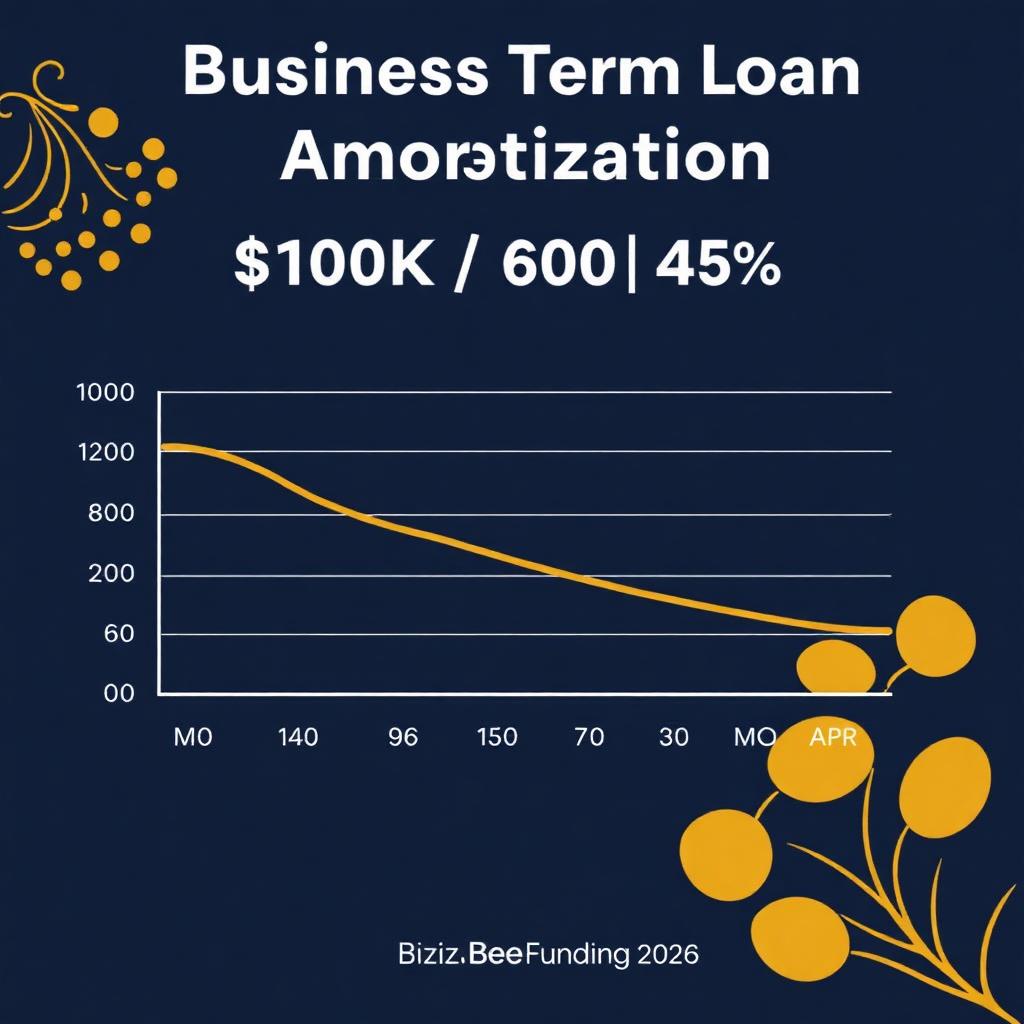
| $100K bank term loan / 60 mo / 10% APR | $2,125/mo · $127,500 total payback |
| $100K SBA 7(a) / 120 mo / 11.5% APR | $1,410/mo · $169,200 total payback |
| $100K online term loan / 36 mo / 22% APR | $3,820/mo · $137,500 total payback |
| $100K equipment term / 60 mo / 12% APR | $2,225/mo · $133,500 total payback |
| $50K working capital / 12 mo / factor 1.30 | $5,420/mo · $65,000 total payback |
How to decide if this is right for you
Use this 5-step framework to narrow your shortlist before comparing specific offers.
-
1
Confirm the use is one-time and quantifiable
Build-out, equipment, acquisition, consolidation, yes. Ongoing payroll, no.
-
2
Match term to the useful life of the investment
10-year equipment on 36-month note = cash flow strain. Inventory on 60-month note = inefficient.
-
3
Run SBA quote first if eligible
9.75–14.75% APR (NerdWallet, June 2026) on 7(a) is often the cheapest option, despite the 3–6 week timeline.
-
4
Stress-test the payment
Model 20% revenue dip. Can you still cover the monthly comfortably?
-
5
Check prepayment terms before signing
Best lenders charge ≤2% on remaining balance. Worst lenders charge full remaining interest.
When this makes sense
- You're funding a one-time, quantifiable investment with predictable ROI.
- You want a fixed monthly payment for budgeting clarity.
- Your revenue is predictable enough to support the payment in every month, including soft months.
- The useful life of what you're buying matches the loan term.
- You qualify for a rate that makes the unit economics work.
When to be careful
- When you're using term-loan proceeds to fund recurring expenses (use LOC instead).
- When the term is much shorter than the useful life of the asset.
- When your revenue is highly variable and a fixed payment would strain soft months.
- When you haven't compared SBA quotes against online — SBA can save tens of thousands.
- When the prepayment penalty exceeds 2% of remaining balance.
How this plays out in practice
Build-out done right
Situation: Restaurant group needed $185K to open a 4th location. 6 years in business, $2.4M revenue, owner FICO 720.
Recommendation: Placed SBA 7(a) at 11.5% over 10 years. Monthly payment $2,608. The build-out generated $42K/month in incremental contribution margin within 9 months, the loan is paid for itself many times over.
Wrong product for the use case
Situation: Owner took a $75K term loan over 36 months to cover seasonal inventory. Repaid $2,900/month, including in off-season when inventory had already sold.
Recommendation: Should have run a $100K LOC, drawn $75K in October, repaid by February. Same capital need, ~60% lower carrying cost over 2 seasons. Refinanced into LOC the following year.
Term-loan refinance after rate drop
Situation: Owner had a 28% online term loan with 14 months remaining and $42K balance.
Recommendation: Re-shopped through BizBee, refinanced into 14.5% term loan with 24-month term, lowered monthly payment by $1,100, total cost reduced by ~$4,800.
Compare term loan offers across 100+ lenders
Apply once with a soft pull and see bank-fintech, SBA, online, and equipment-backed term-loan offers side-by-side. Real APRs in plain English.
Frequently asked
Common questions
Key facts in one line
- Business term loans deliver fixed monthly payments over 12–120 months for predictable budgeting.
- SBA 7(a) term loans currently price at 9.75–14.75% APR (NerdWallet, June 2026).
- Online term loans price at 14–35% APR; bank-fintech at 8–18%.
- The right term-loan duration matches the useful life of the investment.
- Term loans are best for one-time investments, not ongoing operating expenses.
Glossary
Terms worth knowing
- Amortization
- The scheduled repayment of principal and interest over the loan term. Standard term loans amortize in equal monthly installments.
- Prepayment penalty
- A fee for paying off a loan early. Better lenders charge ≤2% of remaining balance; worst charge full remaining interest.
- Personal guarantee (PG)
- A contractual promise that you'll personally repay the loan if the business can't. Standard on most small-business term loans.
Ready to Join the Hive?
Apply now via BeeLine™ and get your funding decision in minutes. Complete in less than 60 seconds.